Waste in Kefalonia: A System Under Seasonal Pressure
The seasonal surge in waste, low recycling rates, and the cost of waste management in Kefalonia: where the island's trash ends up and what critical questions remain unresolved.
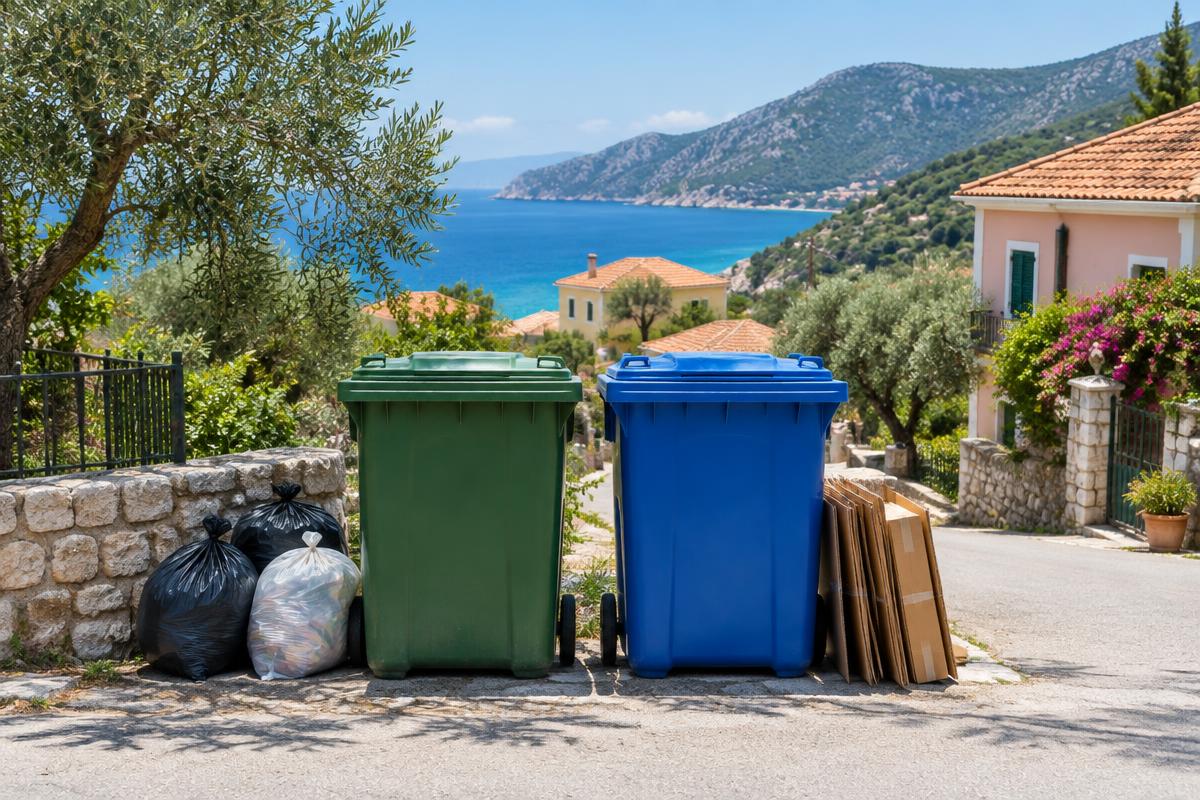
In the Ionian Islands, less than one-fifth of municipal waste is recycled. Nearly three-quarters ends up in landfills. These figures come from a report published in May 2026 by the Regulatory Authority for Waste, Energy and Water (RAAEY) on the Solid Waste Management Body (FODSA) of the Ionian Islands, headquartered in Argostoli.
Kefalonia already has an operational processing plant and a landfill site, which is not the case for all islands in the region. Nevertheless, the system experiences a recurring annual pressure: the volume of waste generated during the summer months. This article examines where the island's garbage ends up, how far recycling remains from its targets, and who pays the bill.
Where the island's waste ends up
Kefalonia's mixed municipal waste is directed to two facilities: the Waste Treatment Plant (MEA) and the Landfill Site for Residues (XYTY). Both operate under the responsibility of the Solid Waste Management Body (FODSA) of the Ionian Islands. RAAEY categorizes the island's facility as a “transitional management plant.” In other words, it is not the final solution envisioned by the regional plan.
The transition is underway, but far from complete. In April 2026, the regional governor, serving as president of FODSA, signed a supplementary contract to convert the facility into a Material Recovery and Recycling Facility (MAA), funded under the NSRF 2021–2027 program. According to the Regional Authority, the budget for Kefalonia's project thus rose from €9.73 million to €13.98 million. In the summer, an additional tender was announced for adaptation works at the plant, with an estimated value of €6.19 million (including VAT) and a duration of 12 months from contract signing.
At the regional level, the Regional Waste Management Plan envisions four integrated facilities—in Corfu, Kefalonia, Zakynthos, and Lefkada. Today, only two are operational, in Zakynthos and Kefalonia. The plants in Corfu and Lefkada remain under construction, and their waste is transported to facilities outside the region.
The picture on the island is therefore better than that of its neighbors, but it is not complete. Furthermore, RAAEY notes that the agency has not yet estimated the remaining lifespan of its landfill sites. For how many more years can Kefalonia's landfill continue accepting waste? RAAEY records no answer.
The site also has a history of accidents. In September 2020, a fire spread across the entire second landfill cell, covering a total surface area of approximately 3.6 hectares (36 stremmas). The Regional Authority requested pollution measurements from the National Centre for Scientific Research "Demokritos". Another fire broke out the following year.
Recycling: falling short of targets
Recycling in the Ionian Islands lags far behind its targets. RAAEY publishes data for the region as a whole rather than separately by island. However, these figures clearly illustrate the broader context within which Kefalonia operates.
| Indicator (Ionian Islands, 2025) | Value |
|---|---|
| Municipal waste generated | 174,843 tonnes |
| Recycling rate | 18.1% |
| 2030 recycling target | 61.4% |
| Landfill rate | 73.8% |
| Separate collection of biowaste | 0.89% |
The current recycling rate represents less than one-third of the target. The agency estimates that only 28.3% of the recycling target has been achieved. For the reduction of landfill disposal, the corresponding figure stands at a mere 13.5%.
The most telling metric involves biowaste. Food scraps and green waste account for a significant portion of household waste, yet less than 1% is collected separately. RAAEY emphasizes that responsibility for separate collection lies with the municipal authorities, not the regional waste management agency. In other words, a processing plant may be modern, but if materials arrive mixed together, recovery remains severely limited.
This means that the island's municipalities largely determine the trajectory of recycling, not just the regional agency. The deployment of brown bins, collection frequency, and public awareness campaigns for residents and businesses are matters of municipal policy.
Seasonality: one system for two islands
The Kefalonia of January and the Kefalonia of August generate vastly different volumes of waste. According to reports published regarding the 18th Panhellenic FODSA Conference in the summer of 2026, during the summer months the population of the Ionian Islands and the volume of waste triple or even quadruple compared to the winter.
RAAEY illustrates this same pressure from a different perspective. If the region's waste is divided solely among the 204,532 permanent residents recorded in the census, it amounts to 855 kilograms per resident per year. Factoring in tourists and seasonal residents, the “equivalent population” climbs to 271,447, causing per capita generation to drop to 644 kilograms. The difference of roughly 67,000 equivalent residents reflects the scale of tourism, measured in garbage.
This strain is visible on the streets. In August 2026, the Municipality of Argostoli issued an urgent appeal to residents and businesses, with a particular focus on tourism professionals. It asked that bags and bulky items not be left outside bins and that cardboard boxes be flattened prior to recycling. It also warned of fines.
The pressure is equally evident along the coastline. In a recent survey conducted as part of a marine litter monitoring program, 126 items were recorded per 100 meters of shoreline on a Kefalonian beach. The European threshold for good environmental status is 20. Plastic accounted for more than 90% of the litter collected.
This challenge is tied directly to the seasonal nature of the local economy, an issue that the Kefalonian Globe has examined previously. Refuse trucks, personnel, and processing facilities must be scaled to handle August. For the remainder of the year, that very same infrastructure serves a dramatically smaller population.
Who pays?
Waste management is primarily funded by municipal budgets—that is, through residents' municipal rates and utility fees. According to RAAEY, in 2025 FODSA managed approximately 57,000 tonnes from Kefalonia and Zakynthos, with an annual operating cost of €4.22 million. This translates to roughly €74 per tonne. This amount covers only processing and landfill disposal; the collection and transport of recyclables are paid for separately by the municipalities.
Added to this is the landfill tax. This is a national financial mechanism that penalizes every tonne of waste buried in landfills, designed to make dumping more expensive than recycling. In a region where nearly 74% of waste is landfilled, any hike in this levy directly burdens municipal budgets. This cost applies year-round, even though the vast majority of the volume is generated in summer.
There is also an unseen long-term cost. Every landfill eventually reaches capacity and must be rehabilitated, incurring expenses that span decades. For Kefalonia's landfill, the agency has set aside a dedicated rehabilitation reserve of €25,000 in both its 2025 and 2026 budgets. Is this sum sufficient for the future restoration and post-closure aftercare of an entire landfill facility? Public documents provide no clear answer.
Finally, the agency operates with limited staff. Out of 70 budgeted positions, only 26 were filled in 2025. Many key roles rely on fixed-term contracts or outsourced service agreements. RAAEY recommends hiring permanent personnel.
Open questions
Upgrading the plant is essential, but it is not sufficient on its own. A recovery facility performs only as well as the materials it receives are sorted. That is why the critical questions concern both the regional waste authority and the island's municipalities.
First, when will the separate collection of biowaste be expanded? With a regional rate below 1%, there is immense room for improvement. Restaurants, hotels, and open-air produce markets generate concentrated volumes of organic waste, making them the obvious starting point.
Second, how will tourism contribute to the costs it generates? Currently, the financial burden is distributed across municipal fees, paid equally by permanent residents living on the island year-round. Policymakers could consider whether businesses generating the bulk of waste during peak summer months should bear a proportional share of the cost.
Third, what is the remaining lifespan of the landfill, and what happens when it fills up? RAAEY has asked the agency to provide this calculation. The answer will reveal just how urgent the upgrade timeline truly is.
Fourth, will the project be completed within the 12-month timeframe stipulated by the tender? Waste management infrastructure in Greece often faces delays. Every year of delay means another year of high landfill rates.
Conclusion
Kefalonia is not facing the acute waste crisis seen on other islands, where trash accumulated for months with nowhere to go. It possesses an operating treatment facility, a landfill, and an upgrade project underway. This is an advantage that should not be underestimated.
Yet that advantage has limits. Regional recycling remains below one-fifth of waste generated, separate organic waste collection is practically non-existent, and landfilling remains the primary method of disposal. Meanwhile, the same infrastructure must cope with a population that multiplies every summer.
Meaningful change also hinges on what happens before waste reaches the plant. This involves municipal collection methods, business participation, and the daily habits of residents. The planning is in place, and contracts for upgrades have either been signed or tendered. The coming period will reveal whether implementation can keep pace.
Related Articles
Προβολή της πολυβραβευμένης ταινίας «Ocean with David Attenborough» στην Κεφαλονιά
Η πολυβραβευμένη ταινία «Ocean with David Attenborough» προβάλλεται στον Θαλασσόμυλο Αργοστολίου στις 25 Σεπτεμβρίου, με ελεύθερη είσοδο.
Ιθάκη: Δράσεις για τη θάλασσα και ειδική προβολή του ντοκιμαντέρ «Ocean with David Attenborough»
Διήμερο δράσεων για τη θαλάσσια προστασία στην Ιθάκη, 27–28 Αυγούστου 2026, με ειδική προβολή του ντοκιμαντέρ «Ocean with David Attenborough» και εκπαιδευτική δράση snorkeling για παιδιά.
Κεφαλονιά: Το Ξι, η κόκκινη άμμος και οι άργιλοι της Παλικής
Το Ξι στη νότια Παλική ξεχωρίζει για την κόκκινη άμμο και τους αργιλικούς σχηματισμούς του. Γεώτοπος του Γεωπάρκου Κεφαλονιάς Ιθάκης, η παραλία αποτυπώνει τη γεωλογική ιστορία και την ποικιλία του νησιού.