Assos: the village, the fortress, and the image that endured
How the small village of Assos in northern Kefalonia gathers in one place geography, Venetian strategy, post-earthquake reconstruction, and present-day tourist appeal.
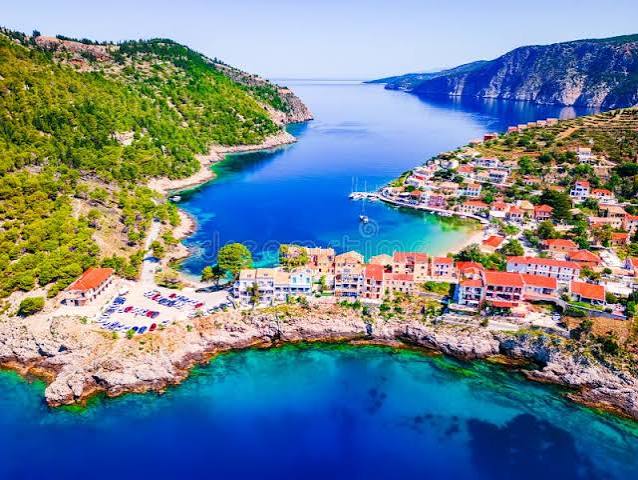
Assos is one of those places in Kefalonia that draws particular interest every summer because, on a small scale, it brings together landscape, history, architectural character, and strong visual recognition. The village lies on the northwestern side of the island, in a natural relationship with the peninsula crowned by its Venetian fortress. Today's image — low houses gathered around the small cove, the gentle scale of the settlement, and the castle stretching above the sea — produces one of the most distinctive scenes in the Ionian. Its recognisability rests on the particular form of the place: a small seaside village set against a major fortification, at a point where geography and history work together.
The value of Assos comes from the succession of its historical roles. The peninsula was chosen in the late 16th century by the Venetians for the construction of a large fortress, in a period when Venice was working to strengthen its defences in the Ionian and the eastern Mediterranean. The plan envisioned a fortified zone of military and administrative importance, capable of acting as a refuge and as a centre for northern Kefalonia. The area's actual evolution followed a different path: its position, accessibility, and lack of sufficient water curtailed any prospect of a large settlement growing inside the castle. Modern Assos developed mainly as a village outside the walls, while the fortress remained as a powerful historical imprint on the landscape.
The geography that shaped the history of Assos
The Assos peninsula offers natural fortification because of its morphology. It lies on the northwestern coast of Kefalonia, in a position of steep slopes whose main point of access is the isthmus connecting it to the mainland. This geographical arrangement carried strategic weight for Venice, since the defence of such a site could be organised through limited passes and control of maritime access. The choice of Assos for fortification is directly tied to its natural position and the ability to survey the surrounding sea.
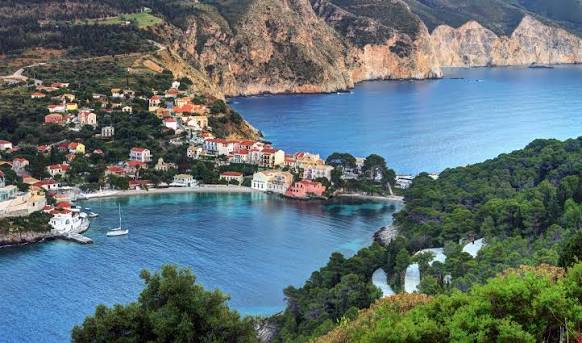
The relationship between the village and the fortress is a defining element of Assos's identity. Today's seaside settlement sits low, close to the cove, while the castle covers a large part of the peninsula. The distance between the small village and the extensive fortifications creates a particular ratio: the village keeps to a modest scale, while the fortress recalls a period when the area was planned with much greater military and administrative ambitions. This contrast in scale is one of the things that makes Assos historically interesting and visually recognisable.
Today's visitor traffic to Assos is built on this composition. The visitor sees a settlement of small dimensions, an enclosed cove, gentle architectural lines, and above all a fortress that occupies a large share of the peninsula. The image has summer-season power, but its explanation lies in older historical and geographical choices. Assos became recognisable because its landscape has a clear structure: sea, isthmus, settlement, fortress, hillsides, and a view onto the Ionian. The composition produces an image that is easy to read, with historical depth and a strong relationship between the natural and the built environment.
The Venetian fortress and the plan for northern Kefalonia
Construction of the Assos fortress began in 1593, as part of Venetian strategy to reinforce the Republic's possessions in the Ionian. The loss of Cyprus in 1571 and the constant Ottoman threat had increased the need for better-organised defensive works in the eastern Mediterranean. Kefalonia, an island with a strategic position between the Adriatic, the Ionian, and the sea routes east, held particular importance for the Venetians. The Assos fortress became Venice's most ambitious fortification project on the island.
The local authorities and the Community of Kefalonia had already asked Venice to build a new castle. In 1577 the Provveditore of Kefalonia, Francesco Tiepolo, reported the need for a new fort, and in 1584 a delegation from the Community of Kefalonia travelled to Venice with the same request. The Castle of Saint George, which had until then served as the island's main administrative and defensive centre, was considered inadequate to protect all of Kefalonia from Ottoman naval raids and pirate attacks. The northern side of the island needed a new defensive point, and the Assos peninsula was deemed suitable thanks to its natural fortification.
The project was designed by the engineer Marino di Gentilini, with technical supervision by Raffaele Rasponi and Piero Gambuti. The main fortification was completed quickly, in about two years, while works inside continued through the first half of the 17th century. The castle had a perimeter of roughly three kilometres, following the form of the peninsula, and was reinforced with five bastions at the most vulnerable points of the walls. The terrain shaped the design: the steep slopes and rocky character of the area limited the full application of the bastioned system. The result was a distinctive fortified ensemble, adapted to the natural conditions of Assos.
A grand plan that remained limited
The Venetian intention for Assos went beyond creating a simple military outpost. The Venetians designed the whole area as an organised fortified space, with streets, building blocks, and the prospect of resettling a population within the walls. The aim was to create a new urban and administrative centre that could offer refuge to inhabitants in case of raids and at the same time strengthen the Venetian presence in northern Kefalonia. The existence of such a plan shows the scale of strategic importance Venice attached to the area in the late 16th century.
Putting the plan into practice ran into practical difficulties. Limited access, distance from the island's main residential and productive centres, and above all the lack of sufficient water discouraged the settlement of a large population inside the fortress. Despite Venetian intentions to sell plots and develop an organised town within the walls, the response was limited. Assos gained fortification and administrative importance, but did not grow into a major urban centre. This evolution explains why today the fortress appears so extensive compared to the small village at the base of the peninsula.
In the early 17th century a harbour was built north of the isthmus, with limited capacity for ships due to its small size and shallow waters. During the same period, outside the castle, the settlement that forms the basis of today's Assos developed. In 1684, after the Venetians captured Lefkada, the strategic importance of the fortress decreased noticeably, as the terms of defence in the Ionian shifted. In 1757, with Argostoli's rise as the island's new centre, Assos lost even more of its administrative role. The history of the area gradually moved from military ambition to local residential continuity.
From castle to village
The trajectory of Assos from the 18th to the 20th century shows the gradual shift of weight from the fortress to the seaside settlement. The castle retained administrative and practical uses at various times, but its military importance declined. During the French period, after the fall of Venice in 1797, some buildings inside the castle were adapted to the needs of administration and garrison, while interventions were made on rainwater collection and drainage systems. In the 19th century the fortress's decline progressed and the population concentrated more in the settlement outside the walls.
Assos preserved its small residential scale, an element that defines its present-day image. Unlike other places on the island that grew into larger commercial or administrative centres, Assos remained limited in size, with an immediate relationship between the houses, the cove, and the castle. This form is owed to historical conditions, geographical position, and the practical difficulties that constrained the growth of a larger settlement. Its present aesthetic value is tied precisely to this small scale and to the preservation of a clear relationship between landscape and buildings.
From 1927 until the 1953 earthquake, part of the fortress was used as an agricultural prison. This use belongs to a period when the castle had lost its military and administrative role and was put to different state functions. Inside, remnants of buildings still survive: the Provveditore's residence, the Catholic church of Saint Mark near the main gate, and the agricultural prison complex in the southern part of the castle. These surviving elements recall the long use of the site — from fort and administrative centre to place of detention and abandonment.
The 1953 earthquakes and the post-war image
The earthquakes of August 1953 were a turning point for Kefalonia and profoundly affected the architectural image of the island. The seismic sequence caused extensive destruction in Kefalonia, Zakynthos, and Ithaca, with the strongest shock recorded on 12 August. Kefalonia suffered enormous damage to housing, public buildings, and settlements, and post-earthquake reconstruction substantially changed the look of many areas. Assos was caught up in this great historical break, with damage to the village and changes to the habitation of the fortress.
After 1953, the use of the castle as a prison ended and the population living within the fortress dwindled until the final abandonment of habitation. The 1961 census recorded only a handful of inhabitants inside the castle, and the last residents left in the early 1960s. These families, known as the Kastrinoi, mainly cultivated olives and vines inside or around the area of the fortress. This development completed Assos's transition into a settlement that operates outside the walls, with the castle preserved as a monumental and historical landmark.
The post-earthquake reconstruction of Assos is of particular interest because it helped preserve an image that today is considered one of the village's defining features. Several contemporary references record the contribution of the French — and in particular of people from Paris — to the rebuilding of the village after the earthquakes. The memory of this assistance is associated with the village square, often referred to as Place de Paris. This information needs to be stated carefully, as the publicly available sources are more local and travel-oriented than strictly archival. The essential point remains that post-earthquake Assos was shaped with attention to restoring its settlement image and an effort to preserve the scale that characterises the village.
The present-day recognisability of Assos
Assos has secured a strong position in the public image of Kefalonia. Its recognisability is owed to the clarity of the landscape: a small settlement, an enclosed cove, a peninsula, a fortress, and colours that work powerfully in photographs. This image circulates widely in travel features, maps, social media, and summer searches. Its tourist appeal grows especially in the summer months, when visitors move from Myrtos toward northern Kefalonia or combine Assos with routes to Fiskardo.
Today's popularity creates practical challenges for a small settlement. Assos has limited scale, narrow spaces, specific parking capacity, and intense seasonal concentration of visitors. This pressure is characteristic of many small historic or seaside places that have become particularly well known through their image. The challenge lies in managing visitation in a way that protects the daily life of the village, access, cleanliness, aesthetic continuity, and the relationship between village and castle. Assos has value because its scale remains small and legible; preserving that scale is a fundamental element of the quality of the place.
Visiting the fortress adds essential depth to the Assos experience. The route up to the castle reveals the size of the fortification and the strategic logic behind the choice of the peninsula. The main gate, the walls, the bastions, the ruins of the buildings, and the view to the sea allow visitors to grasp Assos as a historical space and not only as a seaside village. The connection between village and castle is what sets the area apart from other summer destinations on the island. The image of Assos takes on meaning when read together with the history of the peninsula.
A small village with great historical density
Assos gathers many layers of history into a limited space. Its natural position explains the Venetian choice for fortification. The fortress reflects Venice's defensive policy in the Ionian after the great losses in the eastern Mediterranean. The inability to develop a large town within the walls shows the limits set by water, access, and geomorphology. The later settlement outside the castle reveals the adaptation of local life to the place's real possibilities. The 1953 earthquakes and post-war reconstruction added a further layer to the history of the image we see today.
Summer visitation to Assos can serve as a starting point for a more substantial acquaintance with the place. Visitors usually arrive for the image of the village, the beach, the fortress, and the drive. History adds context to all of these. Assos was a defensive project, a failed Venetian urban ambition, a small seaside village, a site of post-earthquake reconstruction, and a present-day point of high recognisability. This trajectory shows how a small place can take on meaning through the meeting of geography, politics, architecture, and memory.
The value of Assos for today's public lies in its capacity to explain a broader side of Kefalonia. The island has places that became known for their natural image, others for their history, and others for their relationship with modern tourism. Assos combines all three in an especially concentrated way. A serious reading of the village calls for attention to detail: the position of the peninsula, the design of the fortress, the failures and adaptations of history, the post-earthquake continuity, and today's pressure of popularity. Through these elements, Assos remains one of the most interesting places on the island — not simply because it offers a beautiful image, but because that image has real historical depth.
Related Articles
Η ναυτική ιστορία του νησιού πέρα από τα λιμάνια
Από το παράκτιο εμπόριο του Ιονίου έως τη Μαύρη Θάλασσα, τον Δούναβη και το Λονδίνο: πλοιοκτήτες, καπετάνιοι, ναυτικοί και οικογένειες που έδωσαν στο νησί διεθνή ναυτική παρουσία.
Κεφαλονιά: Μικρές ιστορίες πίσω από γνωστά σημεία του νησιού
Από τη Γέφυρα Δεβοσέτου και τις Καταβόθρες μέχρι τη Μελισσάνη, την Άσσο και το Φισκάρδο: μικρές ιστορίες που εξηγούν την Κεφαλονιά πίσω από τις γνωστές της εικόνες.