The Kefalonian diaspora and the relationship with the island that endures through time
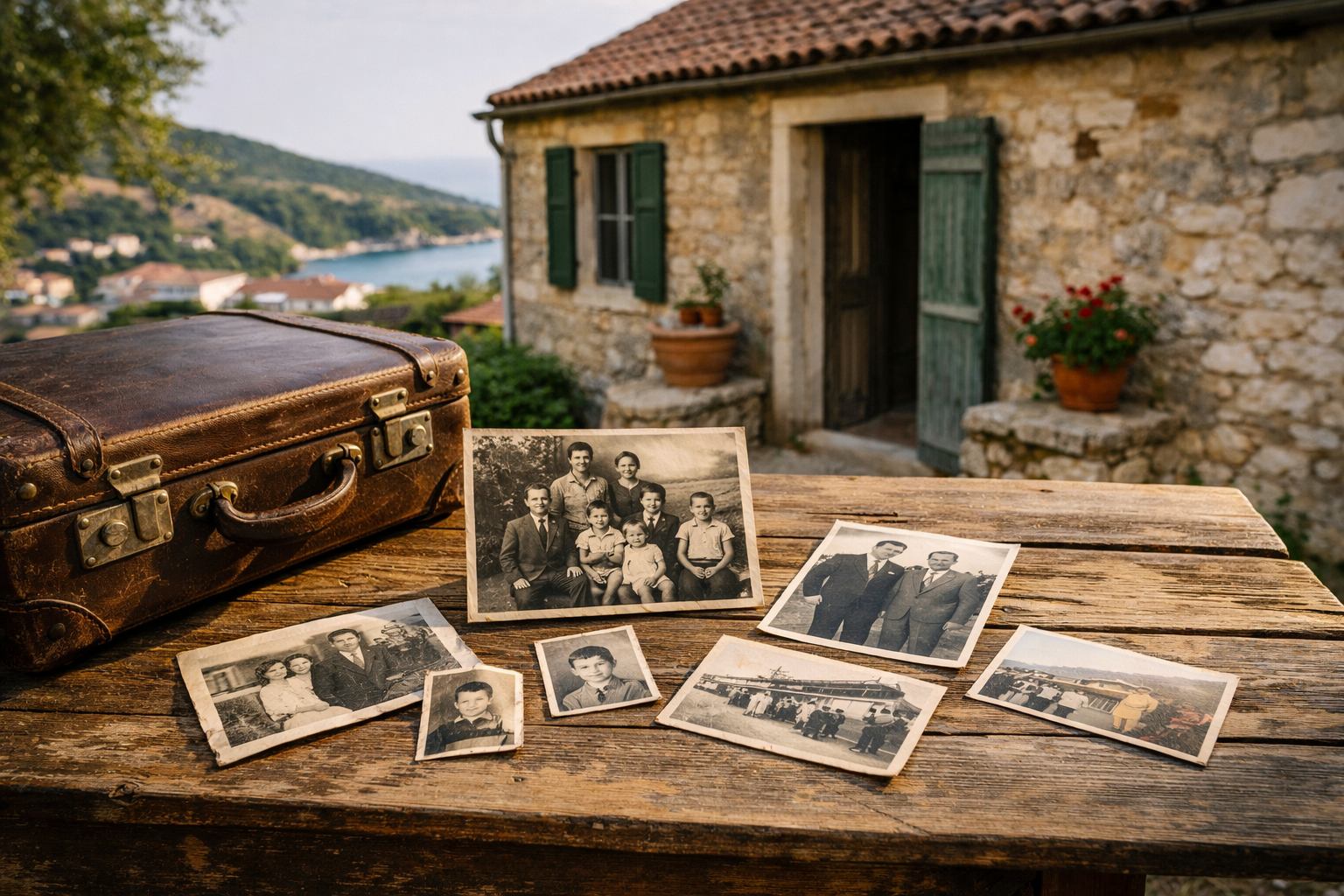
The history of the Kefalonian diaspora has a greater depth and duration than what usually fits into a cursory reference to the Greek diaspora. In the case of Kefalonia, the outward movement followed the course of broader Greek migration, passed through wars, economic difficulties, and natural disasters, and left behind communities that continue to operate today in Canada and the United States. What makes the case particularly interesting is that the connection with the island did not disappear with distance. It was maintained through families, associations, institutions, summer returns, and an almost stubborn insistence that the origin should not be lost over time.
Kefalonia has long had an open relationship with the outside world. As an island with a naval and commercial tradition, it never lived with closed horizons. The Greek state collectively describes the Greek diaspora as a living part of Hellenism with roots reaching from antiquity to modern migratory flows. This does not mean that there is a single, unbroken "organized" Kefalonian diaspora for thousands of years, in the form we imagine it today. However, it does mean that the outward movement, migrations, settlement in other places, and the maintenance of ties with the origin are part of a long history, within which Kefalonia found its own way to survive beyond its geographical boundaries.
In the 20th century, this story becomes more specific. The National Archives of Australia note that Greek immigration to the country began as early as the first half of the 19th century, while the large waves came after the Greco-Turkish War, World War II, and the Civil War. In the 2021 census, 424,744 residents of Australia declared Greek ancestry. This number is not, of course, Kefalonian; however, it shows the size of the environment in which the Kefalonians who arrived there moved. They were not in a vacuum. They were within large Greek communities, strong enough to leave room for narrower local identities, those that do not stop at "Greek," but continue to "where exactly are you from."
For Kefalonia, of course, there is also a very specific station that explains why for many families, departure was not a plan, but a necessity. The 1953 earthquake radically changed the island and decisively affected the course of its people. The bibliography and relevant technical reports on the disaster agree that it was one of the heaviest natural disasters in modern Greek history, with 476 dead and the destruction of more than 27,000 homes out of a total of about 33,000 in the affected areas of the Ionian Islands. In such a landscape, many people found themselves rebuilding their lives elsewhere, often from scratch. Leaving home, for a part of the island, was not an abstract idea. It was the result of a violent rupture.
What is more important today is the way this exodus did not turn into a pure severance. The organized communities of the diaspora give very clear signs here. The Cephalonian Brotherhood "Aenos" (Cephalonian Brotherhood of Canada Aenos) in Montreal presents itself publicly as a community that brings together Kefalonians, Greeks, and friends of Kefalonian culture with the aim of preserving heritage and tradition, while the registration data in Quebec show that the organization has roots dating back to 1973. In New York, the Pan-Kefalonia Association is registered as an active non-profit organization since 1984. When a community survives for decades with such continuity, the information itself says a lot about how deep the bond with the place of origin remains.
This bond did not remain at the level of formal representation. It also passed into federal forms of organization. The World Federation of Kefalonians and Ithacians "Odysseus", as publicly stated by the diaspora bodies themselves, was founded in Montreal in 1996 with the aim of keeping foreign associations united and transferring cultural heritage to younger generations. All this may seem to an outsider like details of corporate life. In reality, it is the way in which an origin continues to function as a living identity and not as a family footnote.
The Kefalonian case also has another characteristic that makes it recognizable to many, even to those who have not experienced emigration themselves. It is what passes through family stories. Almost every house on the island has a memory of an uncle in America, a grandfather in Australia, a cousin in Canada, an aunt who "left after the earthquake" or a child who "went out and moved on." Along with these stories, another, more tangible element passes: the idea that the connection with the island must be maintained, even if life's circumstances move people elsewhere. That
Related Articles
Η ιστορία των καλοκαιρινών φεστιβάλ της Κεφαλονιάς
Από τις φιλαρμονικές και τη Γιορτή της Ρομπόλας έως το Saristra, το SeaNema και τα «Κύματα»: πώς διαμορφώθηκε το πολιτιστικό καλοκαίρι της Κεφαλονιάς.
Άσσος: ο οικισμός, το φρούριο και η εικόνα που άντεξε στον χρόνο
Πώς η μικρή Άσσος της βόρειας Κεφαλονιάς συγκεντρώνει σε έναν τόπο γεωγραφία, ενετική στρατηγική, μετασεισμική ανασυγκρότηση και σημερινή τουριστική απήχηση.
Η ναυτική ιστορία του νησιού πέρα από τα λιμάνια
Από το παράκτιο εμπόριο του Ιονίου έως τη Μαύρη Θάλασσα, τον Δούναβη και το Λονδίνο: πλοιοκτήτες, καπετάνιοι, ναυτικοί και οικογένειες που έδωσαν στο νησί διεθνή ναυτική παρουσία.