The abandoned settlements of Greece: villages disappearing from the map and what this reveals about the country
Dozens of small settlements on islands and in mountainous areas are losing population, services, and economic activity — a slow geographical abandonment that is changing the country's map.
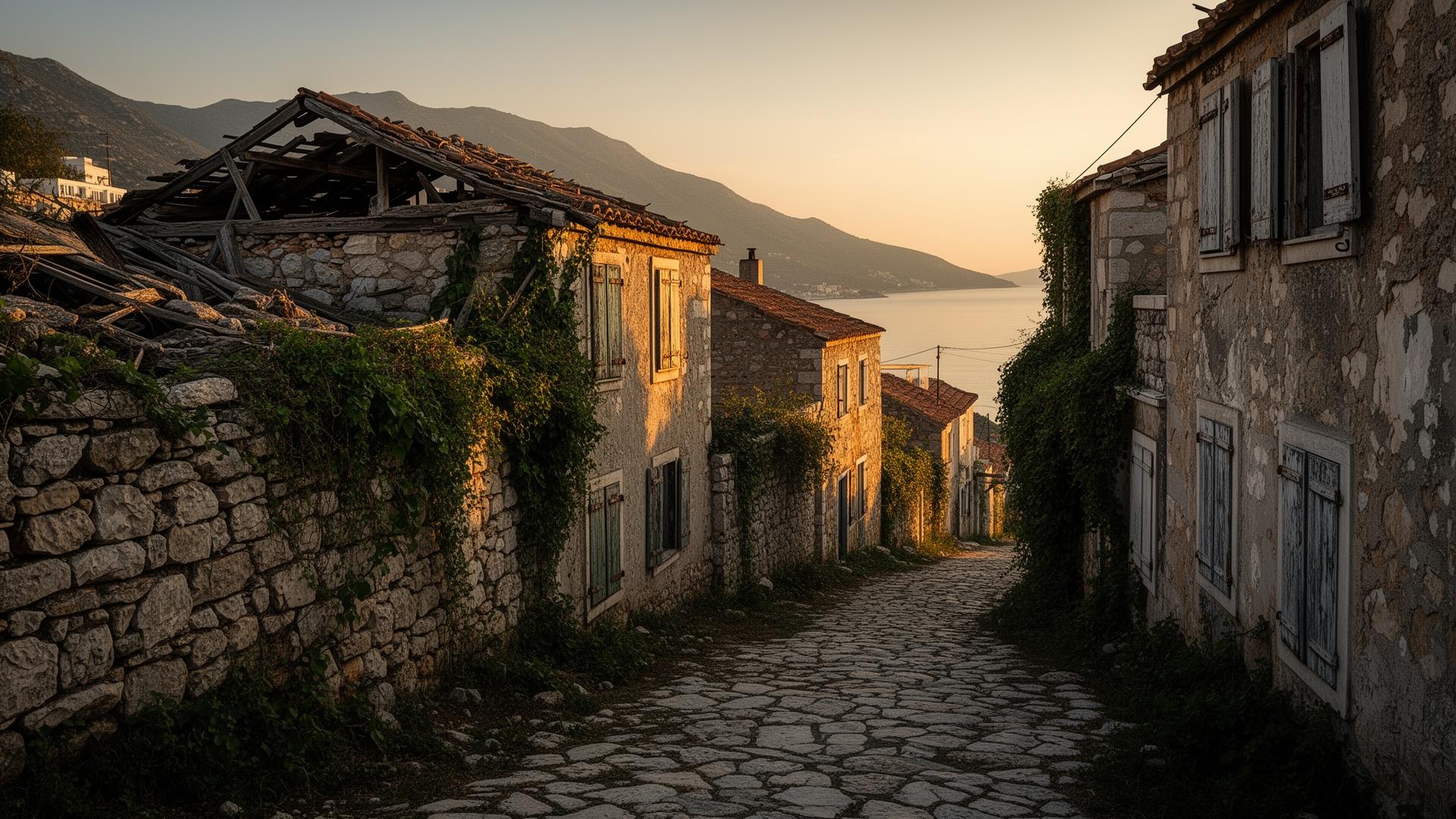
Greece in 2026 is facing not only a problem of declining birth rates or an aging population. It is also facing a slow but profound geographical abandonment, which is changing the country's map without much public debate. Dozens of small settlements on islands, in mountainous areas, and remote communities are steadily losing population, services, and economic activity. In several cases, villages that 40 or 50 years ago had schools, cafes, agricultural production, and a permanent population, are now inhabited only a few weeks a year or have been almost completely abandoned. According to ELSTAT census data, hundreds of small settlements now record a single-digit number of permanent residents, while in some areas, the population decrease exceeds 60% within two generations. This phenomenon does not only concern the so-called "deep countryside." It also affects island regions, even tourist prefectures, where the economy is concentrated in a few centers and leaves large areas out of real development.
Kefalonia is a characteristic example of this dual reality. On the one hand, the island appears internationally as a successful tourist destination, with increased arrivals, investments in accommodation, and strong seasonal economic activity. On the other hand, however, several small settlements on the island continue to lose their permanent population, especially in the mountainous areas or in regions far from the main tourist axes. Villages that were formerly based on agricultural production, livestock farming, or small local economies, today operate essentially only during the summer months, when expatriates return or seasonal homes open. The problem is particularly evident after the 1953 earthquake, which radically changed the demographic and economic structure of Kefalonia. Mass emigration to Athens, Patras, Australia, the USA, and Canada weakened many communities, while subsequent tourism development was not evenly distributed across the island. This created a model where some areas concentrate investments and population, while others gradually empty.
The problem is much broader than a simple population change. When a settlement loses permanent residents, a chain reaction of disintegration begins. The school closes due to a lack of children, the cafe is no longer viable, agricultural farms are abandoned, and public services are removed. The lack of basic infrastructure leads even more residents to leave, creating a self-perpetuating cycle of decline. In many areas of the Greek countryside, even access to medical care or public transport has become a serious problem. The elderly who remain permanently in the villages often depend on relatives or occasional trips to nearby towns. At the same time, the abandonment of agricultural and forest areas also increases the environmental risk. Experts point out that many areas that were formerly maintained through agricultural and livestock activity are now left without management, which contributes to an increase in fires, erosion, and landscape degradation.
The Greek countryside did not empty by chance. From the 1960s onwards, the development of the Greek state was organized almost exclusively around large urban centers. Athens concentrated administration, universities, investments, industry, and services, while the periphery functioned mainly as a source of labor. Greece's entry into the European Economic Community and later the European Union improved infrastructure but did not reverse the basic concentration of population and economic activity. On the contrary, the collapse of much of the small agricultural production and the shift of the economy towards services and tourism further strengthened the movement of young people to cities. Today, many areas face not just aging but demographic collapse. In villages of Epirus, Western Macedonia, Arcadia, or island regions, the average age now far exceeds the national average, while births are minimal or zero.
Kefalonia faces a particular version of this problem. Despite tourism development, much of the economy remains highly seasonal. This means that many young people work a few months a year and then are forced either to move or to rely on unstable incomes. At the same time, the increased cost of living and housing in the more developed areas of the island creates additional pressure. The result is that even young people who want to stay in Kefalonia find it difficult to find stable long-term living conditions. In several communities on the island, homes now function mainly as summer residences or short-term rentals, without real permanent social life during the winter. This creates a paradoxical situation: areas that appear "lively" for three months a year become almost empty settlements for the rest of the year.
The phenomenon also has cultural consequences that are often underestimated. The abandonment of small communities means the loss of local traditions, idioms, technical knowledge, and forms of social organization that survived for centuries. Old paths, dry stone walls, agricultural infrastructure, and local archives are abandoned or destroyed. In several cases, entire parts of local history are lost because there is no longer a community to preserve them. Greece has thousands of small historic settlements, many of which are gradually turning into "memory landscapes" instead of living societies. In Kefalonia, where the historical experience of the earthquake, emigration, and Italian occupation has left a deep imprint, the issue gains even greater importance. The preservation of cultural identity does not only concern the protection of monuments but also the preservation of human presence.
In recent years, efforts have emerged to reverse the trend, mainly through digital work, agri-food ventures, and the return of young people to the periphery. However, the numbers remain limited. Teleworking, which was presented after the pandemic as a possible solution for the revitalization of the countryside, did not ultimately lead to a mass return of population. Most workers continue to depend on urban centers, while the lack of infrastructure, health, education, and stable internet acts as a deterrent. In addition, the rise in property prices in several island regions makes it even more difficult for new residents to settle permanently. In practice, much of the Greek periphery continues to operate under a model of demographic shrinkage, even when it exhibits seasonal economic activity.
The crucial question is whether Greece has a real strategy for the survival of the countryside or if it is simply gradually managing its abandonment. To date, most policies are limited to fragmented subsidies, NSRF programs, or temporary tax incentives without long-term planning. Experts point out that addressing the problem requires a combination of housing policy, support for permanent employment, strengthening local production, and substantial decentralization of services. Without such interventions, the population concentration in a few urban and tourist centers will continue. And this does not only concern the economy or demography. It concerns the very geographical and social future of the country.
Related Articles
Ποιανού είναι πια το χωριό; Η σιωπηλή αναδιάταξη που επιφέρει η βραχυχρόνια μίσθωση
Από το Ελειό-Πρόννοι έως το Ληξούρι και το Αργοστόλι, η Κεφαλονιά διανύει μια μεταμόρφωση που δεν γίνεται πάντοτε αντιληπτή με την πρώτη ματιά.
Η οικονομία των 100 ημερών: Πώς η εποχικότητα αλλάζει τα νησιά
Τι σημαίνει πραγματικά να ζει ένα νησί από λίγους μήνες τουρισμού — και γιατί η «οικονομία των 100 ημερών» καθορίζει την εργασία, την κατοικία και τις υποδομές όλο τον χρόνο.
Πόσο κοστίζει πλέον ένα καλοκαίρι
Η μετακίνηση, η διαμονή και η καθημερινή κατανάλωση ανεβάζουν τον λογαριασμό των διακοπών στην Κεφαλονιά, ενώ οι ίδιες αυξήσεις μεταφέρονται στη ζωή των μόνιμων κατοίκων.