Olive Growing in Kefalonia: A Harvest Under Pressure
As harvest season approaches, Kefalonia’s olive growers face labour shortages, climate uncertainty and a crucial question about the sector’s long-term viability.
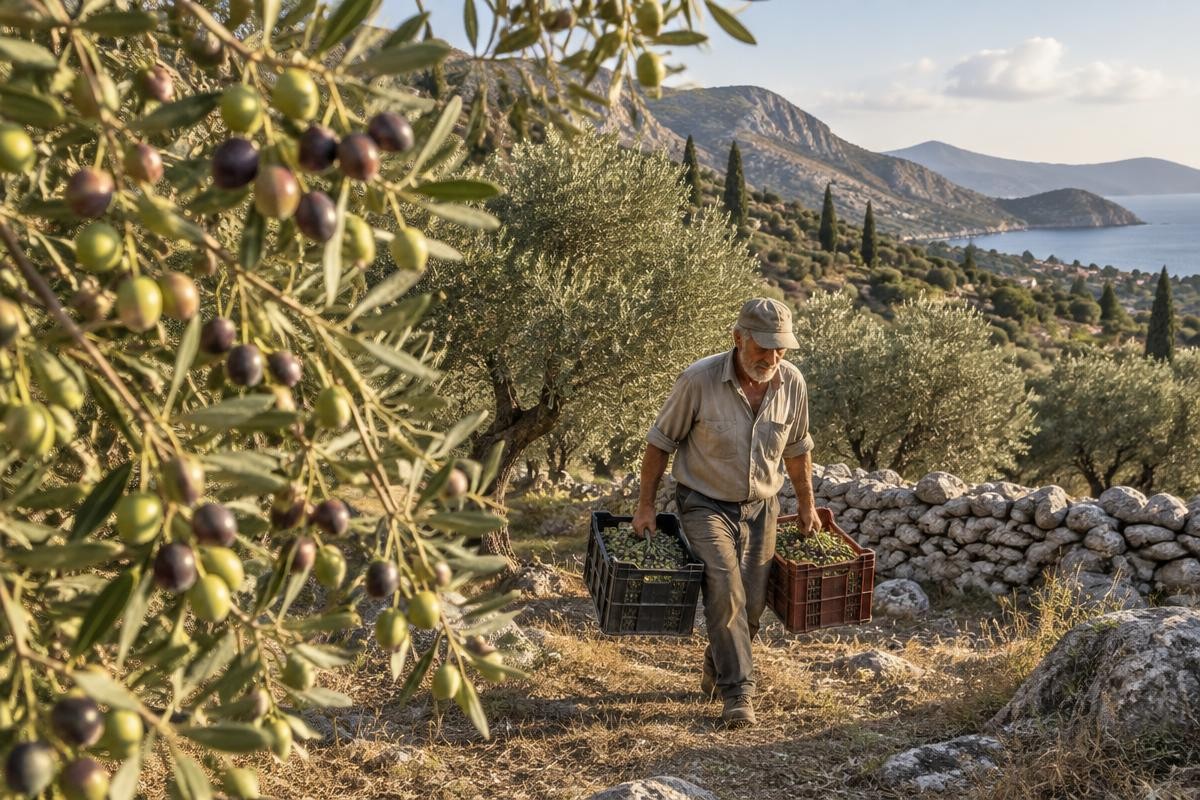
In September, as the tourist season draws to a close, Kefalonia’s olive groves enter the ripening stage that will determine the harvest in the months ahead. It is a sector that receives neither the visibility of Robola wine nor that of tourism, yet it remains an important source of income for many island families, particularly in the semi-mountainous and mountain villages.
A sector with little visibility
Olive cultivation in Kefalonia largely occupies areas where other crops are not equally viable. For many producers, it provides either supplementary or primary income precisely during the winter months, when the island’s tourism economy is inactive. The question is not whether the olive tree still has a place in the local economy, but how much longer the sector can withstand the pressures it faces.
Labour shortages
Across Greece, the sector faces a structural shortage of farm labour. Migrant workers who traditionally covered the harvest are moving into more stable or better-paid occupations, or relocating to other European labour markets. In Kefalonia, the problem is further intensified because the harvest coincides with the end of the tourist season: the available workforce, both local and migrant, has already spent months working in hotels and restaurants. Competition for workers is now internal too, between the two sectors of the local economy.
Climate variability
Producers must also manage increasingly variable weather conditions. Alternate bearing—the olive tree’s natural tendency to produce uneven yields from one year to the next—is intensified by periods of drought that affect spring flowering and by sudden temperature fluctuations that influence the ripening of the fruit. For small producers, who often cultivate only a few acres alongside other work, this uncertainty directly determines whether the year’s income will cover its costs.
What is at stake
These pressures raise a broader question: whether younger generations will continue to maintain their family olive groves, or whether the abandonment of small plots—a trend already visible in many mountain villages across Greece—will spread to Kefalonia as well. An abandoned olive grove means not only lost income but also an increased risk of wildfire, something the island experienced this summer.
Possible solutions
The Robola cooperative model, with shared standardisation, packaging and promotion, gives small winegrowers bargaining power they would not have individually. A similar form of collective organisation in olive growing—through a cooperative or shared olive mill and packaging facility—could secure better prices and reduce dependence on intermediaries. Connecting olive oil with local gastronomy and agritourism could also give the product an identity that goes beyond production volume.
This year’s harvest will show, once again, whether olive growing remains a viable part of the local economy or continues to contract.
Related Articles
Τα τοπικά προϊόντα της Κεφαλονιάς και η σύγχρονη παραγωγή τους: οι άνθρωποι, οι προκλήσεις και το μέλλον ενός παραγωγικού νησιού
Ρομπόλα, ελαιόλαδο, μέλι και τυριά: μια ματιά στους παραγωγούς που κρατούν ζωντανό τον πρωτογενή τομέα της Κεφαλονιάς, στις προκλήσεις που αντιμετωπίζουν και στη νέα γενιά που αναζητά ένα σύγχρονο παραγωγικό μοντέλο.