Analysis of the 2024 European Election Results - The Case of Kefalonia
The results of the 2024 European elections caused strong reactions and concerns in the headquarters of the major parties not only in Greece but across Europe. Abstention from the elections reached alarming levels, becoming the main protagonist or, as some would say, the “winner” of this contest. At the same time, the rise of the far-right, although fragmented, is noteworthy, as are the heavy defeats for the leaders of France and Germany, who traditionally guide the European Union. This new political landscape cannot simply be ignored; it must be immediately studied and evaluated, realigning the values and ideals that the European Union stands for on their correct basis, leaving no room for far-right delusions to find fertile ground.
Europe's reflexes after the results were evidently immediate. In Greece, eight parties won seats in the European Parliament, while discussions have already begun regarding a cabinet reshuffle and the future of the center-left. Parties to the right of New Democracy reaped the greatest benefits from the protest vote, while the KKE strengthened its power by attracting left-wing voters. One of the surprises of the elections was the rise of Afroditi Latinopoulou's "Voice of Reason." France is heading for early elections, and rapid developments are also predicted in other countries.
The Measurable Results of the European Elections
The European elections of June 9 elected 21 new representatives of Greece to the European Parliament. In an electoral contest with a historic record of abstention, as participation was only 41.39%, it is important to analyze the data that emerged from the ballot boxes.
In the 2024 European elections, 4,062,092 out of a total of 9,814,685 registered voters cast their votes. Of the ballots cast, 97.88% were valid (3,976,085 votes), 1.36% were invalid (55,283 votes), and 0.76% were blank (30,714 votes). The 21 new Greek MEPs were elected from eight parties that passed the 3% electoral threshold.
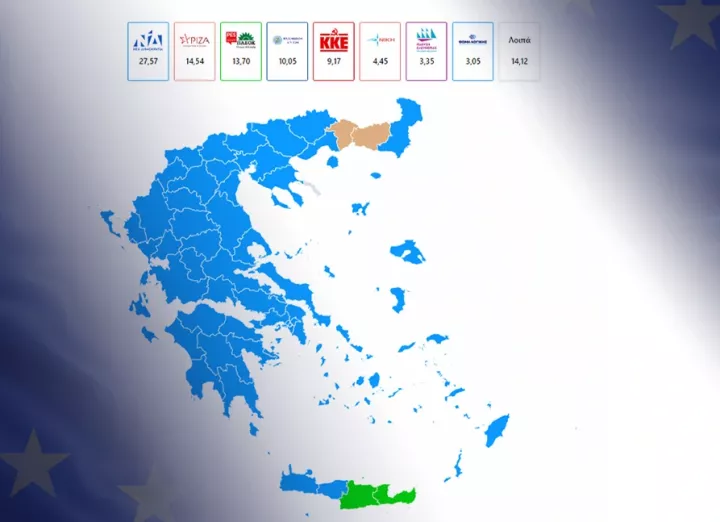
Greece was once again painted "blue," with New Democracy dominating almost all electoral districts, except for two in Crete where PASOK came first and two in Thrace where the Party of Equality, Peace and Friendship came first.
New Democracy recorded its highest percentages in Laconia with 35.62%. It received percentages above 30% in 13 other regions, with the best performances in the Northern Sector of Athens, Chios, Eastern Attica, Karditsa, and Piraeus A.
For its part, SYRIZA failed to come first in any region. Its highest percentages were recorded in Arta with 22.66%. This was followed by Kefalonia (20.59%), Corfu (19.33%), the Western Sector of Athens (18.87%), Achaia (18.35%), and Piraeus B (18.33%).
PASOK won first place in Lasithi with 29.37% and in Heraklion with 26.41%, while also recording high percentages in Rethymno with 25.04% and in Ilia with 22.66%. Greek Solution and Niki boosted their percentages by attracting disappointed New Democracy voters, while the KKE maintained its percentages, even achieving a small increase.
How people voted in Kefalonia
In Kefalonia, New Democracy received 3,701 votes, with candidate Eleonora Meleti emerging as the top choice of voters, securing 1,286 crosses. SYRIZA-PS gathered 3,054 votes, with Nikolas Farantouris receiving 2,276 crosses, and Maria Bekatorou receiving 484 crosses. The high abstention rate on the island, with 70.87% of voters not going to the polls, causes an unfavorable impression and many questions. Despite an improvement from 79.89% in the 2023 Regional elections, abstention remains significant. Regarding the high abstention rate, Argostoli Mayor Theofilos Michalatos commented to Kefalonian Globe, stating that "The main characteristic of this year's European Elections was the large abstention of voters from the polls at local, national, and European levels. This fact, which was not expected to such a wide extent, has concerned state institutions, which are called upon to immediately make corrective moves to restore voters' trust in the political system."
Lixouri Mayor Giorgos Katsivelis, speaking to Kefalonian Globe, said about the European election results across Greece that "abstention, which was the big winner, was evident as voters across Europe have been disappointed by the policies implemented and day by day question the European edifice. The rise of far-right parties shows the dead end that problems such as the economy, security, uncertainty have led citizens to, which no one can guarantee to solve, thus populism finds fertile ground." He also stressed that the message sent by citizens to the government is "for reforms to proceed faster and our state to finally become European, and to deal with greater courage with profiteering, citizen security and the administration of justice."
More specifically, regarding the low participation of residents of the Ionian Islands and specifically Kefalonia, Mr. Katsivelis commented that "the parties did not make voters understand what is at stake in the elections regarding the European Union and our common future; they engaged in introverted sterile confrontation that people are tired of." At the same time, in response to a question about whether local authorities receive adequate support from the European Union, he replied that "local authorities are essentially suffering from an inability to support their role as local authorities do in European countries, as we do not have sufficient resources or specialized staff. Thus, many times we are unable to utilize funding tools from the European Union. There must be a holistic intervention from the Greek state in cooperation with the EU to organize municipalities and regions with appropriate staff who will guide the services."
It should be noted that many candidates and elected officials have a special connection to the island of Kefalonia. In fact, Sami Mayor Panagis Drakoulongonas publicly expressed his congratulations to Eleonora Meleti and Nikolas Farantouris for their election to the European Parliament, emphasizing that "their presence and participation in the supreme institution of the European Union brings great honor to all of us, their fellow citizens and co-municipalities." For his part, Argostoli Mayor Theofilos Michalatos pointed out to Kefalonian Globe that "the election of Mr. Farantouris and Ms. Meleti is very important, as the presence of two Kefalonians in the European Parliament can only have a positive impact on our islands. Both are excellent connoisseurs of our region's capabilities, and through the utilization of European tools and resources, they can offer the utmost to local development and prosperity. We, as a Municipality, will be fellow travelers in this journey, guided by the protection of local interests."
How Voters Voted
The voter profile across the country is interesting. Specifically, according to the qualitative analysis of the exit poll, young people aged 17-24 across Greece gave SYRIZA the lead with 20.8%, while New Democracy gathered 17.1%. PASOK-KINAL followed with 11%, KKE with 7.4%, Greek Solution with 5.9%, and Niki with 4.5%.
Pensioners, on the other hand, preferred New Democracy with 38.9%, while SYRIZA received 17.4%. PASOK gathered 14.4%, KKE 8.7%, Greek Solution 8%, Niki 2.3%, and Plefsi Eleftherias 2.1%.
New Democracy’s losses in the centrist space were the main reason for its decline. According to the analysis of the qualitative data from the exit poll, centrist voters primarily chose abstention rather than shifting to another party. The analysis of the exit poll by Pulse director George Arapoglou on SKAI TV showed that New Democracy lost 12-13% in the centrist space, a percentage equivalent to the loss recorded by the ruling party compared to the 2023 national elections.
Centre-right voters primarily supported New Democracy (68.6%), while centre-left voters chose SYRIZA (37.4%). Centrist voters gave 30.9% to PASOK, 21.5% to New Democracy, and 8.6% to SYRIZA. Greek Solution received 9.8% of centrist voters, while 13.7% turned to another party. Left-wing voters chose SYRIZA (33.9%), KKE (23.3%), PASOK (15.6%), and New Democracy (2%).
The large group of undecided voters, representing 13.1%, decided who to vote for on election day, while 12.1% decided in the last week.
The majority of voters (62.8%) voted to send a message of dissatisfaction to New Democracy, while 31.8% voted with the need for stability in mind.
Which individuals will go to the European Parliament, by party
New Democracy (ND): 7 MEPs
Georgios Aftias - 310,876 crosses
Evangelos-Vasileios Meimarakis - 261,123 crosses
Eliza Vozemberg-Vryonidi - 247,452 crosses
Dionysios-Fredis Beleris - 238,801 crosses
Eleonora Meleti - 173,815 crosses
Emmanouil Kefalogiannis - 162,494 crosses
Dimitrios Tsiotras - 157,731 crosses
SYRIZA: 4 MEPs
Konstantinos Arvanitis - 154,800 crosses
Nikolaos Farantouris - 136,973 crosses
Nikolaos Pappas - 128,078 crosses
Elena Kountoura - 114,963 crosses
PASOK: 3 MEPs
Nikolaos Papandreou - 123,294 crosses
Ioannis Maniatis - 108,231 crosses
Athanasios (Sakis) Arnaoutoglou - 92,087 crosses
Greek Solution: 2 MEPs
Emmanouil Fragkos - 110,699 crosses
Galato Alexandrakis - 51,465 crosses
KKE: 2 MEPs
Lefteris Nikolaou-Alavanos - 108,604 crosses
Konstantinos Papadakis - 106,668 crosses
Niki: 1 MEP
Nikos Anadiotis - 42,066 crosses
Plefsi Eleftherias: 1 MEP
Maria Zacharia - 23,199 votes
Voice of Reason: 1 MEP
Afroditi Latinopoulou - 58,981 crosses
The “poorest” CVs won
The analysis by the Center for Liberal Studies revealed that Greek voters preferred to vote for men over 50 with a lower educational level than the average candidate. In fact, emphasis was placed on journalists, with 24% of those elected practicing journalism, while the corresponding percentage of candidates was only 7.5%. Below you will see the percentages in detail as they appear in the analysis by the Center for Liberal Studies.
Gender: 71% men, 29% women.
Age: Preference for men over 50.
Profession:
24% journalists
14% lawyers/attorneys
10% academics
Re-election: 66.7% of MEPs from the 2019-2024 period were re-elected.
Abstention
The detailed evaluation of the 2023 European election results in Greece highlights high abstention as a central feature, reaching almost 60% nationally and exceeding 50% in almost all prefectures. Florina stands out as the champion of abstention with 73.37%, followed by Kefallinia with 70.87% and Laconia with 69.69%. The main message of the elections is the disapproval of the government and the political system, strengthening the "anti-systemic" vote. According to relevant estimates, one of the reasons for the unprecedented low participation in the polls was the "fatigue" from the successive electoral contests that have taken place in the country over the last eighteen months (double parliamentary elections, local government, and European elections).
At the same time, another reason, which probably played a role in the decrease in participation, was the large difference maintained by the leading party from the others, which created the feeling among some that the outcome had already been decided. For many, however, the low participation is mainly a result of the long-term crisis in political representation and distrust in institutions.
The ranking of Municipalities by abstention:
- Florina: 73.37%
- Kefallinia: 70.87%
- Laconia: 69.69%
- Dodecanese: 67.45%
- Arcadia: 65.57%
- Lesvos: 65.52%
- Corfu: 65.40%
- Evrytania: 65.18%
- Thesprotia: 64.73%
- Zakynthos: 64.59%
- Drama: 64.48%
- Xanthi: 64.40%
- Rodopi: 64.34%
- Serres: 64.33%
- Lefkada: 64.21%
- Messinia: 63.64%
- Chios 63.59%
- Ilia: 62.71%
- West Attica B: 62.57%
- Kastoria: 62.48%
- Samos: 62.47%
- Kavala: 62.13%
- Kilkis: 61.81%
- Evros: 60.93%
- Cyclades: 59.90%
The day after…
The 2024 European elections reveal the need for restructuring and a new strategy among Greek political parties, with PASOK at the center of internal party conflict and SYRIZA trying to regroup the progressive space.
Specifically, PASOK is experiencing intense internal turmoil and leadership challenge to Nikos Androulakis. Officials such as Odysseas Konstantinoupolis are calling for a change in leadership and an acceleration of internal party elections with the aim of a "leading, political, organizational Restart." At the same time, Nikos Papandreou emphasizes the need for immediate intervention by the party's base, while Milena Apostolaki expresses concern about the party's limited rise and failure to achieve second place. Similar concerns have been expressed by other party officials such as Nadia Giannakopoulou and Pavlos Geroulanos. Harilaou Trikoupi, in turn, is trying to limit the discussion, assuring that the timetable for internal party elections and procedures will be adhered to and that introversion will not be allowed.
At the same time, SYRIZA continues to lose ground, although traditionally European elections favor the main opposition party. It is noted that Stefanos Kasselakis called on PASOK to cooperate parliamentarily.
In summary, the 2024 European elections in Greece constituted a strong message of disapproval towards the government and the political system in general, with high abstention reflecting the distance and distrust of citizens. The electoral contest highlighted the need for renewal and effective response to social concerns, which means that the path towards restoring citizens' trust in political structures requires new approaches and strategies.