The history of Kefalonia's summer festivals
From the philharmonic bands and the Robola Festival to Saristra, SeaNema and Kymata: how Kefalonia's cultural summer took shape.
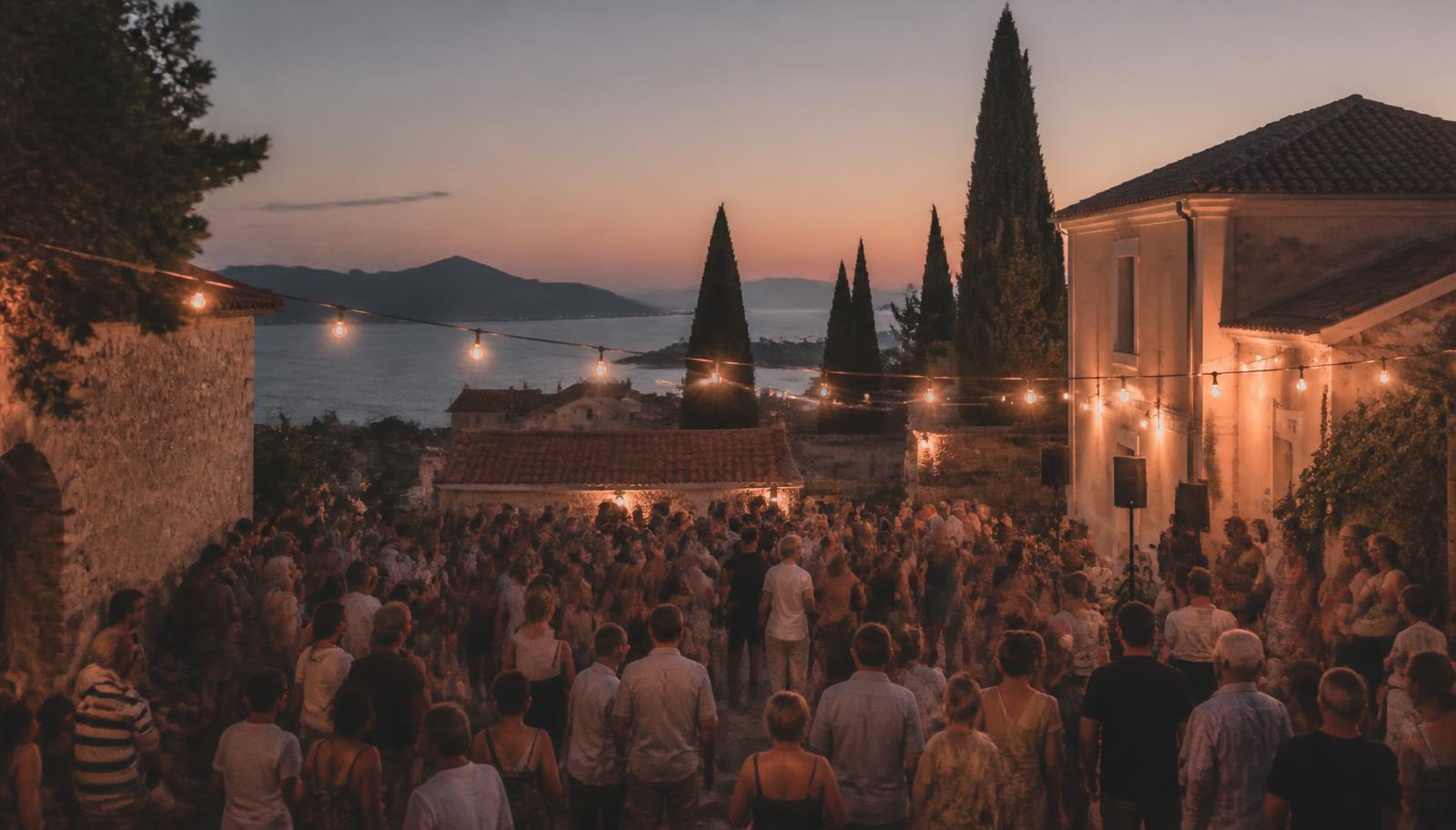
Every summer, the island''s calendar fills with concerts, screenings, sporting displays, local produce festivals and contemporary art events. Behind this dense activity lies a history spanning several decades, beginning with the philharmonic bands, the villages and the cultural associations, and reaching festivals with international participation and specialised artistic programming.
This trajectory did not follow a single plan. Each event was born of a different need: promoting a local product, bringing sports clubs together, giving new life to an abandoned village, creating an open-air cinema or showcasing contemporary film production. What they shared was the initiative of people and associations who chose to turn a public space into a meeting place.
The history of the summer festivals also reflects the evolution of local society. It is linked to the way residents organised themselves after the 1953 earthquakes, to the importance of the diaspora returning in August, to the growth of tourism and to the emergence of a younger generation of creators who kept close ties with the island. Along this path, a cultural summer took shape with many different expressions and a presence across the whole of Kefalonia.
Foundations before the modern idea of a festival
The island''s organised cultural life has deep roots in the Ionian musical tradition. Since the 19th century, philharmonic schools, choirs and mandolin ensembles cultivated an audience familiar with public musical performance. In Lixouri, the Pallis Philharmonic School was founded during the British protectorate and became one of the oldest organised musical institutions in the area. Similar activity developed in Argostoli and in smaller communities, creating a stable tradition of musical education and participation.
Before the word "festival" took hold, summer events took the form of concerts in squares, choral gatherings, theatre performances, serenades, barcarolles and religious feasts. Villages had associations that organised dances, celebrations and local gatherings. The summer season favoured such initiatives, as families returned from Athens, Piraeus and abroad, temporarily increasing both the population and the available audience.
This older tradition created the necessary infrastructure at a human level. There were musicians, dance teachers, volunteers, association boards and communities experienced in hosting public events. Later festivals drew on this ground, even when their content moved away from traditional music towards cinema, contemporary art or mass participation sport.
Post-earthquake reconstruction and new cultural institutions
The earthquakes of August 1953 destroyed most of the built environment and interrupted the operation of many older cultural venues. Along with houses, public buildings and churches, halls, archives, musical instruments and meeting points were lost. The reconstruction of the following years also involved restoring collective life. Philharmonic bands, choirs and associations were re-founded or found new homes, while squares and school yards were used for concerts and performances.
During the 1960s and 1970s, improved transport and the gradual growth of tourism expanded the audience for summer events. Cultural associations took on a greater role in organising the local calendar. Celebrations began to acquire fixed dates, a defined theme and a recurring format. This shift from occasional event to annual institution was the key step towards a modern festival culture.
In the same period, a more stable organisational mechanism emerged. Communities, municipalities and later municipal cultural bodies began to include concerts, theatre performances and local celebrations in unified summer programmes. Publicity, initially through printed announcements and posters and later through radio and the local press, helped events reach audiences beyond the village or association that organised them.
The Robola Festival and the first generation of organised institutions
One of the oldest examples with a continuous presence is the Robola Festival in Fragata. The first edition took place in 1978 on the initiative of the cultural association "O Mermigkas". Choosing Robola as the central theme connected the celebration with the winegrowing identity of Omala and with a product that already had a strong presence in the area''s economy and daily life.
The event gained a fixed place in the August calendar. Wine, local dishes, music and dance formed a recognisable programme, while the participation of residents, diaspora and visitors reinforced its collective character. Its long life shows how a local celebration can evolve into an institution while keeping its link with the community that created it.
The Robola Festival opened a path later followed by several events built around products, customs and farming activity. Its significance lies mainly in its longevity and consistency. For many families, being in Fragata became part of the summer return to the island, turning the celebration into a point of reconnection with the place.
The International Gymnastics Festival and a wider audience
In 1988 the International Gymnastics for All Festival began, on the initiative of the "Eptanison" Athletic Gymnastics Club. Its philosophy was based on participation and on presenting group programmes without competitive ranking. This gave the event an open character, allowing athletes of different ages and levels to take part.
Over the years, the festival attracted international participation and expanded to more parts of the island. Parades, displays and ceremonies took place in Argostoli, Lixouri and Sami, creating an event with a strong presence in public space. After the death of Olympian Anna Pollatou in 2014, the institution took her name, honouring her close relationship with the local club and with gymnastics on the island.
Its evolution broadened the notion of a summer festival. Sport was presented as spectacle, participation and international exchange, while the presence of hundreds of athletes and companions created an event with cultural and economic impact. The institution''s longevity confirms the importance of a stable organisational base and of cooperation between associations, volunteers and local bodies.
The new generation of festivals after 2010
During the 2010s a different category of events appeared. Young creators and professionals with island roots or personal ties brought experience from Athens and abroad. The new festivals relied on specific artistic curation, a recognisable visual identity and systematic online communication. The venue became as important as the programme itself.
This change was linked to the use of locations that until then had not been systematically used for cultural events. Abandoned settlements, beaches, harbours, estates and old buildings hosted concerts, screenings and visual art projects. The audience experience was organised around the relationship between the work and the landscape, creating events that could gain recognition beyond the island.
Saristra in Old Vlachata
Saristra Festival began in 2012 in Old Vlachata, the abandoned settlement destroyed by the 1953 earthquakes. A group of people with ties to the area cleared and shaped parts of the village, organising a programme of contemporary music, visual arts, screenings and workshops. The event took its name from the settlement''s old square.
Saristra''s distinctiveness lay in the direct connection between festival and place. The ruins were a core part of the experience. The village''s history, its abandonment and post-earthquake memory were built into the event''s identity. Audiences moved among the old houses and the different stages, discovering at the same time a lesser-known part of the area''s history.
Within a few years, Saristra gained nationwide recognition and hosted significant artists from the Greek independent scene as well as international acts. Its course included periods of growth, pauses and returns on a smaller scale, reflecting the difficulties faced by independent festivals. Its contribution was clear: it proved that an abandoned place could acquire a new public use through contemporary cultural production.
SeaNema and open-air film screenings
In 2015 the first SeaNema Open Air Film Festival took place, on the initiative of director Vasilis Kekatos. The central idea was film screenings by the sea, with the beach turning for a few hours into an open-air cinema. The first edition at Platis Gialos drew a substantial audience and showed that cinema could be integrated organically into the summer landscape.
In subsequent editions, SeaNema expanded to different locations, from beaches and harbours to estates and seaside venues. The programme included short films, tributes, workshops and activities for children. Moving from place to place gave each screening its own character and allowed different areas to take part in the festival.
The event left a strong imprint, even though it did not achieve the longevity of older institutions. It highlighted a form of cultural action that used the island''s geography in a practical and creative way. It also strengthened the place of cinema in the summer programme and prepared the ground for later initiatives.
"Kymata" and a new film era
The Kymata Festival appeared in 2022 at Thalassomylos, focused on cinema and contemporary arts. The first edition combined films, documentaries, music videos, concerts and visual art. Particular emphasis was placed on the island''s relationship with film production and on creators who come from Kefalonia or have worked there.
The festival went on to establish an international short film competition, educational activities and more participation categories. English subtitles and the presence of foreign filmmakers widened its audience, while Thalassomylos became a stable point of reference. Choosing a specific venue gave the event continuity and a recognisable identity.
Kymata represents a newer phase in which the island is treated as a place of production, discussion and presentation of cinema. Kefalonia''s relationship with the big screen had for years been associated mainly with films shot in its landscape. The festival shifted attention towards filmmakers, short-form production and contemporary film education.
A decentralised cultural map
The major institutions are only one part of the summer programme. Philharmonic concerts, choral gatherings, exhibitions, theatre performances, produce festivals and events by cultural associations take place every year in dozens of villages and settlements. Some have a long history, while others depend on a particular group becoming active or on funding for a single year.
Geographical spread is a key feature of this activity. Argostoli and Lixouri concentrate much of the organised programme, but important institutions also developed in Omala, Sami, Old Vlachata and coastal locations. The result is a cultural map that moves audiences across different areas and highlights places outside the usual routes.
Why the festivals matter today
Festivals rest on complex cooperation between associations, creators, volunteers, municipalities, cultural bodies and sponsors. Organising an event lasting a few days requires months of preparation, technical infrastructure, permits, safety measures and steady funding. Long-term survival often depends on a small number of people who hold the knowledge, the archive and the responsibility for the institution.
Their local impact is substantial. They create opportunities for young people, offer a platform to artists and athletes, strengthen cooperation between communities and draw audiences to different parts of the island. For foreign visitors who return often, they are a direct way of engaging with the contemporary social and cultural life of the place.
Their historical documentation remains limited. Programmes, posters, photographs, organisers'' accounts and association archives are often scattered or held in private collections. An organised digital archive could preserve this trajectory and record more accurately the contribution of each institution.
From the 1978 Robola Festival and the 1988 Gymnastics Festival to Saristra, SeaNema and Kymata, the summer programme evolved together with the society that created it. The events changed in form, size and content, but kept one constant: people''s desire to meet, to present their work and to give new use to public spaces. That continuity explains why festivals have earned a permanent place in the island''s summer.
See all current island events in the Kefalonian Globe events calendar.
Related Articles
Ο Εμίρης, το Φάντασμα και η Μαργαρίτα: Η Θεατρική Ομάδα του ΓΕΛ Κεραμειών στο Λυκιαρδοπούλειο
Σάββατο 20 Ιουνίου 2026, 20:30, στο Λυκιαρδοπούλειο Θέατρο Κεραμειών. Τρία κωμικά μονόπρακτα από τη Θεατρική Ομάδα του Βαλλιανείου Γενικού Λυκείου Κεραμειών. Είσοδος ελεύθερη.
Το Ίδρυμα Γεωργίου & Μάρης Βεργωτή τιμήθηκε με το Βραβείο Ευκράντη για την Κοινωνική Προσφορά
Το Ίδρυμα Γεωργίου & Μάρης Βεργωτή τιμήθηκε με το Βραβείο Ευκράντη για την Κοινωνική Προσφορά, σε μια χρονιά-ορόσημο κατά την οποία συμπληρώνει 50 χρόνια αδιάλειπτης παρουσίας και προσφοράς.
Κεφαλονιά: Μικρές ιστορίες πίσω από γνωστά σημεία του νησιού
Από τη Γέφυρα Δεβοσέτου και τις Καταβόθρες μέχρι τη Μελισσάνη, την Άσσο και το Φισκάρδο: μικρές ιστορίες που εξηγούν την Κεφαλονιά πίσω από τις γνωστές της εικόνες.