When disaster is no longer news
The bad weather that hit Greece in the previous days was not just another intense weather event. It was an event with a real human cost, with two dead, extensive damages and images that can hardly be attributed to the concept of "extreme" anymore. In Attica, a woman lost her life when she was swept away by the waters in an area that turned into a torrent within minutes, while in Paralio Astros a coast guard officer was found dead amid dangerous conditions caused by the bad weather. These events are not footnotes. They are the essence of the discussion. When we talk about natural disasters, we talk first and foremost about loss of life, and only secondarily about damages and hardship.
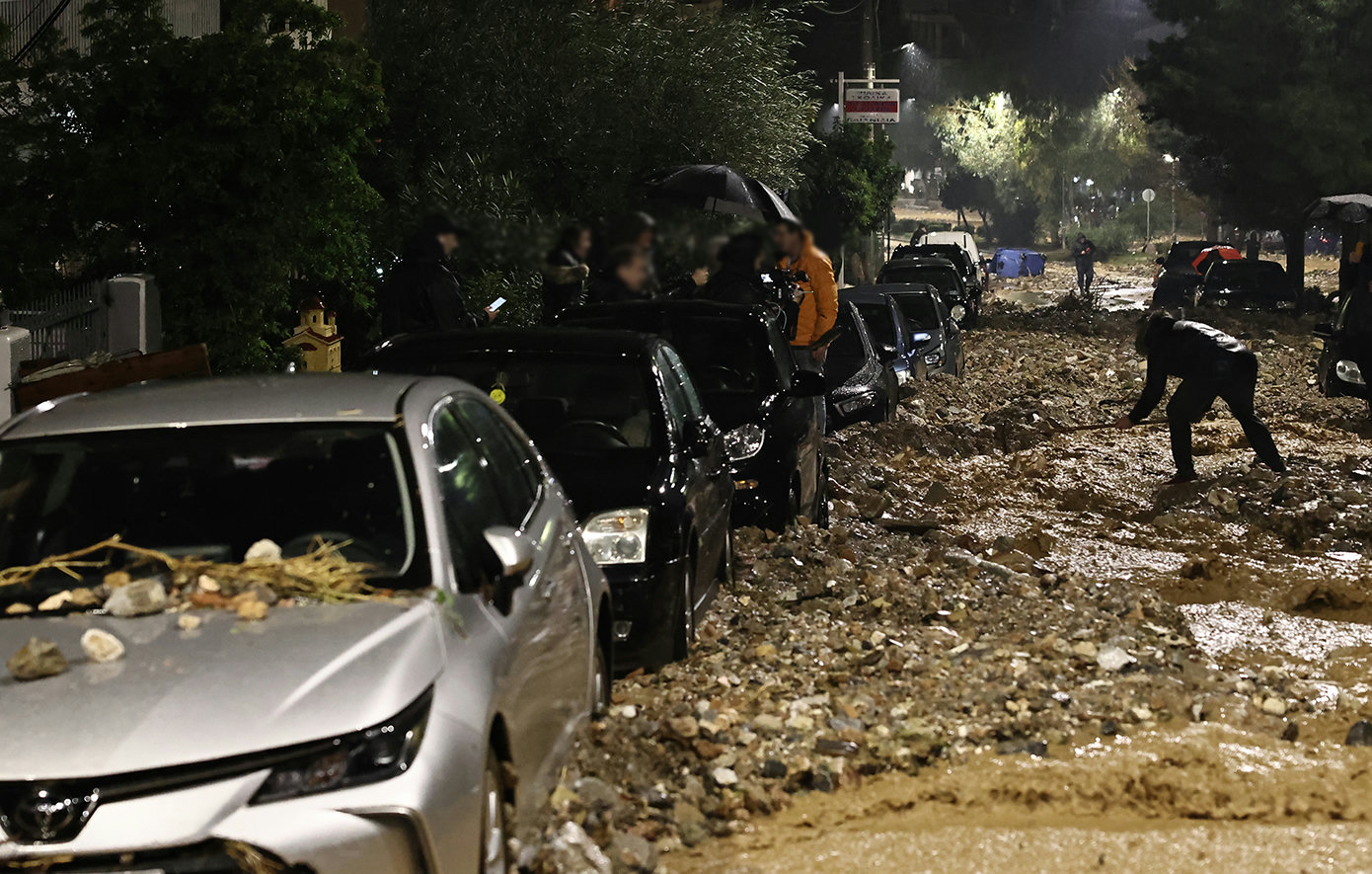
The same bad weather left behind images of extensive floods in Attica, with roads turning into rivers, cars immobilised, basements and ground floors filling with water and mud, and businesses recording serious damage to equipment and stock. These were not isolated incidents, but a phenomenon that manifested itself in many areas simultaneously, revealing once again the difficulty of urban areas to manage large volumes of water in a short time. The fact that these images did not cause shock but a sense of recognition is perhaps the most disturbing element of all.
Greece facing a recurring reality
The country now has enough experience of such episodes that it cannot seriously speak of "surprise". In recent years, intense bad weather, floods, fires and seismic events constitute a reality in which natural hazards do not appear sporadically, but with a frequency that necessitates a different way of thinking. The recent bad weather activated warning mechanisms, travel restrictions and increased readiness, but the results showed again that forecasting and warning alone are not enough to prevent serious consequences. Two people lost their lives, a woman in Ano Glyfada who was swept away by the waters and a coast guard officer in Paralio Astros Kynourias, in conditions directly linked to the dangerousness of the weather. These losses act as a clear limit. From the moment there are dead, the discussion cannot remain general nor be exhausted in descriptions of phenomena. It must become specific and strict, because it concerns the exposure of people in areas that in a few minutes turn into traps.
In Attica, the floods brought to the surface again issues that have been discussed for decades and that every major episode makes visible in an almost violent way. Streams that have been restricted or covered, sewerage networks that are insufficient, overbuilding in areas with natural water flow and maintenance that is done sporadically combine to create an environment that struggles to withstand large volumes of water in a short time. Water does not recognise urban planning lines or administrative boundaries. It follows the geography and history of the place. Every time the city floods, it is confirmed that the problem is not only the intensity of the rain, but the inability of the urban area to absorb it without collapsing at critical points. The damages recorded, houses and shops full of water and mud, roads turned into flows, vehicles immobilised or swept away, are not just images of disruption. They are the practical result of a reality that is repeated and that, the more it is repeated, the less it can be considered accidental.
When disaster ceases to be an isolated event
One of the most disturbing characteristics of the recent bad weather was not only the intensity of the phenomena, but the sense of familiarity that the images caused. Flooded streets in Attica, blockades, property damage and pressure on transport did not cause collective shock. They caused recognition. As if we are watching a development that we have seen before, with only small variations. This familiarity is perhaps the most dangerous element of all, because it turns disaster into something expected and therefore manageable only communicatively, not substantively.
The repetition does not only concern Attica. It concerns the entire country, which in recent years moves from crisis to crisis with minimal time for real assessment and readjustment. Every intense bad weather leaves behind data. Which areas flooded, which roads closed, how long it took for basic functions to return, which people were in greater danger. The problem is not that this data does not exist. The problem is that it rarely translates into changes that reduce the risk in the next episode. Thus, natural disaster ceases to be an exception and becomes a structural element of everyday life.
In this context, the two deaths of the previous days cannot be treated as tragic coincidences. They are the harsh result of a system that allows entire areas to operate marginally when the weather strains. These are not individual errors or momentary carelessness. These are conditions that create situations where an error becomes fatal and where nature leaves no room for correction.
Kefalonia in the same pattern
The image of Kefalonia in the previous days does not contradict what we saw in the rest of Greece, but complements the same pattern from another scale. Where in Attica the bad weather was depicted as flood pressure in the urban area, on the island it manifested as a combination of strong wind, problems in basic functions and restrictions that accumulated as the weather persisted. The very strong winds affected transport and interventions, made daily operations difficult and made every restoration work slower and more demanding. At the same time, power supply problems were recorded in areas of Argostoli and elsewhere, which, even if they were not unprecedented in themselves, gained greater importance in an environment of generalised pressure. When such incidents happen simultaneously, bad weather ceases to be an isolated episode and turns into a test of the overall functioning of the place.
This test was also joined by the restriction of ferry connections, which did not just last one day, but was extended for a continuous period, something that does not often happen for Kefalonia. This is not an isolated transport problem, but a factor that changes the overall sense of security and availability. When the connection with the mainland is cut off for days, even if everything else works marginally, the island enters a state of limited normality. Travel is postponed, professional obligations are compressed, dependence on the internal strengths of the place becomes absolute. At this point, Kefalonia's experience is not comparable to Attica's in terms of the intensity of the effects, but in terms of their mechanism. In both cases, the bad weather acted as a factor that highlighted how easily basic functions are strained and how limited the margins of reaction are when the phenomenon persists.
Pressure on infrastructure as a constant phenomenon
The events of the previous days showed once again that the effects of bad weather are not only determined by the intensity of the phenomena, but by the extent to which infrastructure and mechanisms operate under pressure. In Greece, both in large urban centres and in island areas, the recurring image is that of marginal operation. Networks are interrupted, transport is restricted, restoration times are lengthened and daily activities are suspended, not because the phenomenon was unprecedented, but because the system does not have sufficient margins of adaptation when conditions deviate from the absolutely normal.
In the recent bad weather, what became visible was not just the pressure of the phenomena, but the fact that the system does not have the necessary preparation to absorb them without serious disturbances. In Attica, heavy rainfall led to flood phenomena, extensive damage and human losses, showing that large parts of the urban area remain vulnerable when water collects quickly. In Kefalonia, the bad weather manifested itself differently, through strong winds, problems in basic functions and restrictions on transport, but there too it appeared that the mechanisms are not designed to operate smoothly in conditions of prolonged intensity. In both cases, the problems did not arise because the phenomenon was unpredictable, but because the level of readiness proved insufficient.
This image has been repeated in recent years with different occasions and in different areas, a fact that shows that the lack of preparation is not an exception, but a structural characteristic. Interventions are often made after the problem appears, maintenance remains sporadic and adaptation to conditions of increased risk progresses slowly. Thus, each new episode finds the system in a similar state, with limited margins of reaction and with consequences that could have been largely limited. The recent bad weather did not highlight anything new, but clearly confirmed that the country continues to operate without the level of preparation required for phenomena that can no longer be considered rare.
The consequences beyond the damage
The assessment of bad weather is never exhausted the moment the phenomena stop. It essentially begins afterwards, when it becomes clear what it left behind in terms of operation, safety and resilience. In the previous days, both in Attica and in other areas of the country, the image that was formed was not only that of material damage and disruptions to daily life, but of a generalized sense of instability. Travel became dangerous, areas were temporarily isolated, services operated marginally and citizens had to adapt to conditions that changed from hour to hour. This situation does not always produce impressive images, but it directly affects the sense of security and predictability that underlies public life.
In this context, the two human losses associated with the bad weather were also recorded. These incidents did not come as a result of an isolated, isolated risk, but were integrated into an environment where conditions had already become difficult and daily activities acquired increased risk. The presence of dead does not only change the emotional burden of the discussion, but also the way in which the other consequences should be read. It shows that, when infrastructure and mechanisms operate at their limits, the line between management and loss can become extremely thin.
After the phenomena passed, the burden shifted to managing the consequences. The restoration of damages, the restoration of basic functions and the gradual lifting of restrictions did not evolve simultaneously or at the same pace in all areas. In several cases, it took time before traffic, electricity or access to specific points were fully restored, a fact that prolonged the disruption beyond the duration of the bad weather. This image highlighted that the end of the phenomena does not mean an immediate return to normality.
At the same time, it became apparent that many of the problems that arose were not new. Areas that had presented difficulties in the past were again at the center, while restoration processes moved at familiar rates. As a result, the bad weather acted more as an acceleration of existing weaknesses than as an isolated event. The experience of the previous days did not only add new damages, but brought back to the fore issues that remain open.
At this level, the consequences of the bad weather are not only reflected in numbers or images, but also in the time required to close open fronts. This time is crucial, because it shows how quickly basic operation can be restored and how easily an intense period leaves its mark even after it passes. And it is this factor that determines whether such an episode will be treated as a temporary disruption or as another link in a chain of recurring difficulties.
The recent bad weather was not an isolated event, but another episode that highlighted known weaknesses and recurring limits. Its true assessment will not be judged only by the extent of the damages or the duration of the phenomena, but by whether the conclusions of this experience will be integrated into the way the country prepares and reacts. Until then, every intense phenomenon will continue to serve as a reminder of a reality that can no longer be ignored.
Related Articles
Πυρκαγιά, Ετοιμότητα, Προστασία: Τι Χρειάζεται η Κεφαλονιά Πριν το Επόμενο Καλοκαίρι
Η φετινή πυρκαγιά στην Πάστρα απείλησε χωριά της νότιας Κεφαλονιάς και έθεσε εκ νέου το ζήτημα της πυρασφάλειας. Τι χρειάζεται να αλλάξει —από τις αντιπυρικές ζώνες έως τα σχέδια εκκένωσης και τη στήριξη των εθελοντών— πριν το επόμενο καλοκαίρι;
Ποιανού είναι πια το χωριό; Η σιωπηλή αναδιάταξη που επιφέρει η βραχυχρόνια μίσθωση
Από το Ελειό-Πρόννοι έως το Ληξούρι και το Αργοστόλι, η Κεφαλονιά διανύει μια μεταμόρφωση που δεν γίνεται πάντοτε αντιληπτή με την πρώτη ματιά.
Καλό καλοκαίρι από το Kefalonian Globe! Επιστροφή 21 Αυγούστου
Η ομάδα του Kefalonian Globe κάνει ένα μικρό διάλειμμα για το καλοκαίρι. Επιστρέφουμε στις 21 Αυγούστου με φρέσκο περιεχόμενο.