Summer festivals as a living part of local society
The social function of an institution that survives beyond tourism and seasonality.
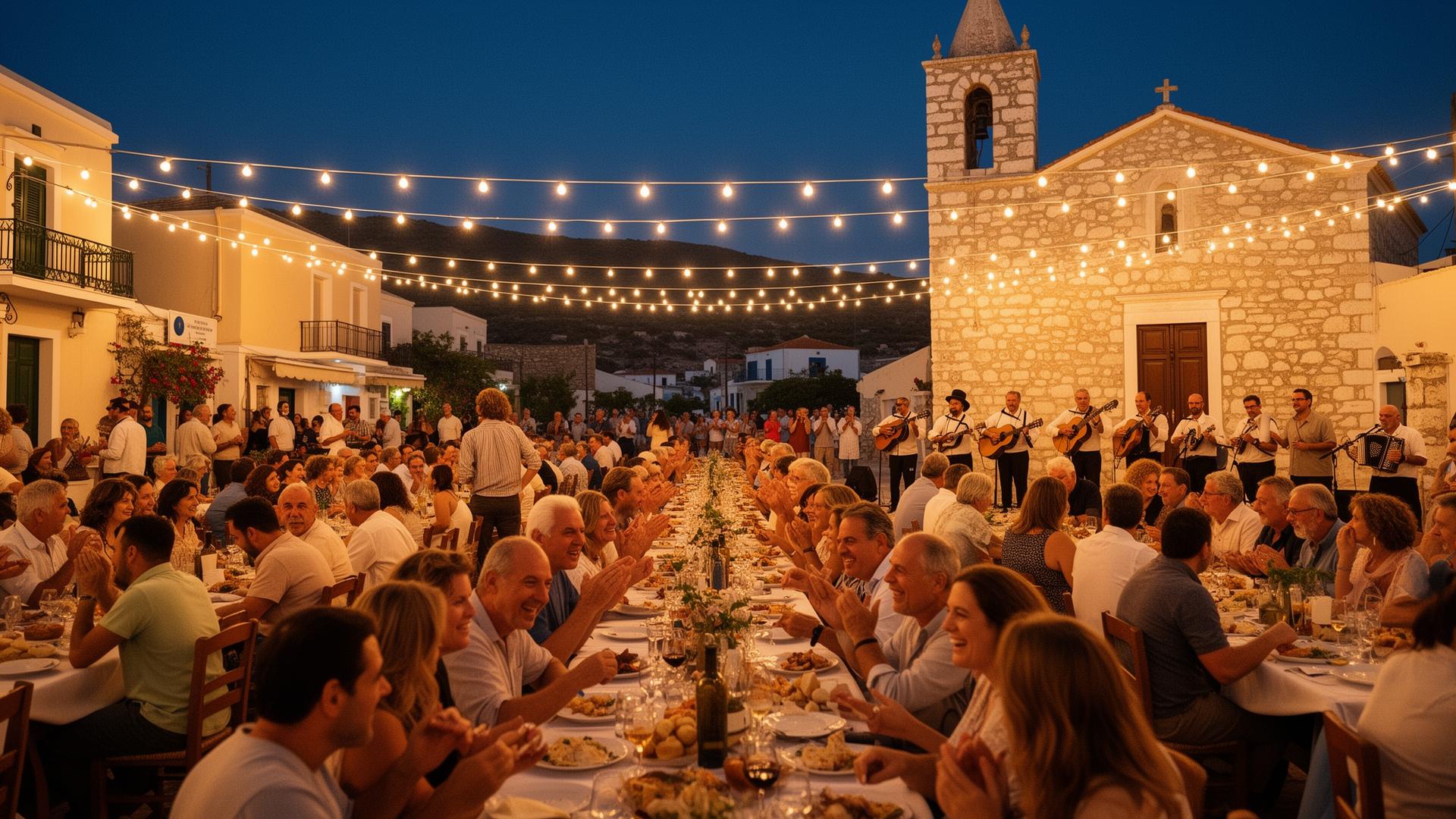
Summer festivals are one of the most enduring social and cultural characteristics of the Greek countryside, and especially of island regions. Despite the profound changes that have affected Greek society in recent decades — urbanization, the decrease in the permanent population in villages, the change in forms of entertainment, and digital everyday life — festivals continue to function as a stable point of reference for local communities. In Kefalonia and generally in the Ionian Islands, the summer period is accompanied each year by dozens of small and large events linked to religious holidays, local traditions, and collective forms of social life. These are not merely recreational events or tourist "spectacles," but rather events that still hold social weight, economic significance, and cultural continuity.
Unlike many modern forms of entertainment based on consumption or individual experience, the festival still operates collectively. The square, the courtyard of a church, or an open public space is temporarily transformed into a meeting point for people of different ages, professions, and social groups. In small communities in Kefalonia, where winter is characterized by limited social mobility and a reduced population, summer festivals also function as a period of reactivating social life. Residents living in Athens or abroad return to their home villages, families reunite after months, and the local community gains, even temporarily, greater cohesion and visibility.
The relationship of festivals with religious life remains strong, although their character has significantly changed over time. In most cases, the events are linked to the celebration of a patron saint or a local saint, especially during the period from June to September, when most religious festivals take place on the islands. However, the social dimension of festivals has now surpassed narrow religious boundaries. Even people with no particular connection to religious tradition participate in the events, as they are more connected to the concept of community and less to formal religious participation. In Kefalonia, as in many other parts of Greece, local identity continues to be shaped around such collective experiences, especially in areas where permanent social life is limited outside of summer.
The economic dimension of festivals is also significant and often underestimated. Behind every event there is a whole network of local mobilization that includes cultural associations, volunteers, catering professionals, musicians, small businesses, and producers. In many villages, the revenue from summer events is a key source of funding for associations and local activities during the rest of the year. At the same time, these events indirectly support small local economies that depend heavily on the summer season. From the supply of food and beverages to the hosting of musical groups and the transportation of visitors, the festival functions as a small but real economic activity, especially in areas with limited other forms of production.
At the same time, festivals are one of the last places where a form of public social life survives that is not fully controlled by commercial chains, platforms, or digital applications. In an era where much of entertainment has moved to private spaces or personalized forms of consumption, the existence of open, collective, and accessible events takes on special significance. The festival does not require a specific social or economic profile for one to participate. Different generations and social groups coexist in the same space, a phenomenon that is increasingly rare in modern everyday life. This dimension largely explains why festivals still retain social resilience, even in areas where other forms of collective life have weakened.
Music remains a key element of the identity of festivals, although here too changes are evident. In the Ionian Islands, the presence of philharmonics, the "kantada" (serenade), and local musical influences historically created a different musical character compared to other parts of Greece. At the same time, however, in recent years there has been a greater homogenization of the musical landscape, with repertoires often repeated from region to region and with an increased presence of more commercial musical choices. Nevertheless, in many local events, special musical elements connected to the history and cultural identity of each area still survive. In Kefalonia, for example, local choral and musical traditions still appear in several events, even if they now coexist with more modern forms of entertainment.
Of particular interest is also the change in the relationship of younger generations with festivals. For many years, there was the impression that young people were gradually moving away from such events, mainly due to the change in entertainment standards and the strong influence of digital culture. However, this image is not entirely accurate. In many regions of Greece, festivals have experienced a new dynamism in recent years, attracting younger ages not necessarily due to tradition, but due to the need for collective experience and open social participation. The return of outdoor events after the pandemic period further reinforced this dimension, as the social isolation of previous years created a greater need for physical presence and shared experience.
Despite maintaining their dynamism, summer festivals also face significant challenges. Increasing commercialization, the pressure of the tourism economy, and the general change in social life inevitably affect the character of many events. In some cases, the emphasis shifts more towards consumption and less towards collective participation, while in tourist areas there is a gradual transformation of traditional events into a product of cultural consumption for visitors. Nevertheless, in much of the Greek countryside — and especially in smaller communities — the festival still functions more as an internal social process than as a tourist spectacle. This difference is crucial for understanding the role that such events continue to play in modern Greek reality.
In a period where social life is becoming increasingly fragmented and everyday life is organized more and more around individual or digital experiences, the resilience of summer festivals is of particular interest. This is not a remnant of an "old Greece" surviving out of habit, but an institution that continues to adapt and remain functional within different social conditions. Their importance lies not only in the music, the food, or the entertainment, but mainly in the opportunity they offer for collective presence at a time when shared experiences are becoming increasingly limited. And perhaps this explains why, despite the technological and social changes of recent decades, summer festivals continue to be one of the most vibrant elements of Greek local society.
Related Articles
Η δημογραφική συρρίκνωση της Κεφαλονιάς: πού χάνεται ο πληθυσμός και γιατί
Η απογραφή του 2021 δείχνει ότι η Κεφαλονιά δεν αδειάζει ομοιόμορφα. Το Αργοστόλι χάνει πληθυσμό, η Σάμη κερδίζει, και το ερώτημα είναι τι σημαίνει αυτό για το μέλλον του νησιού.
Ποιανού είναι πια το χωριό; Η σιωπηλή αναδιάταξη που επιφέρει η βραχυχρόνια μίσθωση
Από το Ελειό-Πρόννοι έως το Ληξούρι και το Αργοστόλι, η Κεφαλονιά διανύει μια μεταμόρφωση που δεν γίνεται πάντοτε αντιληπτή με την πρώτη ματιά.
Η ιστορία των καλοκαιρινών φεστιβάλ της Κεφαλονιάς
Από τις φιλαρμονικές και τη Γιορτή της Ρομπόλας έως το Saristra, το SeaNema και τα «Κύματα»: πώς διαμορφώθηκε το πολιτιστικό καλοκαίρι της Κεφαλονιάς.