Kefalonia: From Antiquity to the Modern World
    By Anonymous
    6 min read
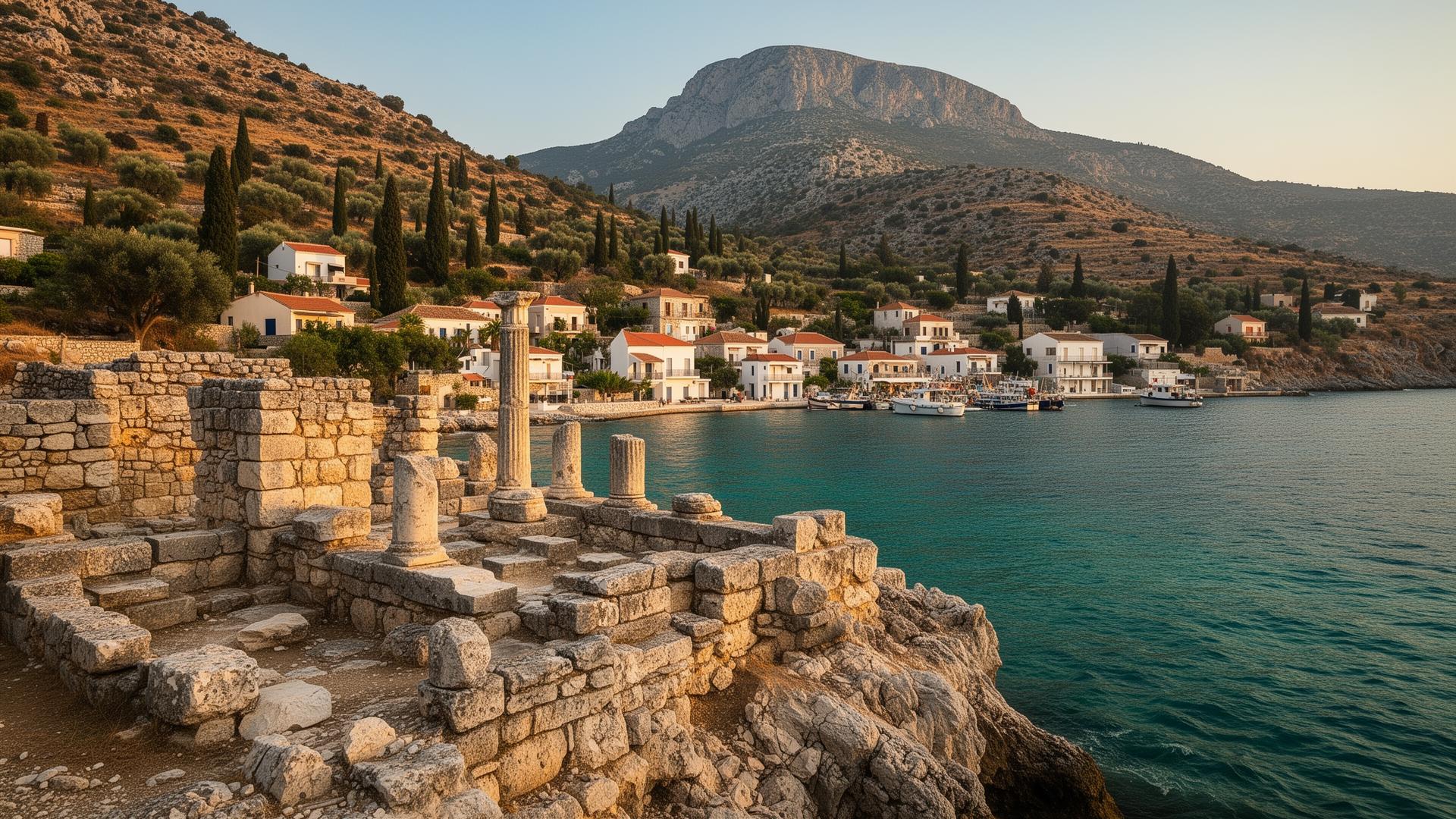
    Αρχαία ερείπια στην ακτή της Κεφαλονιάς με παραδοσιακό χωριό και θάλασσα — από την αρχαιότητα στον σύγχρονο κόσμο

    From prehistory to ancient organization

    Kefalonia is one of the oldest continuously inhabited areas in the Ionian, with human presence documented as early as the Neolithic period, approximately between 4000 and 3000 BC. Its geographical location, between mainland Greece and the western Mediterranean, combined with its natural harbors and mountainous terrain, made it an early point of contact and movement for populations. During the Mycenaean period (1600–1100 BC), the island became part of a wider network of trade and culture, with significant findings such as the tholos tomb in Tzannata of Poros (14th century BC) demonstrating the existence of strong local elites and an organized social structure. These findings are linked to a period during which Kefalonia did not function as an isolated area, but as an active part of the Mycenaean world, with contacts likely extending to the western coasts of Italy.

    From the 8th century BC onwards, Kefalonia gained clearer political organization through the creation of the Tetrapolis, a system based on the existence of four autonomous city-states: Krani, Same, Pali, and Pronnoi. This structure reflected a balance of local powers, where each city maintained its own administration, economy, and military presence, without forming a unified state. Same developed into an important naval and commercial center, while Krani gained a strong presence in the hinterland. During the Peloponnesian War (431–404 BC), the island sided with Athens, a fact that demonstrates its strategic importance in controlling the maritime routes of the Ionian. This period ended with its conquest by the Romans in 189 BC, after a siege of Same, marking the transition to a new historical phase.

    From Roman rule to medieval instability

    The integration of Kefalonia into the Roman Empire in 189 BC did not lead to decline, but to adaptation to a broader administrative and economic system. The island acquired a role within an extensive network connecting the Mediterranean, a fact reflected in both architecture and daily life. The Roman villa in Skala, dating from the 2nd–3rd century AD and featuring elaborate mosaics, is a characteristic example of the era and attests to the presence of wealthy social strata and the adoption of Roman standards of living. At the same time, the existence of baths and other infrastructures indicates that Kefalonia actively participated in the urban and cultural way of life of the Roman period.

    After the 4th century AD, the island was integrated into Byzantium and became particularly important from the 8th century, when the Theme of Cephalonia was formed, an administrative and military unit with a strong naval character. Kefalonia served as a base for controlling the Ionian and combating pirate raids, enhancing its role as a strategic point. However, from the 11th century onwards, this stability began to waver, culminating in its capture by the Normans in 1185. The period that followed was characterized by successive changes in power, as the island passed from the Orsini to the Tocco family and other local rulers, reflecting its importance as a point of control for maritime routes.

    Venetian rule and the shaping of the island's identity

    In 1500, Kefalonia came under the control of Venice, ushering in a period of almost three centuries (1500–1797) thatproved decisive for the formation of its identity. The Venetians organized the administration, strengthened its defenses, and integrated the island into their commercial network, which extended across the entire Mediterranean. The Castle of Agios Georgios served as the administrative center for a long time, while the fortress of Assos, built in the 16th century, is one of the most important fortification projects in the Ionian. This period is also characterized by the development of agriculture and shipping, as well as the formation of a society with a clear class structure.

    Beyond administrative and military works, Venetian rule left a deep cultural imprint, which remains evident to this day. Venice's influence is visible in the language, architecture, music, and social structures, creating a distinct Ionian identity that differentiates Kefalonia from other regions of Greece. This long period of stability allowed the island to develop and incorporate elements of Western culture, which survive even after the end of Venetian rule.

    From Venice to Union with Greece

    The fall of Venice in 1797 led Kefalonia into a period of intense political changes, with the island initially passing to the French (1797–1799), then participating in the establishment of the Septinsular Republic (1800–1807), and later temporarily returning to French control (1807–1809). In 1809, the British occupied the island, and in 1815 the United States of the Ionian Islands was established under British protection, lasting until 1864. During this period, significant infrastructure projects and administrative reforms were carried out, with a characteristic example being the De Bosset Bridge in Argostoli, which was built in 1813 and remains one of the most recognizable works of that era to this day.

    In 1864, with the Treaty of London, the Ionian Islands were united with Greece, marking a new phase for Kefalonia. Despite its integration into the Greek state, the island retained strong elements of its Ionian identity, which had been shaped during Venetian and British rule. In the 20th century, Kefalonia participated in the events of modern Greek history, with special significance in 1943, when the massacre of the Italian "Acqui" division by the German occupation forces occurred, one of the most tragic events of World War II in Greece.

    The 1953 earthquake and the island's modern form

    August 1953 represents the most decisive turning point in Kefalonia's modern history. On August 9, 11, and 12, successive strong earthquakes occurred, with the main earthquake on August 12 reaching 7.2 Richter, causing almost complete destruction on the island. Most of the settlements were destroyed, and along with them a significant part of Kefalonia's pre-earthquake architecture and historical character was lost. The fires that followed exacerbated the situation, leaving behind an area that essentially had to be rebuilt from scratch.

    The subsequent reconstruction was based on new anti-seismic regulations, a fact that determined the form of today's towns and villages. At the same time, a large part of the population migrated, mainly to Australia and the United States, creating strong communities of the Kefalonian diaspora. The modern image of the island is directly linked to this period, as the post-earthquake reconstruction shaped both the urban fabric and the demographic evolution.

    Kefalonia today as a result of historical continuity

    Today's Kefalonia is the product of a long and complex historical course, in which different periods and influences coexist. From the Mycenaean finds and the remains of the ancient Tetrapolis to the Venetian fortresses, the British infrastructure projects, and the post-earthquake constructions, the island presents a multifaceted image that reflects its timeless evolution. Understanding this history allows for a more meaningful approach to Kefalonia's identity, which is not limited to a specific point in time, but is shaped through the continuous interaction of past and present.