Kefalonia in Times of War
The great wars that shaped the historical and social identity of the island
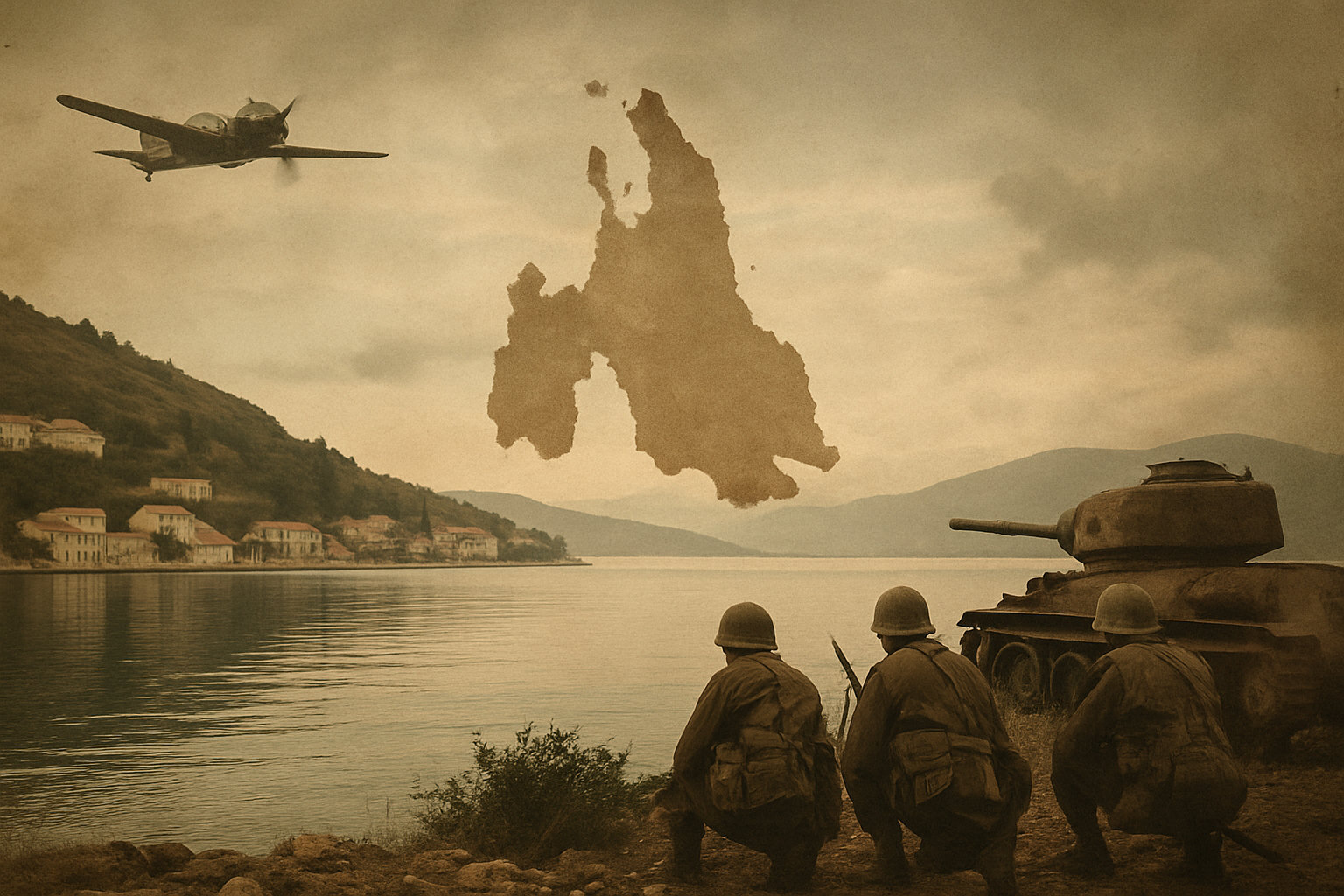
For more than two centuries, Kefalonia has been an island caught between European empires, national revolutions, military conflicts, and occupations that deeply shaped its society. Although it never became a major military front, the impact of wars has been continuous, multifaceted, and decisive for the way its inhabitants' identity was formed. Local history is full of evidence of participation, from letters and recruitment archives to oral testimonies; these attest to a society constantly at the crossroads of international developments, forced to adapt, reorganize, and redefine its position. Kefalonia, then, did not experience war as a sporadic event but as a recurring historical pattern, which affected daily life, the economy, social relations, and political thought. This article attempts to examine how the most important wars of modern Greece were imprinted on the island, using documented sources and emphasizing both military events and their social impact.
Kefalonia and the Revolution of 1821
Although Kefalonia did not become a theater of war during the Greek Revolution, its participation was decisive through support, funding, and secret movements of people and materials. The island was under British administration, a regime that explicitly forbade participation in the Struggle and imposed strict censorship, as stated in the Minutes of the Ionian Senate (1821–1825). However, according to Gerasimos Zotos (The Ionians and the Struggle of '21, 1974), hundreds of Kefalonians secretly crossed the Ionian Sea in small boats to fight in the Peloponnese. This secrecy and the constant threat of British punishment created a paradoxical situation: a war that was not fought on the island, but which was everywhere in its society, in conversations in homes, in collective anxiety, in the secret transfer of war materials.
The social dimension of that period is strongly reflected in the communities. In the villages of Livatho, Sami, and Paliki, families gathered supplies, while women took on the practical support of material transporters and fugitive fighters. The island became an informal refuge; according to the Archive of the Ionian Islands, dozens of wounded passed into Kefalonia to recover, while philhellenes, including Lord Byron, chose the island as a stop before joining the Struggle. Byron's presence in Argostoli in 1823, which he himself describes in his diaries, cultivated a strong philhellenic climate, which strengthened the local society's identification with the cause of independence.
Politically, the Revolution had an even greater impact. The opposition between the philhellenic sentiment of the inhabitants and the strict British policy strengthened the radical movement in the Ionian Islands, which in the decades that followed would play a leading role in the path towards Unification. Kefalonian society learned during this period to associate war not only with weapons but also with political identity; 1821 created the groundwork for the island's democratic and radical tradition, which is reflected in many testimonies of the era, such as those collected by Theotokas in his Modern History of the Ionian Islands (1930).
The Balkan Wars: Kefalonia's first mass mobilization
With the Balkan Wars, Kefalonia entered a completely new era. For the first time since the Unification of 1864, the island participated in a national war with large-scale conscription. The recruitment registers of the General State Archives of Kefalonia record over 1,800 conscripts, a number corresponding to a significant portion of the active male population. Villages such as Lixouri, Mazarakata, Poros, Troianata, and Assos saw their young men depart en masse for the fronts of Epirus and Macedonia, creating an unprecedented social deprivation. Daily life was redefined: women took over cultivation, family finances, and agricultural work, while the elderly were called upon to keep alive productive activities that required labor.
Social life in the villages changed completely. The absence of men created new axes of solidarity; families exchanged food and labor, helping each other in an effort to withstand economic and emotional pressure. The war entered the island through soldiers' letters, which were often published in full in newspapers in Patras and Corfu. These letters, as Leonidas Petratos notes in his work The Kefalonians in the Balkan Wars (1967), changed not only people's relationship with the state but also the sense of what 'pan-Hellenic participation' means. The experience of war brought a more dynamic sense of national identity to the island.
The losses were significant. Many villages mourned soldiers who did not return, their names etched on monuments that today serve as a distinct reminder of the period. The social consequences of the Balkan Wars were long-lasting, as the absence of labor, combined with the wave of emigration that followed, changed the island's productive structure. Kefalonia, for the first time, experienced war as a social upheaval that affected every aspect of its life.
Kefalonia in World War I
World War I transformed Kefalonia into an important point for the Entente powers, although it was not a battlefield. The port of Argostoli, one of the safest and deepest in the Eastern Mediterranean, was systematically used by French, Italian, and British ships as a supply and repair station. The French Naval Logs of the Ionian Sea (1916–1918) record dozens of warship arrivals every month. The image of the port changed radically: crowds of sailors, military cargo, smoke from shipyards and workshops created an unprecedented daily life for an island accustomed to commercial and fishing activity.
Social life was deeply affected. In the cafes of Argostoli, one could encounter languages and cultures from all over Europe; local young people were hired as workers on ships or as auxiliary personnel, while trade experienced a temporary boom. However, as Aggeliki Papadopoulou notes in her study Kefalonia in the Great War (2009), this economic mobility did not eliminate the difficulties of blockades: food decreased, prices rose, and families in mountain villages turned to self-sufficiency, reactivating traditional forms of production.
At the same time, Kefalonian soldiers fought on the Macedonian Front, where they were exposed for the first time to a war of industrial scale. The memoirs of Dionysios Fioravandes (Memories from the Macedonian Front, 1935) describe the soldiers' surprise at new technologies, allied armies from different countries, and large-scale operations. This experience shaped a new social perception of Greece's role on the world map and strengthened the extroversion of Kefalonian society.
The Greco-Italian War and the Italian occupation
The war of 1940 brought Kefalonia into a period of deep turmoil. Kefalonian military personnel participated massively on the Albanian front, with testimonies collected by Stefanos Metaxas (Kefalonians on the Albanian Front, 1989) describing exhausting marches, heavy battles, and losses that left their mark on many families on the island. Society found itself again in a state of male population absence; in the villages, women played a crucial role in maintaining production, while the lack of information from the front created a climate of fear and insecurity.
With the occupation of the island by the Italians in 1941, social reality changed. The Acqui Division was stationed in many parts of Kefalonia; according to the Giornali di Guerra della Divisione Acqui, the Italians used schools, public buildings, and warehouses as barracks, transforming Kefalonia's urban and rural areas into a military network. The coexistence of inhabitants and occupiers was contradictory. On the one hand, the Italian presence imposed requisitions, restrictions, and control. On the other hand, human relationships were created, as recorded in the oral testimonies collected by M. Rouhota (1994), which show a daily life where the occupier often became part of local life.
Socially, this period was characterized by strong solidarity. Food shortages were addressed through product exchanges, communal cultivation, and family networks of mutual support. Anthropologist Elpida Louvrou (Social Cohesion during the Occupation, 2002) notes that Kefalonia presented one of the strongest models of horizontal social support in the Ionian Islands.
The Massacre of the Acqui Division and the German occupation
September 1943 marks the most tragic moment in Kefalonia's modern history. After Italy's surrender, the Acqui Division refused to hand over its weapons to the Germans. Battles followed in areas around Argostoli, Livatho, and Paliki. The events are meticulously recorded in the German War Reports of the 1st Mountain Division. When the Italians surrendered, more than 5,000 soldiers were mass executed; according to the Allied post-war investigation (Allied Post-War Inquiry Files, 1945), this was one of the largest executions of prisoners in Europe.
Kefalonian society was literally caught in this horror. Residents heard the volleys, saw the executed, were forced to bury bodies hastily or help the wounded. Sofia Kourkoumeli's testimony (Kefalonia during the War, 1960) describes the moment when women of Livatho locked their children in their homes so they would not see the execution sites. The subsequent German occupation was harsh, with requisitions, famine, and threats. Yet, small resistance groups formed in the mountains, and villages created survival networks.
The social trauma of the massacre is still alive. As Marc Mazower writes in The Mediterranean in War (2001), "Kefalonia experienced a conflict of empires on its body." The memory of Acqui is not only historical but deeply social, as it was a catalyst for the island's self-perception for decades.
The imprint of wars on the island
Kefalonia experienced war not just as a military event but as a social condition that demanded continuous adaptations. From the secret support of 1821 to the tragic experience of 1943, the inhabitants learned to live amidst volatility, to support each other, to rebuild their communities, and to form an identity that combines resilience, memory, and a sense of collectivity. The sources that document this journey speak not only of battles; they speak of people who were tested, of societies that were transformed, and of an island that found itself many times at the heart of history without ever losing its character.
Related Articles
Η ιστορία των καλοκαιρινών φεστιβάλ της Κεφαλονιάς
Από τις φιλαρμονικές και τη Γιορτή της Ρομπόλας έως το Saristra, το SeaNema και τα «Κύματα»: πώς διαμορφώθηκε το πολιτιστικό καλοκαίρι της Κεφαλονιάς.
Άσσος: ο οικισμός, το φρούριο και η εικόνα που άντεξε στον χρόνο
Πώς η μικρή Άσσος της βόρειας Κεφαλονιάς συγκεντρώνει σε έναν τόπο γεωγραφία, ενετική στρατηγική, μετασεισμική ανασυγκρότηση και σημερινή τουριστική απήχηση.
Βαλλιάνειο ΓΕΛ Κεραμειών: Πρόσκληση στην εκδήλωση αποφοίτησης 2025-2026
Η τελετή αποφοίτησης του Βαλλιανείου ΓΕΛ Κεραμειών θα πραγματοποιηθεί την Πέμπτη 25 Ιουνίου 2026, στις 20:00, στο Λυκιαρδοπούλειο Θέατρο Κεραμειών.