The Maritime History of the Island Beyond the Ports
From Ionian coastal trade to the Black Sea, the Danube and London: shipowners, captains, seafarers and families who gave the island an international maritime presence.
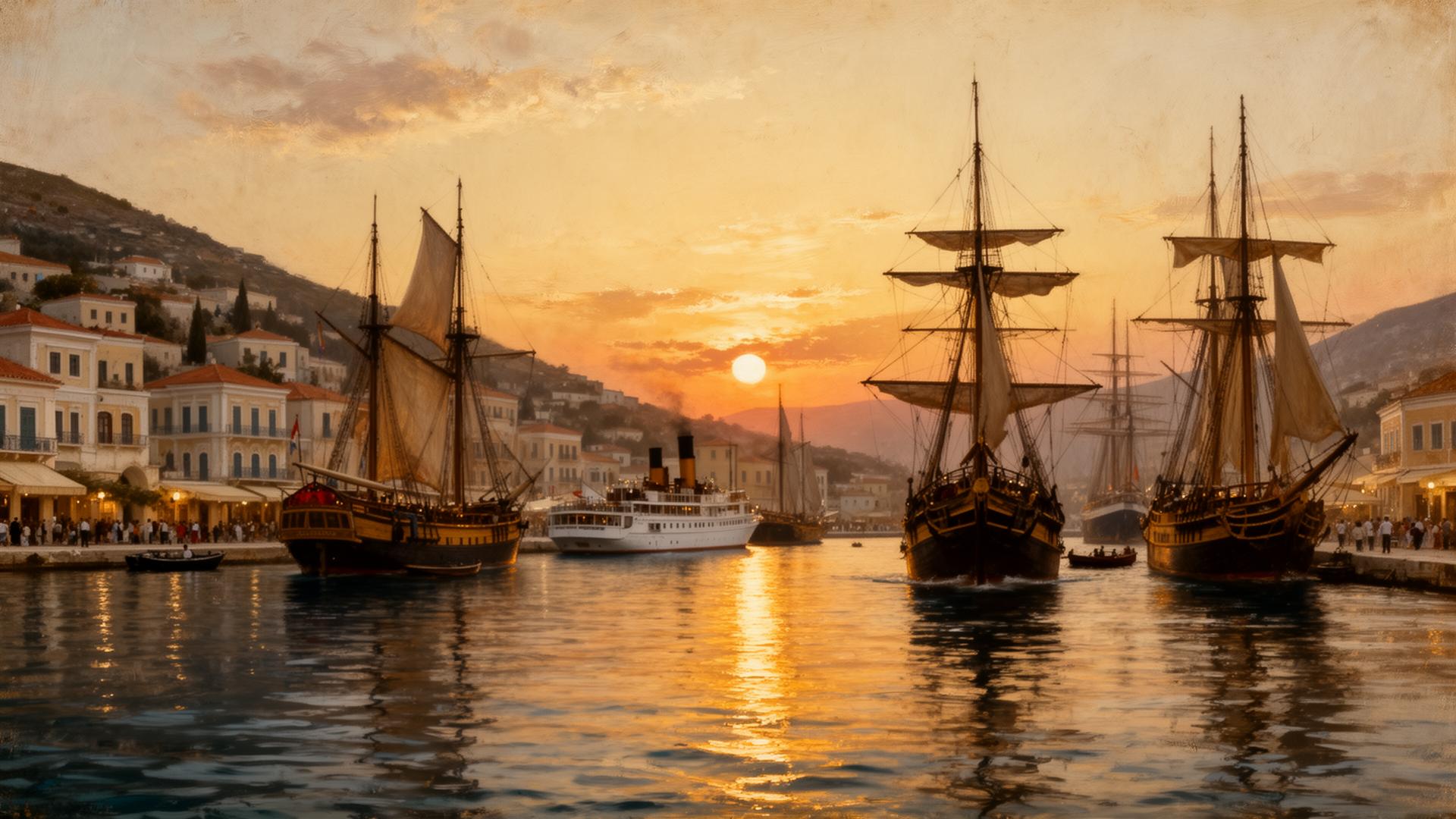
Kefalonia's maritime history is woven from trade routes, family networks, shipowners, captains, sailors and communities that grew up around the sea. From coastal trade in the Ionian to the routes of the Black Sea, the Danube and the Mediterranean, Kefalonians played an active role in shaping Greek-owned merchant shipping. The island produced people and families who moved between major commercial hubs, founded companies, managed cargoes and connected with markets far from the Ionian. Kefalonia's geography provided the initial foundation, but the rise of its maritime presence rested above all on experience, family organisation, commercial adaptability and the capacity of Kefalonians to operate within international networks.
For Kefalonia, the sea was a place of work, movement, trade and social mobility. Maritime activity shaped the island's economy, family strategies, diaspora and relationship with the outside world. In the 18th and 19th centuries, the Kefalonian presence in maritime trade grew especially strong, with involvement in networks that linked the Ionian to the Black Sea, the Danube, Marseille, London and, later, Piraeus. That history explains an important side of local identity: the outward-looking character of an island that produced seafarers, entrepreneurs, merchants and families with a footprint across many regions of the Mediterranean and Europe.
From the Ionian to the great sea routes
Kefalonia developed its maritime activity within an Ionian Sea that functioned as a passage between the Adriatic, the eastern Mediterranean and the western markets. The island's position favoured contact with the other Ionian Islands, the coasts of western Greece, Italy and the commercial networks revolving around Venice, Trieste, Zakynthos, Corfu and the shores of Epirus and the Peloponnese. In the early phases of modern maritime activity, Kefalonians worked mainly in coastal and regional shipping, gaining nautical experience, contact with trade centres and knowledge of the routes. That foundation proved decisive for their later involvement in larger maritime circuits.
From the 17th century, and especially during the 18th and 19th centuries, the Kefalonian maritime presence grew in scale. The shift from local transport to wider trade routes demanded capital, ships, experienced captains, reliable crews and commercial intelligence. Family ties played a defining role, since the shipping of the era depended on trust, personal connections and constant communication between ports. Kefalonia, together with Ithaca and other maritime centres of the Ionian, took its place in this economic geography and gradually built a strong presence in merchant shipping.
The period of the British protectorate of the Ionian Islands, from 1815 to 1864, was important in strengthening the Ionian merchant fleet. Panagiotis Kapetanakis's research on the deep-sea merchant shipping of the Ionian Islands in the period 1809/15-1864 highlights Kefalonian primacy in the fleet, in ports, in cargoes, in routes, in seafarers and in business networks. The Ionian State, though small in extent, managed to operate effectively in Mediterranean trade, while Kefalonia emerged as one of the most significant maritime centres in European waters in the mid-19th century. This development was linked to the carriage of third-country cargoes, especially grain, and to the integration of the Ionian Islands into the central trade routes of the era.
The grain trade and the Black Sea
The grain trade was a core field of activity for Ionian shipping and especially for the Kefalonian presence in the 19th century. The Black Sea and the Sea of Azov grew into major grain-exporting regions, while the ports of the Danube and southern Russia were linked to the markets of the Mediterranean, Marseille, Trieste, Livorno, London and other commercial centres. Carrying grain required ships, capital, secure trade relationships and knowledge of international prices. Kefalonians took part in this network as shipowners, captains, merchants, agents and financiers.
The Black Sea acquired a distinctive position in the global economy of the 19th century. Research programmes on the history of the region document the formation of the Black Sea littoral as a major grain-exporting zone from the second half of the 19th century to the early 20th. In this environment, Greek merchants and shipping families from the Ionian Islands found room to grow. Odessa, Taganrog, Rostov, Berdiansk, Kerch, Mykolaiv, Brăila, Galați and Sulina became points where cargoes were gathered, transactions took place and shipments were organised towards the western markets.
The Kefalonian and Ithacan families who settled or did business in these centres created an extensive network linking the Ionian with the Black Sea and western Europe. Commercial activity rested on family offices, relatives in different ports, partners sharing the same local origin and steady market information. That structure made it possible to track prices, secure cargoes, find freight and manage risk. Kefalonian shipping grew through this web of relationships, combining nautical know-how with commercial flexibility.
The families of Kefalonian shipping
Kefalonia's maritime history has a strong family dimension. Research from the Ionian University's Greek Maritime Centres notes that in the 19th century the Kefalonian families involved in maritime trade and shipowning exceeded 250. Among the most prominent are the Athanasoulis, Ambatielos, Vallianos, Vergottis, Giannoulatos, Lousis, Lykiardopoulos, Metaxas, Potamianos, Svoronos, Tsitselis and Fokas families. The breadth of this list shows that maritime activity was an organic part of the island's economy and society.
These families operated in an era when trust was a basic tool of commerce. One member might be on the island, another in a Black Sea port, a third in Marseille or London. That structure gave businesses an immediate presence at different points of the chain: buying cargo, chartering ships, insurance, financing, sale and reinvestment. Kefalonian shipping evolved through this family geography, which combined local origin with international action. The family functioned as an economic unit, an information network and a mechanism for managing risk.
The Vallianos family is a characteristic example of this transition from diaspora to international shipping business. The Vallianos family, with roots in Kerameies of Livathos, distinguished themselves in the trade and shipping of the 18th and 19th centuries. Panagis Vallianos, whose activity was linked to Taganrog, London and the international grain trade, is regarded by maritime historiography as one of the major figures of Greek-owned shipping. The case of the Vallianos family shows how a Kefalonian family could begin in the Ionian, join the networks of the Black Sea and acquire a role in the great financial and commercial centres of Europe.
From sailing ships to steam
The transition from sailing ships to steamships radically changed the shipping of the 19th century. That change affected the Kefalonian shipping families too, since it demanded larger capital, different expertise, new forms of organisation and adaptation to a more competitive international environment. Sailing ships could operate with smaller capital and a more traditional family structure. Steam shipping brought higher costs, the need for technical support, fuel, engineers and more complex management.
The families that managed to adapt to the new era strengthened their position. Setting up offices in centres such as London helped them access financing, insurance services, chartering brokers and international intelligence. The Greek-owned shipping of the late 19th and early 20th centuries was shaped through such transitions. The Kefalonian families that had already gained experience in the grain trade, in cargo management and in running offices abroad had an advantage over those who remained at smaller, local scales.
This transition is also linked to the rise of Piraeus as the centre of Greek shipping. During the 19th century, many maritime networks of the islands and the diaspora began to connect gradually with the new Greek commercial and shipping centre. Kefalonia retained strong external routes, while part of the shipping activity moved towards Piraeus and the international offices. That development captures the adaptation of Kefalonian shipping to new conditions, with the island remaining a place of origin, family memory and social reference.
Seafarers and the society of the island
Maritime activity directly shaped the society of Kefalonia. The sea offered professional outlets in an island society where agricultural production had natural limits and economic security required several sources of income. Work on ships, involvement in commercial enterprises and employment in offices abroad created routes for social advancement. Many families combined seafaring with the education of their children, the acquisition of property, settlement in cities abroad and the maintenance of ties with the island.
The life of seafarers also had a difficult side. Voyages were long, the dangers of the sea real, and illnesses, shipwrecks, economic crises and wars affected families directly. The absence of men from home, the wait for news from distant ports and the dependence on international markets shaped a society familiar with mobility and uncertainty. Kefalonia's maritime history includes successful shipowners and major merchants, as well as the crews, captains, engineers, agents and families who sustained this economy on a daily basis.
The relationship between shipping and the diaspora was also decisive. Kefalonians moved to cities of the Black Sea, of western Europe and later to other destinations, keeping ties with the island through family relations, bequests, donations and returns. The economic success of several families was reflected in charitable works, educational initiatives and foundations. The island's maritime history therefore has social continuity: the sea created economic resources, those resources sustained families and communities, and the communities preserved the memory of that outward-looking spirit.
The maritime memory of Kefalonia today
Kefalonia's maritime history is preserved in family names, archives, studies, local narratives and cultural initiatives. The names of the great shipping families remain known in many parts of the island, while the bibliography on Ionian shipping has highlighted Kefalonia's place in Greek and European maritime history. This memory is also linked to local efforts to promote the island's maritime heritage, such as museums, archives and educational institutions. The Merchant Marine Academy of the Ionian Islands on Kefalonia represents a modern continuation of a long maritime tradition, adapted to the needs of present-day maritime education.
Bringing this history to light has value for locals and visitors alike, since it offers a broader framework for understanding the island. Kefalonia was a place of seafarers, merchants, migrants, benefactors and families who moved within international markets. The sea served as an economic road, a professional field and a channel of communication with the world. The contemporary image of the ports, the coastal settlements and the family names acquires greater depth when connected with the routes of the Black Sea, the Danube, the Mediterranean and the great European centres.
Kefalonia's maritime history beyond the harbours is a history of networks, trade, work and social mobility. It includes the ships and the cargoes, the people who managed them, the families that organised around the sea and the cities where Kefalonians found a role. This side of the island explains its intense outward-looking character and its involvement in processes that went beyond local borders. The sea was one of the main mechanisms through which the island connected with the modern economic history of the Mediterranean and Europe.
Related Articles
Κεφαλονιά: Μικρές ιστορίες πίσω από γνωστά σημεία του νησιού
Από τη Γέφυρα Δεβοσέτου και τις Καταβόθρες μέχρι τη Μελισσάνη, την Άσσο και το Φισκάρδο: μικρές ιστορίες που εξηγούν την Κεφαλονιά πίσω από τις γνωστές της εικόνες.