Kefalonia underground | What do the island's caves hide?
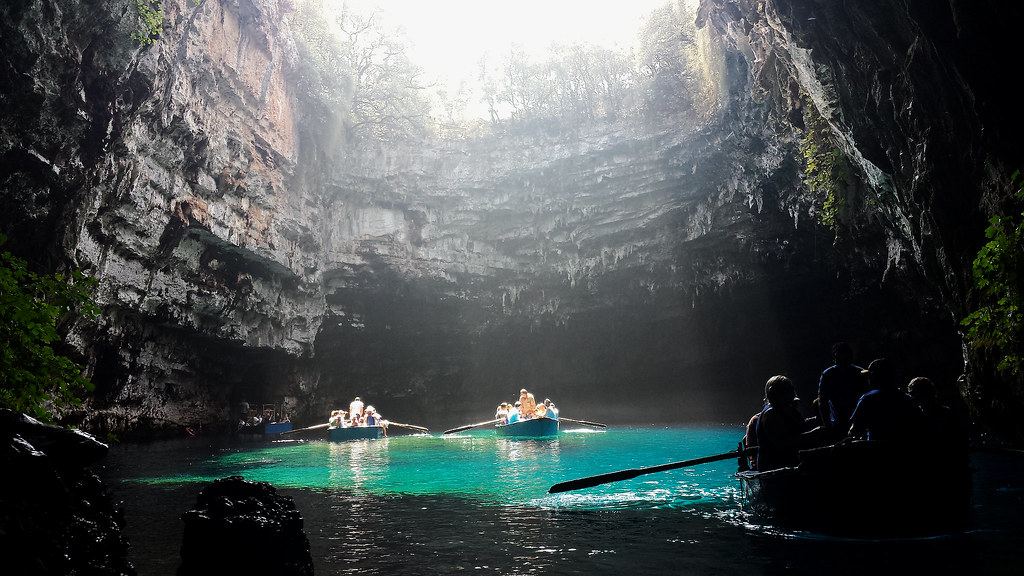
From the depths of time to the bowels of the earth, caves have been man's first temples — places of protection, worship, and discovery. Places unusually attractive and inaccessible to many "mass" visitors. The case of Kefalonia deserves further exploration of the issue of caves. There, in this blessed place where visitors can get lost among the verdant slopes of Ainos, the cosmopolitan beaches of Myrtos and Antisamos, its traditional villages, and the heavy shadows of its seismic history, there in this island place and beneath this colorful surface, a parallel universe, silent and dark, still remains largely unexplored.
When we talk about caves in Kefalonia, the names Melissani and Drogarati monopolize the public image. But the island is actually full of underground cavities, sinkholes, and caves, many of which remain almost unknown even to locals. This tribute attempts a dive beneath the surface — literally and metaphorically.
The island as a geological "puzzle"
Kefalonia is a geological "hell" – or paradise. The island is crossed by the most active tectonic zone in Europe, the so-called "Kefalonia Zone," where the Eurasian plate meets the African plate. Earthquakes, frequent and strong, have been sculpting the terrain for millions of years, creating a unique landscape: sinkholes, underground rivers, karst fields, and breathtaking caves. From 1953, when earthquakes destroyed everything, until today, the island continues to "breathe" from the depths. The existence of many sinkholes (such as those near Argostoli) demonstrates the dynamics of the island's geomorphology.
It's time for the unknown caves to become... KNOWN
Zervati Cave (Eleios - Pronnoi)One of the most impressive and little-known caves is Zervati, near Poros, where entire sections of the ground seem to have "collapsed" inwards, creating an inaccessible labyrinth. Few know that traces of ancient cult rituals have been found inside. Scientists believe that these caves are connected to the phenomenon of the Katavothres – where seawater penetrates the subsoil and ends up… where, exactly?
Why are the Katavothres a mystery?
The phenomenon of the Katavothres in Argostoli is perhaps the most famous, but at the same time the most misunderstood. Since the 19th century, scientists have been trying to explain why seawater "disappears" into the ground and reappears in springs near Sami. In 1963, geologists Zötl and Maurin proved with a colored tracer that there is an underground hydrological connection. This phenomenon feeds the island's underground lakes and caves, giving life to an entire underwater economy – and mythology.
Agia Sofia Cave, Lourdas
It was unofficially used as a refuge during wartime. Although small, it has a special acoustic, and local residents say that "you hear voices if you sit alone inside for a long time."
Agoulata Cave
Agoulata cave is located in the mountains of Sami and is considered one of the most difficult to access. It is formed within a small gorge, and its entrance is only possible with ropes. Rare forms of stalagmites have been recorded inside, while hydrological measurements showed the presence of clean underground water with specific characteristics: high magnesium content and a stable low temperature throughout the year.
Aggalaki Cave
Aggalaki cave, near Sami, is another hidden gem. It is located at an altitude of 50 meters and is characterized by impressive stalactite decoration and lakes with clear blue waters. It impresses with its blue waters and underground lakes.
Chiridoni Cave
In the village of Svoronata, Chiridoni cave hides a small wonder. With a length of approximately 100 meters and a depth of 40 meters, the cave is connected to another cave, Sotira, through an underground conduit 190 meters long. A unique species of grasshopper was also found there, wingless and with atrophied eyes – a living fossil of life in the dark. The grasshopper species Dolichopoda kefalonica, which exists nowhere else in the world. It lives in absolute darkness, has lost its sight, and feeds on organic residues. Similar rare species have also been found in the Aggalaki and Agia Eleousa caves.
Drogarati Cave
Concluding the record, we must mention the two most famous caves on the island. That of Drogarati and that of Melissani, which are visited by hordes of visitors annually. Drogarati Cave, near Sami, is a wonder of nature with a history of thousands of years. It was discovered accidentally after an earthquake and stands out for its magnificence, with impressive stalactites and stalagmites that create an almost theatrical setting. Thanks to its excellent acoustics, it occasionally hosts concerts, making it the island's unique natural "amphitheater."
Lake – Melissani Cave
Finally, Melissani cave is perhaps the most mythical of Kefalonia's caves. It is also located near Sami and includes an underground lake with crystal clear waters, which take on unique shades when the sun's rays pass through the cave's open ceiling. According to mythology, nymphs were worshipped here, which is why it is often called the "Cave of the Nymphs."
The underground world we don't see
The caves in Kefalonia were not only geological phenomena but also places of cultural significance. Many times they were used for religious reasons – such as the Agia Sofia cave, where according to legends there was a chapel inside the rock.
A large part of these caves is threatened by human intervention or abandonment. It is not uncommon for them to have been used as landfills. Underground Kefalonia is there, waiting for the brave. For those who are not content with the surface. For those who know that the true face of the island may lie somewhere between darkness and light, in the deep, cool subsoil that for centuries has composed nature's most peculiar maps. The question is not whether there is something down there… but whether we are ready to discover it.
Related Articles
Άσσος: ο οικισμός, το φρούριο και η εικόνα που άντεξε στον χρόνο
Πώς η μικρή Άσσος της βόρειας Κεφαλονιάς συγκεντρώνει σε έναν τόπο γεωγραφία, ενετική στρατηγική, μετασεισμική ανασυγκρότηση και σημερινή τουριστική απήχηση.
Η ναυτική ιστορία του νησιού πέρα από τα λιμάνια
Από το παράκτιο εμπόριο του Ιονίου έως τη Μαύρη Θάλασσα, τον Δούναβη και το Λονδίνο: πλοιοκτήτες, καπετάνιοι, ναυτικοί και οικογένειες που έδωσαν στο νησί διεθνή ναυτική παρουσία.
Κεφαλονιά: Μικρές ιστορίες πίσω από γνωστά σημεία του νησιού
Από τη Γέφυρα Δεβοσέτου και τις Καταβόθρες μέχρι τη Μελισσάνη, την Άσσο και το Φισκάρδο: μικρές ιστορίες που εξηγούν την Κεφαλονιά πίσω από τις γνωστές της εικόνες.