The Language of Everyday Life: The Cephalonian Dialect as a Historical Trace
The Cephalonian dialect was shaped by everyday use and followed the way of life on the island, under conditions where communication had to be immediate, clear, and commonly understood. The words that prevailed were not connected with abstract concepts or self-identification needs, but with actions that were repeated daily, with roles that had to be recognized without explanations, and with situations that required quick and accurate descriptions. This language was born and evolved where there was continuous contact between people – at home, at work, in the neighborhood, and in transactions. For this reason, its vocabulary remains closely tied to the practice and function of everyday life.
Kefalonia's historical course directly influenced the way professional roles and processes were named, especially in areas related to administration, property management, and dispute resolution. The need for clear terms, immediately understood by everyone, led to the use of words like "avoukátos" for lawyer, a word fully integrated into everyday speech and used to denote the person one turned to when they had a case to settle, a contract to sign, or an issue to resolve. This word did not function as a formal title but as a practical term, connected with specific actions and experiences. Similarly, the word "atsinténte" was used to describe an unexpected event that occurred and needed to be reported, from a small everyday incident to something more serious, allowing for the quick transmission of information without further clarification.
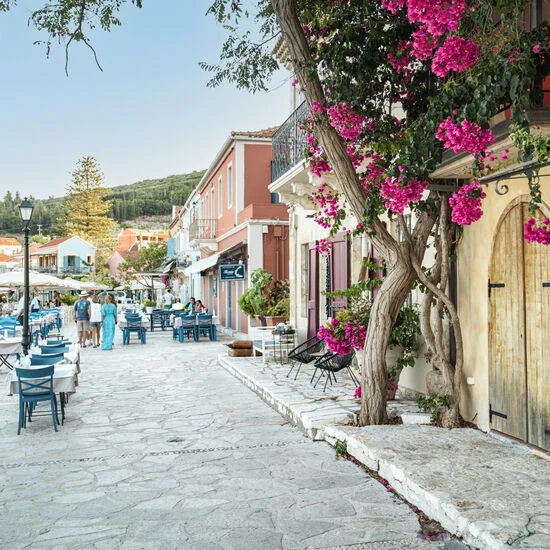
The form of Cephalonian settlements was clearly imprinted in the language. The word "kantoúni" describes the narrow street within the settlement, the space where people moved, met, exchanged conversations and information, and lived their daily lives in public view. The use of this word was not merely about naming a street, but incorporated the experience of the space, as it was shaped by dense construction and continuous social contact. In the same context are words that denote presence and readiness, such as "apíkou," which was used to indicate that someone was in their place and could respond immediately, signifying not just physical presence but active participation in the daily functioning of the community. "Avánti," as a call for an action or process to proceed, expressed movement and decision at times when something needed to start or continue.
The internal organization of the home and workplace is also reflected in the idiomatic vocabulary. "Katzélo," as a term for a shelf or drawer, shows that objects had a defined place and that order and functionality were part of daily life. The word was used without explanation because everyone knew its meaning and use. In the area of production and trade, the precision of the language becomes even more apparent through words such as "kantári," which was associated with the process of weighing and transactions, and "kintinári," which denoted a specific quantity of tied garlic and functioned as a practical unit of measurement. Through such words, an entire way of organizing agricultural production and trade is depicted, based on experience and repetition.
The Cephalonian dialect also records sensory changes in an immediate and understandable way. When they said that the weather or the voice "kiárine," the word described the change without requiring further analysis. Similarly, words like "kapakízo" and "kaniázo" depict ways of speaking and bodily experiences associated with intense oral communication, describing familiar and recurring situations in everyday life.
From the entirety of this vocabulary, an image of daily life organized around practical needs and common experiences emerges. Words function as tools for communication and recording life as it evolved over time, allowing one to discern how settlements were organized, how transactions were regulated, and how repeated everyday experiences were expressed. Language followed life and captured its function in a stable and continuous manner.
Orality was a key element of Cephalonian society and largely determined how the dialect functioned. For long periods, daily communication relied almost exclusively on spoken language, which required words that were immediately understandable, easy to use, and adapted to the speed of conversation. Language had to function in real-time, under conditions of work, transaction, or social contact, without the luxury of explanation or rephrasing. This characteristic explains why many words in the Cephalonian dialect have dense meaning and a wide range of use, allowing different situations to be denoted by the same term, depending on the context.
The oral transmission of language also contributed to the formation of a collective linguistic memory, where words were preserved as long as they served needs and gradually withdrew when those needs changed. This process was not the result of conscious choice, but a natural consequence of daily use. Words associated with professions, practices, or forms of life that ceased to exist were limited without immediately disappearing from memory. They often remained recognizable even when not actively used, functioning as linguistic traces of an older way of life. This property of language, to retain traces of experience even after conditions change, gives particular value to the study of the dialect as a historical document.
The geographical and social stratification of Kefalonia contributed to the formation of internal differentiations in language use. The island was never an absolutely homogeneous entity, neither linguistically nor socially. Distances, terrain, and the relative isolation of certain areas created differences in speech patterns, pronunciation, and the frequency of use of specific words. Nevertheless, the basic core of the vocabulary remained common, allowing for mutual understanding and the cohesion of the linguistic community. These differentiations do not indicate fragmentation, but an adaptation of the language to local living conditions and the needs of its speakers.
The evolution of the Kefalonia dialect is directly linked to the changing social and economic structures of the island. The change in professions, the shift in production, the decline of the agricultural economy, and the strengthening of other forms of activity inevitably affected the vocabulary. Words associated with specific tasks or practices lost their usefulness when those practices were abandoned. Language adapted quietly, without abrupt breaks, following life as it changed. This process shows that the dialect does not function as a static system, but as a living mechanism that responds to the conditions of everyday life.
The gradual prevalence of standard Modern Greek, especially through education and mass media, accelerated this linguistic change. The Cephalonian dialect was largely confined to spoken language and specific social environments, but without disappearing. Many words continued to be used as they were or integrated into everyday speech, often without being consciously recognized as idiomatic. This phenomenon shows that linguistic influence is not only measured by the intensity of use, but also by its duration and penetration into common discourse.
The value of the Cephalonian dialect lies not in the multitude of words that can be recorded, but in the way these words illuminate the functioning of society. Through the vocabulary, one can discern how space was organized, how transactions were regulated, how unforeseen events were dealt with, and how relationships were formed in daily life. Language here functions as an imprint of practices and experiences, not as an abstract system.
Overall, the Cephalonian dialect creates a picture of life that evolved over time without being detached from its use. Words were not preserved for display, but because they served needs and were organically integrated into everyday life. Through them, a way of life based on practice, understanding, and common experience is depicted. Language does not need idealization to be highlighted. It is enough to read it carefully, as it is: a stable trace of the history of everyday life in Kefalonia.
Related Articles
Κεφαλονιά, γέφυρα της ναυτιλίας: Από το χθες της παράδοσης, στο αύριο των νέων ευκαιριών
Το Ίδρυμα Γεωργίου & Μάρης Βεργωτή και η Isalos.net διοργανώνουν ανοικτή συζήτηση για τη ναυτιλία, το Σάββατο 17 Οκτωβρίου, στις 19:00, στα Κουρκουμελάτα. Δωρεάν συμμετοχή.
«Βίωμα ελιάς... και άλλες περιπέτειες!»: παρουσιάσεις του βιβλίου του Τάκη Βασιλάτου σε Αργοστόλι και Ληξούρι
Οι Εκδόσεις Φυλάτος παρουσιάζουν το βιβλίο του Τάκη Βασιλάτου στο Αργοστόλι στις 24 Οκτωβρίου και στο Ληξούρι στις 25 Οκτωβρίου 2026, παρουσία του συγγραφέα.
Εορτασμός της αναστήλωσης του Παλαιού Καθολικού της Ιεράς Μονής Σισσίων
Το Ίδρυμα Γεωργίου & Μάρης Βεργωτή διοργανώνει στις 2 Οκτωβρίου εκδήλωση για την αναστήλωση του Παλαιού Καθολικού της Μονής Σισσίων. Εσπερινός στις 3 Οκτωβρίου.