Myrtos Beach Chapter: The Unbearable Fines, Its Management, and Future
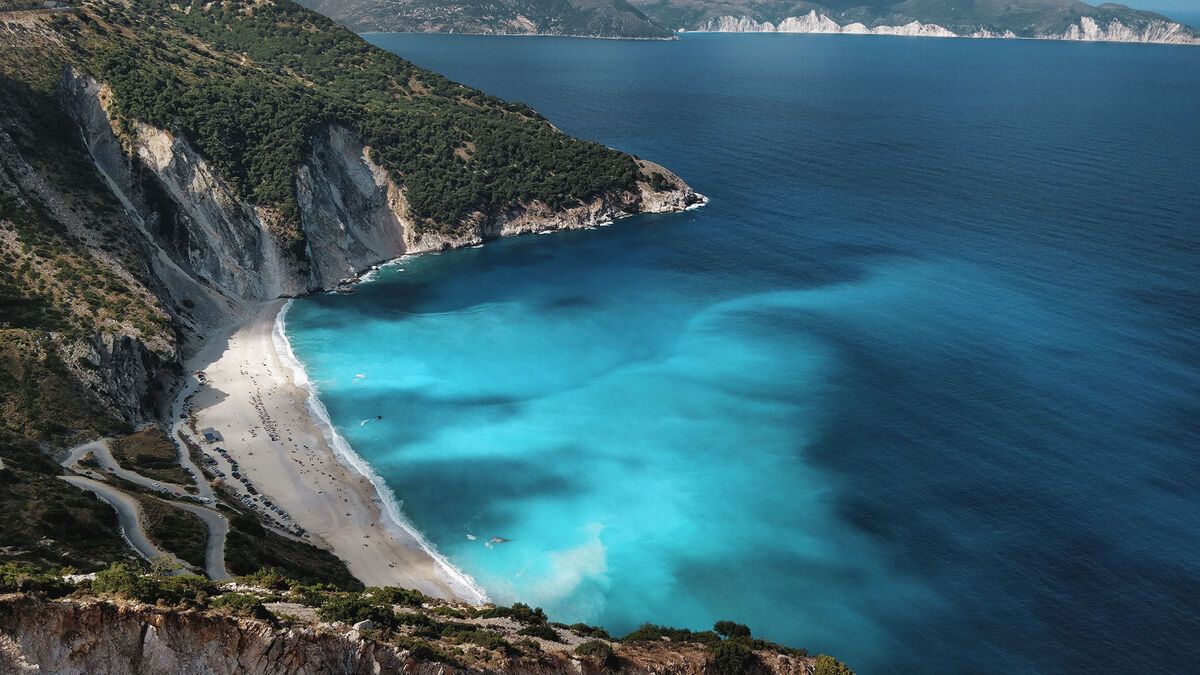
Myrtos Beach in Kefalonia is by far the most popular beach on the island and one of the most famous in all of Greece and the world. However, this summer, the island's pride made headlines not for its wild beauty but for the exorbitant fines imposed on the Municipality of Sami for it. Specifically, a fine of €1,565,672.00 was imposed on the Municipality by the Kefallinia Property Service, as well as a fine and sealing by the AADE of services (canteen - sunbeds) for not issuing receipts for umbrella rental services.
This fact, as expected, raises serious questions about the future of the beach and its management. In this context, the thekefalonianglobe.com report details the actions taken, the positions of the municipal authority and the opposition factions, as well as some important legal details, while also referring to the value of Myrtos Beach for the island.
The Chronology of the Case
This year, the law on the management and control of the seashore changed, thus the procedure that a municipality should follow if it wished to manage a part of the seashore or beach itself, instead of assigning it to a private entity, is also different. Regarding the change in the law, in early September 2024, the Deputy Mayor of Sami, Spyros Spathis, stated in a public address to a local radio station that “this year, an electronic tender was held for the concession of beaches. Myrtos Beach in Kefalonia has a special status and has been granted to the Municipality of Sami for the last 22 years. This year there were four conditions: A) The Municipality of Sami must guarantee that it will not rent this specific beach to private individuals. B) The Municipality itself must manage the coast. C) The concession concerned 2,000 square meters for 100,000 euros, and D) To authorize the Mayor to take all necessary actions, as was done by decision of the Municipal Council”.
However, the case of Myrtos Beach, according to Mr. Kavallieratos Giorgos, head of the major opposition in the Municipality of Sami, who spoke to thekefalonianglobe.com, began when, on April 8, 2024, his faction asked the Municipal Authority to convene a council to discuss tourist destinations. On April 19, a municipal council meeting was held where the situation of tourist areas, including Myrtos Beach, was analyzed. On April 26, the Kefallinia Property Service sent a document to the Municipality of Sami, outlining the procedures to be followed if the municipality decided to keep the beach under its management. After one month, on May 28, at the new municipal council meeting, it was decided by majority that the beach would remain under the responsibility of the municipality without being tendered to third parties, while the mayor was authorized to proceed with the required documents. In mid-June, the mayor submitted the relevant request to the Property Service, without receiving any answer, either positive or negative, as explained by the mayor of Sami himself, Mr. Panagis Drakoulongonas speaking to thekefalonianglobe.com. However, a few days later, the Property Service visited Myrtos Beach for an inspection and imposed a fine of €1,565,672.00 on the Municipality.
On September 11, a municipal council meeting was convened to discuss Myrtos Beach. It was unanimously decided to reconvene a municipal council meeting where all four mayors of Kefalonia and Ithaca (Michalatos, Katsivelis, Drakoulongonas, Stanitsas), the MP, the Regional Governor of the Ionian Islands Mr. Ioannis Trepeklis, and the Deputy Regional Governor of Kefalonia Mr. Eustathios - Sotirios Kouris would be present, along with citizens, in order to solidify the region's position and to form a delegation to travel to Athens. The mayor of Sami informed us that these procedures are underway to facilitate the meeting of all the aforementioned individuals.

Disagreements regarding the management of the issue
Mr. Kavallieratos attributes part of the responsibility for the imposition of the fine to the municipal authority, stating that “the mayor delayed greatly in executing this whole process, and at some point, we found ourselves without information that we didn’t get the beach. We were delayed by about two months, meaning from the moment the document arrived for us to take possession of the beach until we sent the request to keep it, two months intervened. Here the landscape is blurry. During this two-month period, deadlines were missed, resulting in an ambiguity when we went to the property service.” Regarding the fine, Mr. Kavallieratos even claims that the opposition was not immediately informed about the event.
For his part, Mr. Drakoulongonas responds and clarifies that even if the procedures had been completed earlier, the greater part of the fine could still not have been avoided. Specifically, he states that “the fine is divided into two parts. The fine regarding the placement of umbrellas and sunbeds for which umbrellas and sunbeds, we had requested space on June 17, and here the opposition argues that we should have requested it much earlier. However, for this part, in any case, the fine was 360,000 euros.
On the other hand, regarding the corridors leading to the canteen and the canteen floor for which we had never requested to be granted as a municipality, the amount imposed on us is 1,205,000 euros. Consequently, even if the procedures had been completed earlier, the fine we would have avoided would have been 360,000 euros.”
Indeed, regarding the amount of the fine, the mayor emphasizes that it is excessively large. Specifically, he states that “my position is that even if we say that it is correct to credit a fine, its amount is enormous. They treat us as if we are private individuals, while we are the municipality and we provide services not for profit but for service.”
The head of the Popular Rally of the Municipality of Sami, Mr. Nikos Athanasatos, on the other hand, denounces the wrong approach to the issue from the outset. “Our view was that from the beginning we should not have gone to rent the beach. That is, essentially, we would not accept the law. Myrtos beach is ours, it is an asset of the area,” said Mr. Athanasatos, while also expressing his concerns about the development of the case. “I am not at all optimistic. The legal framework does not favor us, and the mayor is making some moves on his own. We, as the Popular Rally, are mobilizing the popular factor,” Mr. Athanasatos underlines.
More specifically, Mr. Athanasatos wants to emphasize, in relation to the other factions regarding Myrtos Beach, as he states, is that “our difference is that we don't want the municipality to tax the people. It should be noted that the municipality had an umbrella with two sunbeds for 15 euros and an additional 5 euros per person. So, one of our main differences is that we don't want the municipality to have it and tax the people. We want free beaches for the people or at least a symbolic amount to cover expenses. Essentially, we want free and clean beaches.”

What the future holds
According to the mayor of Sami, the process is underway to form the council with the presence of all local bodies and elected politicians to reach a common political decision. Furthermore, the mayor stressed that “discussions have been held with Athens, and various solutions are being considered. The issue is ongoing.” In fact, as the mayor informs us, a few days ago at the third pre-conference dialogue meeting of KEDE held in Messolonghi, the island's position was adopted, namely to abolish the fine and hand over the management of Myrtos to the municipality. “They fully support us,” the mayor conveyed, wanting to express his optimism. Beyond that, there is still a deadline for filing an objection regarding the fine imposed, which the municipal authority will request, according to the mayor.
For his part, Mr. Kavallieratos emphasizes that it is the mayor's duty to elevate the issue high on the agenda and act collectively, not individually. “Personally, I believe that there are no personal politics on this issue. This issue must be high on the agenda of both society and local politicians.” Furthermore, Mr. Kavallieratos stresses the necessity of cooperation among all relevant bodies and the participation of citizens, as Myrtos Beach has unique cultural and economic value for the area. In fact, as he emphasizes, the consequences of privatizing the beach would be serious, and its preservation under the responsibility of the municipality is crucial for the local community and tourism in Kefalonia.
In any case, the message that the mayor of Sami wants to send is that “we will certainly fight and are optimistic that the fine will not remain at its current amount. However, what mainly concerns us and what we are fighting for is that we want Myrtos to remain under the management of the municipality. We cannot accept that the management of the beach will be held by anyone other than the municipality. In this, I agree with the opposition and endorse what the head of the minority said that Myrtos for our municipality is what the Acropolis is for Athens. We are interested in the public character of the beach. The fine is 1% of what concerns us; the remaining 99% is for Myrtos to remain under the management of the municipality of Sami, to have a public character.”
The issue of responsibilities and the role of the State
Into the equation of the two already known fines, Mr. Nikos Athanasatos introduces the scenario of a third fine from a family of tourists who were vacationing on the island last summer, and while at Myrtos Beach, a stone fell from the mountain and injured the husband, who was hospitalized in Rio. The family, according to Mr. Athanasatos, is asking for 300,000 euros.
On the occasion of this case, Mr. Athanasatos raises another issue that requires attention, according to him, that of managing demanding issues by a small municipality, such as the Municipality of Sami. Specifically, he states that “this is a small municipality which, as you know, is severely constrained, so it cannot guarantee safety. On Myrtos Beach, stones even fall on cars. The management of this situation should be undertaken by the Ministry of Infrastructure, as the technical services of the Municipality of Sami are meager. If I were mayor, I would have reported to the government that the municipality cannot undertake such responsibilities as we cannot respond.”
What the new law changed regarding beach concessions
The new law 5092/2024 on the exploitation of public property in coastal areas addresses important issues related to the concession of shorelines, such as their demarcation, the tenders for their concession, the obligations of concessionaires, and the handling of violations.
Aiming for greater transparency in concession tenders through a centralized electronic process and higher effectiveness of controls through the use of modern technology, combined with stricter penalties, it attempts to address chronic pathologies. On the other hand, however, it has provoked strong criticism from environmental organizations, mainly regarding the demarcation of the seashore.
The new law establishes rules for environmental protection, ensuring public access to beaches, upgrading the tourism product, and safeguarding public interest.
The 7 most important changes established by the new law, as recorded by the Ministry of Finance, are as follows:
- A transparent electronic procedure is established for the auctioning of beaches
Starting in 2024, all auctions for the concession of parts of the seashore and beach will be conducted by the Property Service and not by the Municipalities. The process will be digital through an electronic platform that guarantees transparency and excludes any interventions. The tender announcement will be posted on the platform and on the website of the respective municipality at least twenty days before the date of the auction. The platform will display the data (coordinates, polygon, and aerial photographs) of each concession, its duration, the terms of the concession, and the time for placing and removing movable items.
Concessionaires will pay a minimum fee, which is derived from a mathematical formula based on the objective values of the area, a weighting factor for the activity, and a weighting factor for the seashore depending on the specific characteristics of the beach.
The auctions to be held in 2024, during the first implementation of the law, will be completed by May 15. From 2025 onwards, procedures will be completed by March 31.
- “Untouched beaches” are established
High-protection shorelines and beaches ("untouched beaches") located in Natura areas are established for which concession is prohibited and, by extension, the placement of umbrellas, sunbeds, etc. Untouched beaches will be determined by a joint decision of the Ministers of National Economy and Finance and Environment and Energy after a recommendation from OFYPEKA and a proposal from the head of the General Directorate of Environmental Policy.
- Stricter rules are established for beach management to ensure free public access
On beaches that will be granted for exploitation, limits are set to ensure public passage and adequate free spaces. Specifically, at least 50% of the beach must remain free, and at the same time, the area of each concession cannot exceed 500 square meters. Umbrella seats can occupy up to 60% of the granted area or 30% for beaches located in Natura areas not designated as untouched. There must be a distance of at least 6 meters between concessions (3 meters on each side, or 4 meters for businesses operating in adjacent buildings) and umbrella seats must be at least 4 meters from the sea.
Also, the concession of seashore and beach is not allowed when their length or width is less than 4 meters or when the total area of the seashore is less than 150 sq.m.
- Very strict obligations are introduced for those who lease beaches
Nine specific obligations are established in all cases, which are provided for by law but will also be included in the concession agreement. Specifically, the concessionaire:
- Ensures free, unhindered, and safe passage for the public to the seashore and beach.
- Ensures the use of the seashore and beach for people with disabilities on the shorelines and beaches that will be designated by - Ministerial Decision, by installing special platforms for their service, if not already installed by the Municipality,
- Limits the development of umbrellas, sunbeds, and marine recreational equipment and other movable elements according to the limits set by the bill (60% of the granted area or 30% if it is a protected coastline and beach) and maintains a free zone of at least four meters wide from the coastline.
- Keeps the granted part of the seashore and beach clean daily.
- Posts a sign in a conspicuous spot on the seashore or beach, which allows the public to access, in an electronic way, the identifying elements of the concession, such as coordinates, the number of the concession decision, the rights and obligations of the public and the concessionaire, and the concession diagram.
- Places movable elements for public service.
- Ensures the preservation of the ecosystem's balance and the coastline's morphology
- Returns the conceded area to its original condition after the concession period ends and removes movable items during the periods specified in the concession agreement.
- Ensures the presence of a lifeguard, if this obligation is not covered by the local municipality.
- The role of citizens in protecting beaches from arbitrary constructions is enshrined.
A digital application for mobile phones, tablets, etc., will be created and made available free of charge to citizens. Each concession will correspond to a QR code, which will be posted on the website of the Public Property Service, on the website of the respective municipality, and on the signage board of the seashore or beach, which is mandatory to be placed at the location. Through the same application, citizens will be able to view the diagram of the part of the seashore and beach that has been conceded and can immediately submit a complaint if they observe arbitrary occupation or exceeding the concession limits.
- New technologies (drones, satellites) are utilized for more effective state controls
The new law provides that new technologies (drones, satellites) will be utilized to make beach controls by the state more effective. At the same time, a comprehensive control mechanism is being created, with mixed control teams, consisting of executives from the Ministry of National Economy and Finance, the Property Service, the municipality, AADE, the Financial Police, the Hellenic Police, and the prosecutorial authorities, while mixed teams are also provided for.
- Stricter penalties are imposed on those who act arbitrarily and violate beach management rules
Penalties are scaled according to the severity of the violation and particularly whether there is a contract and the concessionaire has exceeded the concession or not, in which case it is an arbitrary occupation. In any case, umbrellas and sunbeds are removed, and if there are illegal structures, they are demolished.
In cases of arbitrary occupation, sealing and cessation of operation of the business in the occupied area are imposed, the area is sealed with tape, and entry is prohibited, as is any economic activity therein. A fine equal to four times the minimum auction price is imposed, and the offender is excluded from any seashore and beach concession process for five years.
If the concession has been exceeded, penalties range from fines to prohibition of participation in auctions and suspension of business operations. With the changes introduced in Parliament, the framework is further tightened as the most serious sanctions (exclusion from new concessions and suspension of operations) are imposed when the excess is greater than 30% of the concession (instead of 50% initially provided).
For the first time, fines are introduced for obstructing free public access to the sea, the seashore, and the beach, ranging from 2,000 to 60,000 euros. Criminal penalties are also provided for anyone who causes any change to the seashore or beach without permission or exceeding it, or with permission issued illegally.
In summary, Myrtos Beach is facing serious problems, as its high fines and uncertain management raise questions about its future. At this critical juncture, political initiative, unanimity, and solidarity are required from the involved stakeholders and the island's community. The future of the beach now depends on the ability of the involved parties to reach an understanding and effectively manage this crisis.
Related Articles
Με θλίψη ανακοινώνεται ο θάνατος της εκπαιδευτικού Ράνιας Φραγκισκάτου
Ο Σύλλογος Εκπαιδευτικών Π.Ε. Κεφαλονιάς – Ιθάκης ανακοινώνει με βαθιά θλίψη τον θάνατο της Ράνιας Φραγκισκάτου, επί σειρά ετών διευθύντριας στο Ειδικό Σχολείο.
Συλλυπητήρια ανακοίνωση του Ιδρύματος Γεωργίου και Μάρης Βεργωτή για την απώλεια του Νικόλαου Σ. Βεργωτή
Το Διοικητικό Συμβούλιο του Ιδρύματος Γεωργίου και Μάρης Βεργωτή εκφράζει θερμά συλλυπητήρια στον Πρόεδρο, κ. Γεράσιμο Ν. Βεργωτή, και την οικογένειά του για την απώλεια του πατέρα του, Νικόλαου Σ. Βεργωτή.
Τα καλοκαιρινά πανηγύρια ως ζωντανό κομμάτι της τοπικής κοινωνίας
Η κοινωνική λειτουργία ενός θεσμού που επιβιώνει πέρα από τον τουρισμό και την εποχικότητα.