Water in Kefalonia: a problem of quality, infrastructure, and funding
Water quality, salinization, vulnerable infrastructure, and water supply funding in Kefalonia: the available data and the questions that remain open.
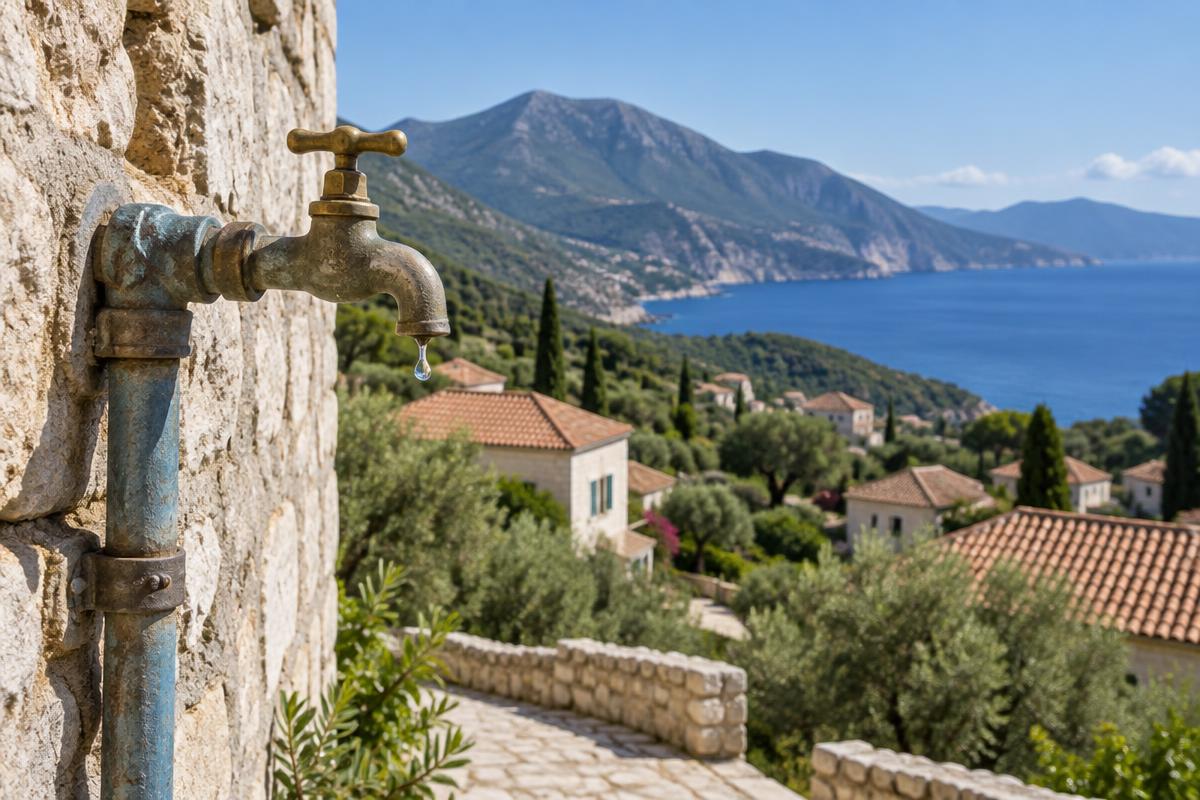
Kefalonia is located in one of the rainiest parts of the country, yet every summer its villages remain without water for days. The summer of 2026 was no exception. After the fire in Pastra, settlements in southern Kefalonia were left without electricity and water for over 48 hours. In September, residents in Faraklata reported nearly a week without normal water supply. During the same period, the Intermunicipal Water Supply and Sewerage Company announced successive interruptions, from Lakithra to Eleios.
The issue is usually described as "water scarcity." However, the term only explains part of the problem. Available data show that Kefalonia does not primarily face a lack of water, but a lack of suitable water, vulnerable infrastructure, and a funding system that has not yet included it in the most recent interventions. How did we get here, and what questions remain open?
Where does the island's water come from?
Kefalonia is mainly supplied by groundwater. According to DIAD.E.Y.A. of the Municipalities of Kefalonia, the water supply for the entire island requires approximately 6,000,000 cubic meters of water per year. The main sources are 80 boreholes and the desalination units of Argostoli and Fiskardo. The water is stored in 125 reservoirs, from where it is distributed to the settlements.
This system is extremely dispersed. In a Kathimerini report in 2018, the then head of the company described an island where almost every village has its own borehole. This dispersion has advantages, but it also means that a malfunction in a pump or a power outage in a pumping station can leave an entire settlement without an alternative supply.
The official data of the company for the network date from 2023. No published, updated data were found for monthly consumption or for the difference in demand between winter and the tourist season.
Quality, not just quantity: salinization
To understand Kefalonia's problem, quantity must be separated from quality. In 2018, the then Director of Water of the Ionian Islands in the Decentralized Administration, Michael Lagkadas, estimated that the island's problem mainly concerns the quality of groundwater. As he stated, the main groundwater bodies show intense salinization. As causes, the same report cited the geological substratum, overpumping, and incorrect choices of the past.
Salinization occurs when seawater infiltrates coastal aquifers, usually when pumping exceeds their natural replenishment. The result is water that can be used for other needs, but not for drinking. According to the then head of DEYA, only a few of the island's boreholes provided potable water; in the other areas, residents used network water but did not drink it.
The current official position of the company is that network water is potable, of very good microbiological and chemical quality, with moderate to high hardness due to hydrogeological conditions. The discrepancy between the two images is not explained by the published data. Has the situation improved throughout the island or only in the areas served by desalination? This question remains open.
The distinction has practical significance. If the problem were only quantitative, the solution would be new boreholes. However, when the problem is quality, more pumping can exacerbate salinization. This explains why desalination became a central tool of water policy on the island.
The Argostoli desalination plant: solution and cost
The Argostoli desalination unit has been operating since March 22, 2019. It processes brackish water using reverse osmosis technology and has a capacity of 8,000 cubic meters per day. Before this, two smaller units operated on the island in Fiskardo, which in 2018 worked simultaneously only in July and August.
The project was accompanied by a choice worth noting. Before installation, the municipality gradually replaced approximately 22 kilometers of the city's network. The then deputy mayor responsible explained that the old network, made of asbestos pipes, had losses of 65–70%. Without this replacement, a large part of the water produced at high cost would be lost underground.
Desalination solves the quality problem but shifts the burden to operating costs, mainly energy. In March 2026, the opposition faction "Popular Rally of Argostoli" denounced the assignment of the operation and maintenance of the unit and domestic water meters for five years for 3,279,800 euros plus VAT. The faction argued that the cost would be passed on to consumers' bills. This position expresses political criticism and not an official assessment; however, it highlights a question that concerns every island investing in desalination: who pays for its operation after construction?
Reports on the construction cost of the project vary significantly depending on the source and the phase of the project. For this reason, no single amount is presented here.
Vulnerable network: fire, malfunctions, information
The summer of 2026 showed that water in Kefalonia directly depends on the electricity grid. The fire that broke out on the evening of August 1st in the Pastra area destroyed poles and cables. Without electricity, the pumping stations could not operate normally. Katelios, Ratzakli, Markopoulo, Pastra, Kremmydi, and Skala were left without electricity and water for over 48 hours, at the peak of the tourist season.
The incident was not merely a consequence of the fire. It highlighted a structural dependence: a system based on boreholes and pumps has no water when there is no electricity. This connection directly concerns fire protection, as the same areas need water precisely when the network is most vulnerable.
The problems were not limited to the fire-affected areas. In Faraklata, residents reported in September nearly a week without normal water supply. Their central demand was not only the repair of the malfunction but official information on when water would return. Similar protests had been recorded earlier. In 2024, settlements in Sami were left without water for four days due to a malfunction in the central borehole, without a clear restoration timetable.
In the areas mainly covered by the newspaper, the company's announcements for autumn 2026 include water supply interruptions in Lakithra in early September and in Eleios on September 18th. These announcements are not enough to form a picture of the frequency of malfunctions per area. Such data were not found published.
Funding: where Kefalonia stands
Water scarcity has become a central priority of government policy for the islands. On June 24, 2026, the Ministry of Environment and Energy signed the inclusion of ten projects in nine island municipalities, totaling over 15 million euros. The projects concern leak reduction, new networks, and desalination units.
From the Ionian Islands, only Zakynthos was included in the list, with a potable water treatment unit. Kefalonia is not included. This absence does not necessarily mean that it did not submit a request; however, it means that it was not among the beneficiaries of this specific decision.
The Ministry subsequently announced a new call for water supply projects amounting to up to 65 million euros, with a deadline for submitting requests from municipalities and DEYA on Friday, September 11, 2026. It was also announced that separate calls would follow for islands with more than 3,500 inhabitants and for mountainous areas. Kefalonia meets the population criterion.
In June 2026, the Vice President of the Regulatory Authority for Waste, Energy, and Water (RAAEW), Dimitris Psychogios, visited Argostoli. The meeting was attended by representatives of all three municipalities of the island and the administration of DIAD.E.Y.A. The municipalities submitted proposals and requests, but their content was not made public. It is not known whether these proposals were converted into funding requests.
The open questions
The public discussion about water in Kefalonia mainly takes place in the context of crises: a fire, a malfunction, a village without water. The data that would allow a calm assessment are either not published or are outdated. This lack itself is part of the problem.
What are the network losses outside Argostoli today? How much does consumption increase during the summer months, and what part of this increase is due to tourism and short-term rentals? What is the condition of the aquifers regarding salinization? Did Kefalonia submit a request in the September call, and if so, for which projects?
There is also the issue of energy autonomy. If water stops when electricity stops, what plans are there for backup power supply for critical pumping stations? Finally, irrigation, which was also raised at the meeting with RAAEW, constitutes a separate chapter with direct importance for the island's small producers.
Conclusion
Kefalonia is not an arid island that simply does not have enough water. It is an island where the available groundwater has deteriorated in quality, where the desalination solution has high operating costs, and where a dispersed network of pumps depends on an equally vulnerable electricity grid.
The case of Argostoli shows that the order of interventions matters: first, reducing losses, then producing new water. The question is whether the same logic can be applied to the rest of the island, and with what funding, when the most recent state inclusions do not include Kefalonia.
The answer depends less on rain and more on planning. And planning requires public data, which are currently missing.
Sources
- DIAD.E.Y.A. of the Municipalities of Kefalonia – Water Supply
- DIAD.E.Y.A. of the Municipalities of Kefalonia – Water Quality
- DIAD.E.Y.A. of the Municipalities of Kefalonia – Announcements
- Kathimerini, republished eKefalonia (2018)
- Mesogeos S.A. – Argostoli Desalination
- Kefalonia Magazine – Desalination plant start date
- Kefalonia Press – Popular Rally Announcement (27/03/2026)
- Dimokratia – Fire-affected areas without electricity and water
- The Press Project – Pumping stations after the fire
- Kefalonia Press – Faraklata
- Kefalonia Life – Sami (2024)
- Kefalonia Magazine – RAAEW visit (18/06/2026)
- YPEN – 10 projects in 9 island municipalities (24/06/2026)
- Reporter.gr – YPEN Call for 65 million
Related Articles
Άλλη μια δημόσια δομή κλείνει στο Ληξούρι και η Δημοτική Αρχή Κατσιβέλη απλά παρακολουθεί!
Η Λαϊκή Συσπείρωση στον Δήμο Ληξουρίου καταγγέλλει το οριστικό κλείσιμο του Γραφείου Εξυπηρέτησης Φορολογουμένων και ζητά να αποτραπεί η απομάκρυνση ακόμη μιας κρίσιμης δημόσιας δομής από την Παλική.
Βαλλιάνειο ΓΕΛ Κεραμειών: Πρόσκληση στην εκδήλωση αποφοίτησης 2025-2026
Η τελετή αποφοίτησης του Βαλλιανείου ΓΕΛ Κεραμειών θα πραγματοποιηθεί την Πέμπτη 25 Ιουνίου 2026, στις 20:00, στο Λυκιαρδοπούλειο Θέατρο Κεραμειών.
Ο Εμίρης, το Φάντασμα και η Μαργαρίτα: Η Θεατρική Ομάδα του ΓΕΛ Κεραμειών στο Λυκιαρδοπούλειο
Σάββατο 20 Ιουνίου 2026, 20:30, στο Λυκιαρδοπούλειο Θέατρο Κεραμειών. Τρία κωμικά μονόπρακτα από τη Θεατρική Ομάδα του Βαλλιανείου Γενικού Λυκείου Κεραμειών. Είσοδος ελεύθερη.