The Play "The Gods of Ainos" by the Vallianeio Lyceum of Keramies
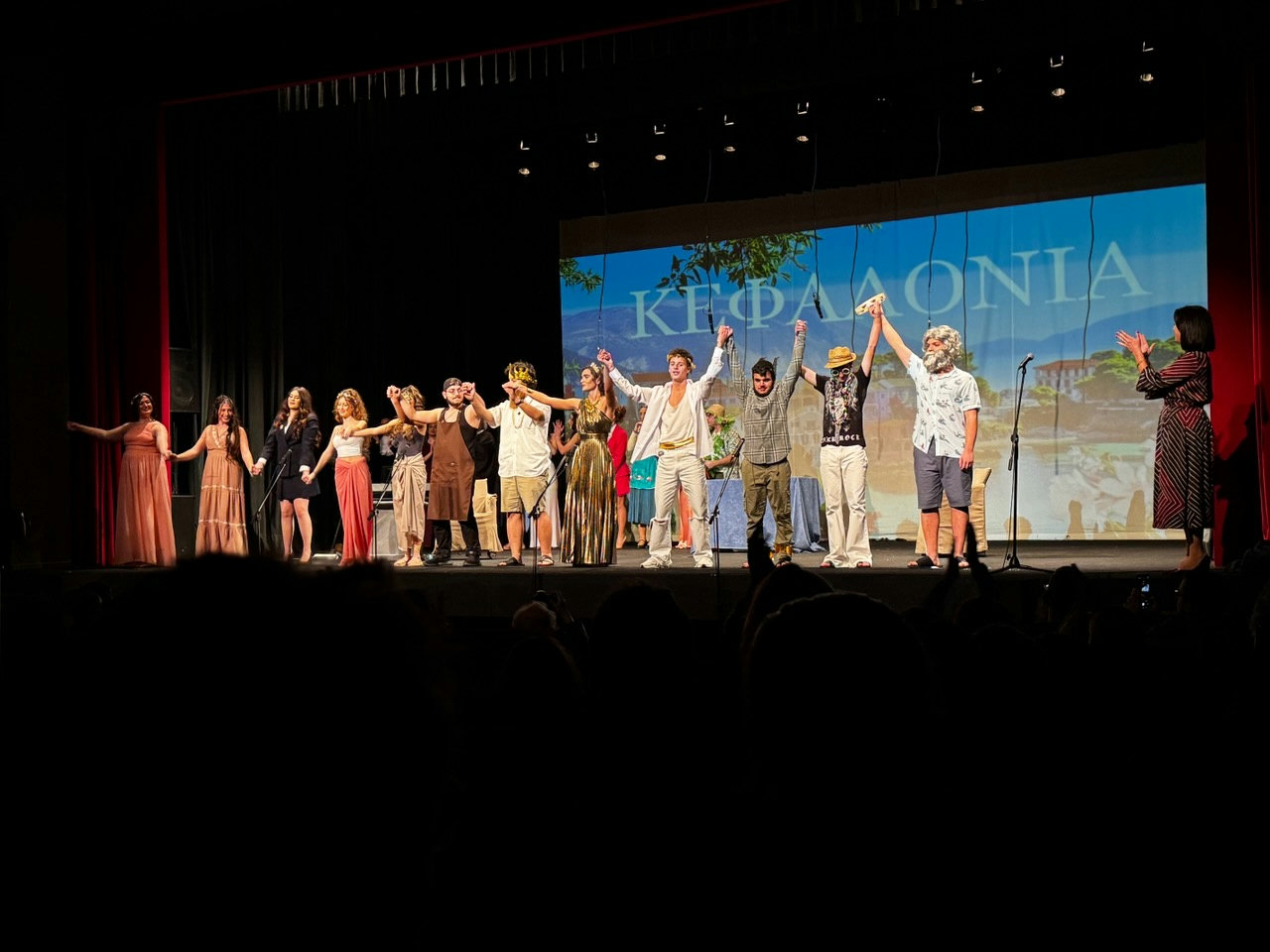
The play "The Gods of Ainos" was presented by the theatrical and musical group of the Vallianeio Lyceum of Keramies at the Municipal Theater "O Kefalos" in Argostoli, on January 28 and 29, 2026. It is a school comedy with musical parts, written and directed by Ilias Toumasatos, which uses the world of mythology as a starting point and transfers the action to Kefalonia, with Ainos becoming the reference point of a story where the gods, instead of staying in their "own" space, find themselves for a while in a reality that has local characteristics, local reactions, and a way of commenting on things as we comment on them here.
We watched the performance and were amazed by the result. It was excellent and we say it in the simplest way, as we felt it in the hall, because the evening had cohesion and kept the audience's attention from beginning to end, while the performances of the students were very good and gave the story a clear flow. There was no sense of a "typical" school performance that is done just to be done, but of a team effort that had been organized and presented with care, with scenes succeeding each other without losing the thread, with changes that did not break the evening and with an energy that remained constant.
Comedy, especially when it also has singing, requires a common measure in the image and in time, because otherwise the story breaks into pieces. Here, the feeling was that the performance moved step-by-step, without the viewer having to "gather" what was happening by himself, and this was also evident from the reaction of the hall, from the fact that people were watching, waiting for developments, laughing at the points where the story opened up space for laughter and returning to the flow without losing their concentration.
The students, throughout the play, were on stage with a clear presence and with audible dialogues, which is always essential when a performance relies on speech, fast transitions and comic situations. The nice thing about a school group is when it seems that the result is not the affair of one or two children, but of a collective effort, and this is exactly what came out here, with the roles fitting into the story, with the reactions coming when they should and with the image showing a team, not in the sense of a "technical achievement", but in the sense that all these had been worked on together and had been presented as a unified whole.
The musical parts were present throughout the evening and did not seem like something independent that is simply inserted to be heard. There was a continuity from scene to scene and the songs gave a change of pace without taking us out of the story. In such performances, this is important, because when the song "cuts off" abruptly, the viewer feels that he is watching two different things, while when it stays within the spirit of the story, the evening flows more naturally, and here there was this feeling.
One of the most characteristic elements of the performance was the humor and the way it was connected with the Kefalonian culture and dialect. The dialect did not appear as a typical "local color" to simply remind us where we are, but was present in the way the roles spoke, in the expressions, in the rhythms of the dialogues, in that familiar Kefalonian turn that makes a conversation sound different. This gave the story a familiar tone, without needing to be said or explained, because people recognized it immediately, and this was heard in the laughter in the hall, which came as a reaction to situations and not as an obligatory "applause" for a line.
Humor, when based on situations, lasts longer and is not exhausted in isolated points. Here, the feeling was that the story generates its humor, as the mythological characters come into contact with a place that has its own idiosyncrasy, with people who respond in the way Kefalonians respond, with an everyday life that is not easily impressed, and so the play progressed with scenes that left room for something comical to happen, without relying on a series of "clever" phrases that simply pass and are lost.
The Kefalonian dialect, when it goes on stage, has a peculiarity, because it is very direct and very recognizable, and can easily either distract from the story or become part of the story. In the performance we saw, it was present as part of the narrative, as a way of telling the scenes, and this helped to maintain a stable relationship between the stage and the audience, because you heard something that is close to you, but in a theatrical context, with rhythm, with alternations, with characters and with a musical element. This, in a hall like "Kefalos", makes the evening have a specific pulse, a feeling that the audience is not just a spectator, but participates with its reaction.
What we kept saying after the performance was very simple. That the children gave something very good, that the performances were very good and that the humor worked, mainly because it had local language and a local perspective. And this is what is worth writing clearly, without making it a critique, because it is not a matter of grading a performance, but of recording an evening that achieved its purpose and left the audience with the feeling that it was worth being in the theater.
It is also important, in such cases, to make it clear that behind a school theatrical production there is time, rehearsals and understanding, things that are not always visible, but one understands them when the whole progresses without "gaps" and when a group can maintain an evening without losing cohesion. The performance had many characters, had changes, had music, had local speech, and all these require common preparation to be presented in a theater in front of an audience.
The audience at the Municipal Theater "O Kefalos" was present in a way that resembled a normal theatrical evening, with attention and reaction, which helps the students themselves feel that they are in a real stage situation, not in a "classroom". On these two dates, the performance had the mood of an event that is being discussed, not because something has to be said, but because people went out, saw, laughed, went home and mentioned it the next day as happens when an evening has left an impression.
The play "The Gods of Ainos" was presented as a school comedy with musical parts at the Municipal Theater "O Kefalos", written and directed by Ilias Toumasatos, and was watched by an audience that filled the hall and followed the flow of the story. The students participated in all the roles of the performance, both in the theatrical and musical parts, in a work based on collective preparation and stage presence. The performance was an excellent effort by the children and the director Ilias Toumasatos, who worked as a team and presented a result that won over the audience, while the humor utilized the Kefalonian culture and dialect, elements that were present throughout and contributed to the overall image of the evening.
Related Articles
Κεφαλονιά, γέφυρα της ναυτιλίας: Από το χθες της παράδοσης, στο αύριο των νέων ευκαιριών
Το Ίδρυμα Γεωργίου & Μάρης Βεργωτή και η Isalos.net διοργανώνουν ανοικτή συζήτηση για τη ναυτιλία, το Σάββατο 17 Οκτωβρίου, στις 19:00, στα Κουρκουμελάτα. Δωρεάν συμμετοχή.
«Βίωμα ελιάς... και άλλες περιπέτειες!»: παρουσιάσεις του βιβλίου του Τάκη Βασιλάτου σε Αργοστόλι και Ληξούρι
Οι Εκδόσεις Φυλάτος παρουσιάζουν το βιβλίο του Τάκη Βασιλάτου στο Αργοστόλι στις 24 Οκτωβρίου και στο Ληξούρι στις 25 Οκτωβρίου 2026, παρουσία του συγγραφέα.
Το νερό στην Κεφαλονιά: πρόβλημα ποιότητας, υποδομών και χρηματοδότησης
Η ποιότητα του νερού, η υφαλμύριση, οι ευάλωτες υποδομές και η χρηματοδότηση της ύδρευσης στην Κεφαλονιά: τα διαθέσιμα στοιχεία και τα ερωτήματα που παραμένουν ανοιχτά.