Access to Healthcare in Kefalonia: A System Under Strain
Doctor shortages, rural distances, and seasonal population surges are putting severe pressure on healthcare in Kefalonia.
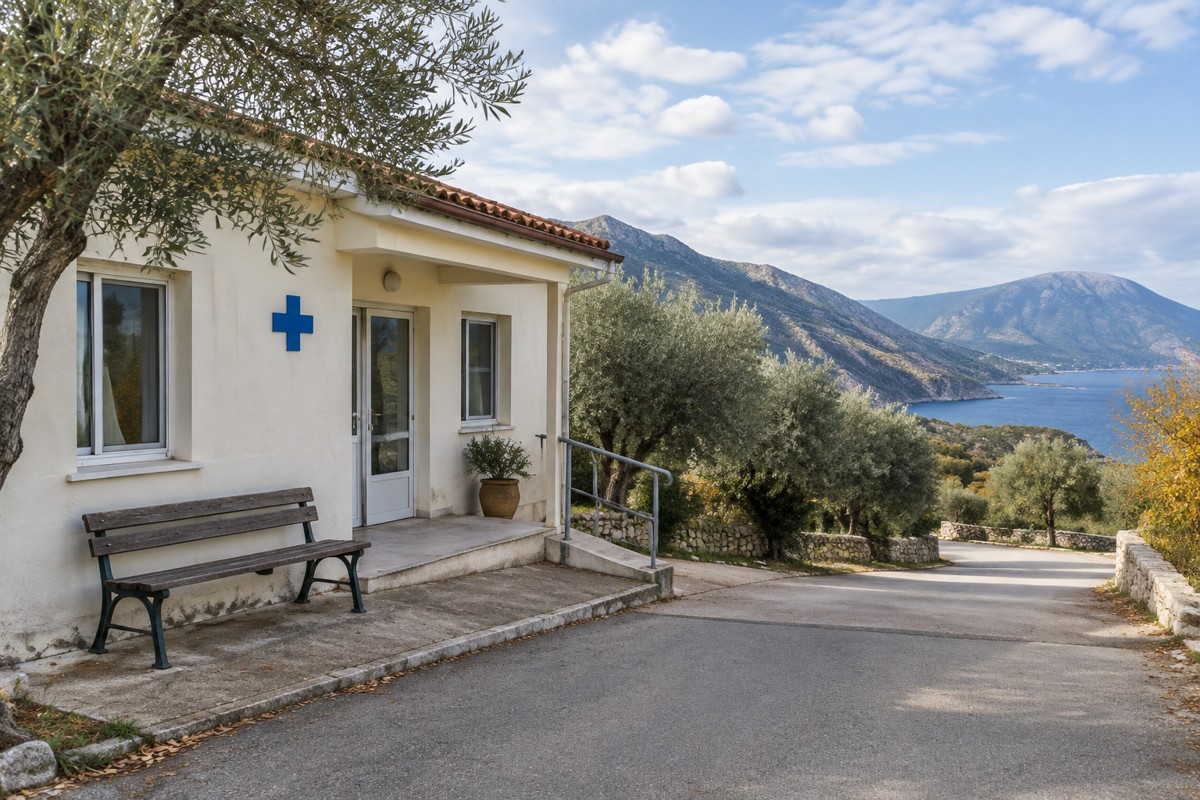
For a permanent resident of Kefalonia, access to healthcare does not depend merely on the presence of a hospital. It depends on whether a doctor of the appropriate specialty is available, how far their village is from Argostoli, and whether a severe case can be treated on the island or requires an emergency medical evacuation.
In 2026, the issue resurfaced with renewed intensity. Staff at the Argostoli General Hospital reported severe personnel shortages, in the Poros area the lack of a resident doctor was reported for yet another year, and the structural rehabilitation of Mantzavinatio Hospital in Lixouri remains pending. This article examines where the real gaps lie and why they are not easily filled.
A System with a Single Center
The island's public healthcare system relies on a single major facility: the Argostoli General Hospital, operating since 1987. Around it are the Mantzavinatio Hospital in Lixouri, the Sami Health Center, and a network of regional and multi-purpose clinics across the villages.
In practice, however, these smaller facilities increasingly function as initial points of contact rather than comprehensive healthcare units. In July 2026, the Argostoli Hospital Workers' Union described the Sami Health Center as severely understaffed, with its physicians being reassigned to Argostoli. It also noted that the Vasilikades Multi-Purpose Regional Clinic was operating solely for issuing prescriptions.
The Burden Shifts to Argostoli
When a regional medical unit cannot accommodate patients, they end up in the Emergency Department (ED) in Argostoli. This has two consequences: residents of remote areas must travel greater distances for conditions that could have been handled locally, and the central hospital faces a caseload disproportionate to its staffing levels.
Paliki is a case in point. Mantzavinatio is the peninsula's only hospital facility, but its building is still awaiting seismic retrofitting twelve years after the 2014 earthquakes, as previously reported by the Kefalonian Globe. Hospital workers in Argostoli maintain that due to shortages, the Lixouri hospital essentially operates as a medical clinic.
Buildings Without Staff
The primary issue is not infrastructure. In 2026, Argostoli Hospital was completing extensive modernization work: the electrical grid, plumbing, medical gas systems, fire safety, and space for an MRI scanner. According to the administration, much of the electromechanical installations dated back to the hospital's founding. The issue is who will staff these facilities.
What Workers Say vs. What Administration Says
In July 2026, the hospital workers' union recorded at least 28 staff departures between 2021 and the end of 2025, with further departures occurring in 2026. According to the union, the hospital had one active internist instead of four, one anesthesiologist instead of four, one psychiatrist instead of three, and two general surgeons nearing retirement instead of four.
In August, the hospital director announced the addition of four auxiliary doctors on three-year contracts: a general surgeon, an obstetrician-gynecologist, a neurologist, and a pediatrician. He acknowledged, however, that the hospital remained without an internist. He also noted that two anesthesiologists were on duty, while the latest call for applications for a third post attracted no candidates.
The two sources differ on specific figures and reflect conditions in different months. Yet they agree on the essential point: in core medical specialties, the hospital operates well below its designated staffing capacity.
The Stopgap of Temporary Reassignments
To fill the gaps, the 6th Regional Health Authority (YPE) temporarily reassigns doctors from other regions via administrative orders. In September 2026, the Patras Medical Association intervened regarding the mandatory reassignments of doctors from Patras to Argostoli, pointing out that systematic reliance on such measures is not a viable solution.
Temporary rotations cover on-call shifts, but they do not foster a stable doctor-patient relationship. For a resident suffering from a chronic illness, this hampers consistent follow-up care by the same attending physician.
Why Positions Remain Vacant
Unsuccessful hiring calls cannot be explained solely by nationwide shortages in certain specialties. The workers' union points to the significant difficulty healthcare professionals face in finding housing, particularly during the summer. This issue is directly tied to the pressure that short-term rentals exert on the housing market, an issue previously explored by the Kefalonian Globe.
The institutional framework offers some tools. Article 529 of the new Code of Local Authorities (Law 5314/2026), enacted in June 2026, enables qualifying municipalities and regions—including island municipalities—to provide free food and lodging to categories of public employees, such as nursing and paramedical staff. In October 2026, a municipal faction in the Municipality of Argostoli called for utilizing this provision to attract doctors to the Pronnoi region, pointing out that Poros has been left without a doctor for another year. Can a municipality bridge a gap it lacks the jurisdictional authority to staff directly? The answer depends on whether these incentives are put into practice.
When the Island Is Not Enough
On any island, certain medical emergencies will always necessitate transport to a larger tertiary hospital. Severe trauma, complex surgical procedures, and newborns with complications cannot be fully managed at a facility the size of Argostoli Hospital. The question is how many emergency transfers are dictated by geography and how many are driven by inadequate staffing.
An Intensive Care Unit That Does Not Operate
Argostoli Hospital features a designated Intensive Care Unit (ICU) space equipped with medical technology, donated by the Maris and Georgios Vergottis Foundation. According to hospital personnel and local press, the unit has never operated due to a lack of specialized medical and nursing personnel. In practice, any patient requiring intensive care must be transported off the island.
An incident on November 25, 2026, illustrated this clearly: a 15-year-old was critically injured in a road accident in the Erissos area, was intubated in Argostoli, and was airlifted late at night by an EKAV air ambulance to an Athens hospital with an available pediatric ICU bed.
What the Data Shows
According to Hellenic Air Force data, in January and February 2026, seven air medical evacuations involving ten patients were carried out from Kefalonia. In the same period in 2025, twelve such airlifts were recorded. Destinations were primarily Elefsina and the University General Hospital of Patras, utilizing aircraft and helicopters from the fleet funded by the Stavros Niarchos Foundation.
The decrease in the first two months of the year does not allow for definitive conclusions. It may stem from fewer severe cases or improved clinical coordination. It demonstrates, however, that even outside the peak tourist season, air evacuations are a routine, rather than extraordinary, component of the island's healthcare reality.
The Unseen Journeys
Beyond emergency evacuations, there is also a less visible burden: scheduled patient travel. Hospital workers stress the absence of a day clinic for oncology patients, which forces individuals to travel to Patras or Athens for chemotherapy and treatments. The same applies to inpatient psychiatric care. The administration has announced that psychiatric outpatient clinics can operate in the first phase, while a full inpatient department will depend on permanent staffing allocations from the 6th YPE.
For a permanent resident, every such journey entails ferry or flight tickets, accommodations off the island, and frequently the cost of an accompanying family member. This financial burden does not appear on any healthcare budget line, yet it is borne squarely by local households.
Two Pressures: Summer and Distance
A System Designed for Winter
According to healthcare workers, the organizational chart of Argostoli Hospital does not account for the vastly heightened demands of the summer season. In the summer, however, the island's population surges. According to preliminary data from Fraport Greece, in June 2026 Kefalonia Airport handled 170,128 passengers, of whom 152,070 were on international flights—a 7.5% increase compared to June 2025. These figures encompass arrivals and departures combined rather than unique visitors, but they demonstrate the magnitude of summer traffic. Seasonal tourism workers must be added to these numbers.
In July 2026, the leadership of the Ministry of Health maintained that the National Health System (ESY) had been reinforced across summer destinations. In contrast, the president of the Argostoli hospital workers' union, speaking in an interview, described night shifts staffed by just two nurses for roughly 40 inpatients. Reconciling these two opposing accounts is difficult, and published monthly staffing metrics that could resolve the discrepancy do not exist.
Seasonality has a less obvious fallout for year-round residents as well. When the Emergency Department is overwhelmed by summer influxes, scheduled diagnostic tests and regular outpatient clinics face severe pressure, resulting in ballooning wait times. The very economy that sustains the island, as examined in the Kefalonian Globe's analysis on seasonality, places an acute strain on public services needed year-round by the local community.
The Remoteness of the Villages
The second pressure is geographical. Eleios-Pronnoi provides the clearest example. Poros, the primary population center in the area, lies far from Argostoli across a mountainous road network. In October 2026, an Argostoli municipal faction stressed that the district was entering yet another winter without reliable primary care, demanding an operational plan from the 6th YPE and EKAV that tracks emergency response times.
This demand highlights a gap in public data. There is no publicly available data on how long it takes an ambulance to reach various outlying areas across the island. Without these figures, it remains difficult to evaluate where staffing and emergency resources should be prioritized.
At the same time, the population of rural villages is aging, as shown by the Kefalonian Globe's investigation into demographic decline. Elderly residents require more frequent medical check-ups and are least capable of traveling long distances over winding roads. In short, healthcare needs are greatest precisely where coverage is at its weakest.
Conclusion
The healthcare challenge on Kefalonia is not fundamentally a shortage of buildings. Argostoli Hospital is undergoing renovation, the ICU possesses medical equipment, and the island is served by a modern air ambulance fleet. What is missing is medical personnel: internists, anesthesiologists, psychiatrists, nurses, and general practitioners for rural clinics.
Administrative rotations provide temporary triage, but they do not solve systemic problems. Air evacuations save lives, but they often act as a stand-in for clinical services that could be provided on-island. And vacant job postings demonstrate that standard ESY financial incentives fall short when incoming medical staff struggle to find affordable housing.
The defining question for the coming years is whether the island's healthcare planning will be tailored to its ground reality: an aging permanent population, remote rural distances, and massive population influxes during the summer months. The legislative and logistical tools exist in part, ranging from municipal housing incentives to an equipped ICU. The challenge remains who will step forward to put them into practice.
Related Articles
Τα σχολεία των χωριών της Κεφαλονιάς: τι προβλέπουν οι γεννήσεις για την επόμενη πενταετία
Οι μειωμένες γεννήσεις στην Κεφαλονιά και την Ιθάκη προδιαγράφουν μικρότερες σχολικές τάξεις: τι σημαίνει αυτό για τα σχολεία των χωριών και τις τοπικές κοινότητες.
Η δημογραφική συρρίκνωση της Κεφαλονιάς: πού χάνεται ο πληθυσμός και γιατί
Η απογραφή του 2021 δείχνει ότι η Κεφαλονιά δεν αδειάζει ομοιόμορφα. Το Αργοστόλι χάνει πληθυσμό, η Σάμη κερδίζει, και το ερώτημα είναι τι σημαίνει αυτό για το μέλλον του νησιού.
Ποιανού είναι πια το χωριό; Η σιωπηλή αναδιάταξη που επιφέρει η βραχυχρόνια μίσθωση
Από το Ελειό-Πρόννοι έως το Ληξούρι και το Αργοστόλι, η Κεφαλονιά διανύει μια μεταμόρφωση που δεν γίνεται πάντοτε αντιληπτή με την πρώτη ματιά.