The castles of Kefalonia: from Saint George to Assos and the island's fortification
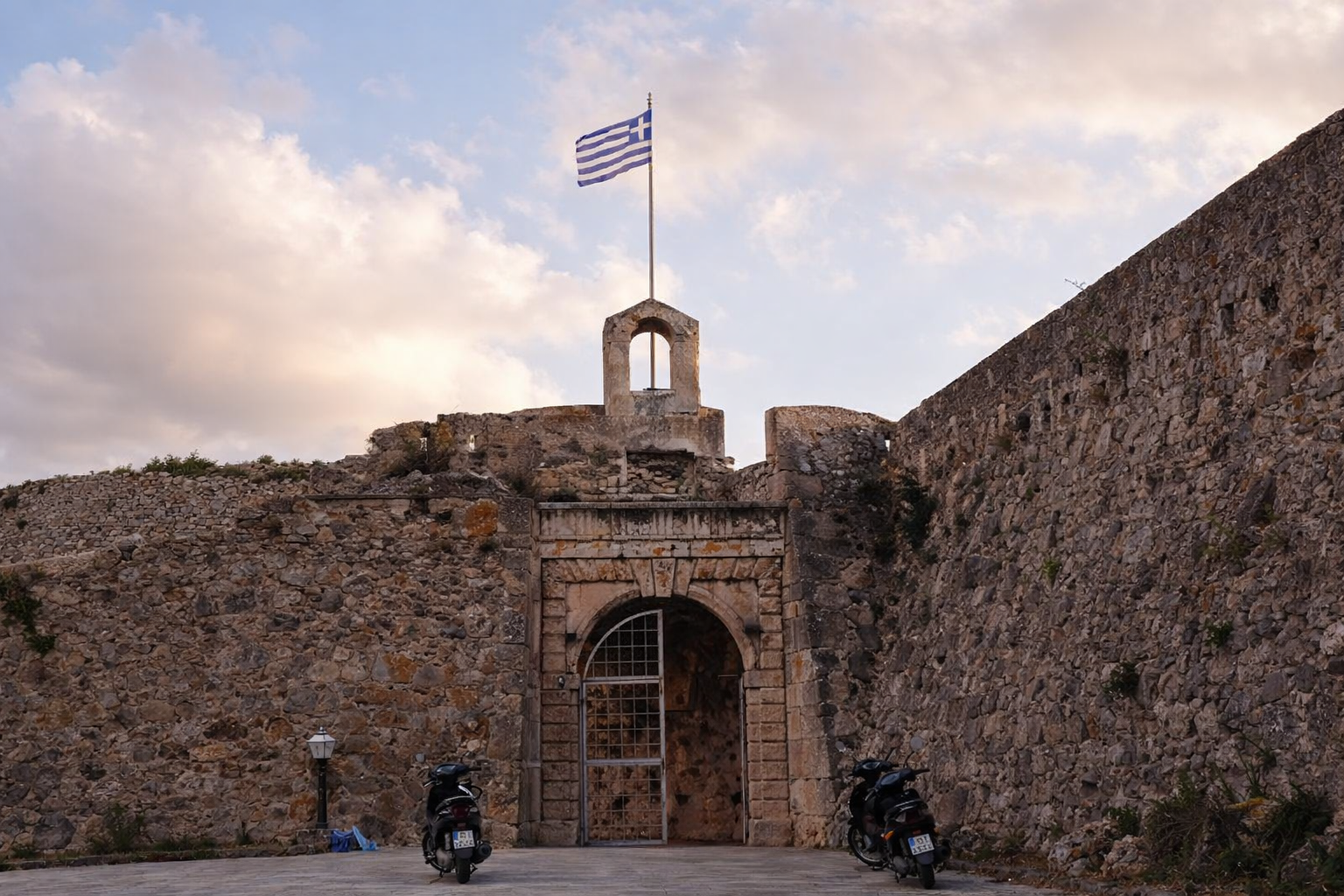
Kefalonia is an island more frequently associated in the public image with its natural landscape, its settlements, and its more recent historical course. However, an equally essential part of its identity lies in its fortifications, meaning those monuments that more accurately capture the way in which defense, administration, and political power were organized on the island over many centuries. Kefalonia's geographical position in the Ionian Sea, in a zone where naval routes, military interests, and rivalries of powerful forces intersected, explains why fortification was never a secondary matter. Castles were not merely military works, but organized centers of power, surveillance, and protection of the population. In the case of Kefalonia, two castles clearly stand out: the Castle of Saint George, which for centuries was the island's main administrative center, and the Castle of Assos, which was the most ambitious Venetian fortification project in Kefalonia. Together, these two monuments allow for a clearer reading of the island's historical trajectory, from the Byzantine and medieval periods to Venetian rule and modern times.
The Castle of Saint George: Kefalonia's old administrative center
The Castle of Saint George is located in Livathos, on a hill overlooking the southwestern part of Kefalonia. Its location is not accidental. Although not coastal, it allowed for control of the important anchorage in Livadi Bay, as well as the maritime area between Kefalonia and Zakynthos. According to data from the Ministry of Culture, the first fortification of the hill dates back to the middle Byzantine period and is connected with the establishment, in the 8th century, of the naval theme of Cephallenia, i.e., an administrative and military district of the Byzantine Empire. Although subsequent interventions and reconstructions do not allow for a complete reconstruction of all original phases, it is clear that the site was used from very early on as a point of strategic importance. Already in the 11th century, the "castle or city of Cephallenia" is mentioned as the most important settlement and the administrative seat of the island, while from the 13th century it appears in sources as the Castle of Saint George, a name attributed to the existence of a church dedicated to Saint George within the fortification. This development is of particular importance because it shows that the castle was not a simple military installation, but an organized place of administration, closely linked to the political formation of Kefalonia.
The importance of the castle was further enhanced after 1184, when Kefalonia was conquered by Margaritone, admiral of the Norman kingdom of Sicily. At that time, the Palatine County of Cephallenia, Ithaca, and Zakynthos was founded, with its seat at the Castle of Saint George. For approximately three centuries, the fortress served as the main administrative and military center of a political entity that successively passed from the Orsini, the Angevins, and the Tocco. The Ministry of Culture notes that the castle housed the residence of the respective ruler, while in the early 15th century, Western visitors still recorded the refined court of Charles I Tocco and his wife. This element is revealing of the monument's character: Saint George was not only a place of defense, but also a true seat of power, with political, social, and administrative weight. This is precisely where its historical distinctiveness lies. It is not a provincial fortress, but the place from which power was exercised in Kefalonia for a long period of time.
In the late 15th century, the castle's history entered a new phase. The Ottomans occupied the island and the castle for short periods, while previously, in 1469, a strong earthquake had caused serious damage to the fortifications. When the Venetians captured Saint George on Christmas Eve of 1500, after a three-month siege and with the assistance of Spanish troops, the castle was already in poor condition. From 1501, extensive reconstruction works began, which continued until 1544, with intermittent interruptions and new interventions due to the earthquakes of 1503 and 1542. The inhabitants of the island also participated in this effort through taxes and forced labor, a fact that shows that the maintenance of the castle directly concerned the whole of Kefalonia. The form that survives today is largely a product of this Venetian reconstruction, although the monument stands on an older Byzantine and medieval core.
The fortification of Saint George has a total length of approximately 600 meters and forms an elongated irregular polygon, following the natural relief of the hill. It is reinforced by three bastions, with the strongest being the southeastern one, which protects the most vulnerable side and the main entrance. Within the castle, remnants of the Venetian settlement, public buildings, barracks, armories, water tanks, the Governor's residence, and religious monuments, such as the church of Saint Mark, the chapel of Panagia tis Frouras (Our Lady of the Guard), and the church of Saint Nicholas, are preserved. All these indicate that the castle functioned as a fully organized fortified settlement and not just as a military observatory. However, already from the 16th century, it became clear that its fortifications were outdated for the needs of the time. The Ministry of Culture itself states that they were considered inadequate both in terms of the new military reality and the protection of the population. Attempts were made to wall off the outer settlement, the so-called borgo, in 1569 and 1636, but both remained incomplete. The transfer of the capital to Argostoli in 1757, at a time when the latter had already become an important commercial port, marked the beginning of the castle's decline as an administrative center. In the following centuries, the monument went through successive political phases and suffered new damage, both during World War II and in the earthquakes of 1953.
The Castle of Assos: the great Venetian fortification project of northern Kefalonia
The gradual inability of Saint George to meet the new defense needs explains why Venice turned to the creation of a new, much larger fortress in northern Kefalonia. The Castle of Assos, on the Assos peninsula, on the northwest coast of the island, was Venice's most ambitious fortification project in Kefalonia. Its location had significant natural advantages: steep slopes, difficult terrain, and only one main access point through the narrow isthmus connecting the peninsula to the mainland. According to the Ministry of Culture, in 1577, the provveditore of Kefalonia, Francesco Tiepolo, pointed out the need to build a new castle, while in 1584, a delegation from the Community of Kefalonia traveled to Venice with the same request. The reason was clear: the Castle of Saint George was no longer sufficient to protect the inhabitants against the frequent raids of the Ottoman fleet and pirates from Lefkada. The construction of the new castle was part of a broader Venetian effort to strengthen its possessions in the East, at a time of increased tension and uncertainty in the Ionian Sea and the eastern Mediterranean.
The construction of the castle began in 1593, after a second embassy of the Kefalonians to Venice, with designs by the engineer Marino di Gentilini and technical supervision by Raffaello Rasponi and Piero Cambuti. The project was completed in just two years, in 1595, although construction interventions inside continued throughout the first half of the 17th century. The speed of construction shows the magnitude of the strategic importance that Venice attached to this new fortress. In contrast to Saint George, which gradually developed over time as an administrative and residential core, Assos was from the beginning the result of conscious and organized state planning. Venice attempted here not merely to erect a new castle, but to create a model fortified complex that would meet the demands of the era and could, potentially, become a new administrative center for the island.
The most characteristic element of Assos is that it was designed as a fortified town and not merely as a military installation. The peninsula was laid out with wide streets and building blocks, in order to create an organized fortified city. The inhabitants of the surrounding areas were invited to buy plots of land and settle there, but the response was limited. As the Ministry of Culture notes, Assos never developed into a true urban center, mainly due to the lack of water and the difficulty of access from the rest of the island. In the early 17th century, a harbor was also built north of the isthmus, but its shallow waters and small size did not allow it to be transformed into an important naval hub. Thus, while the settlement that constitutes present-day Assos gradually developed outside the castle, the fortress itself could not function as a new capital or as a real administrative center of Kefalonia.
Despite this partial failure as an urban planning endeavor, Assos remains an impressive technical and military work. Its walls have a total perimeter of approximately three kilometers and are reinforced by five bastions. Due to the particularly steep and rocky terrain, the Venetian engineers could not fully apply the principles of the regular bastioned system, but they shaped a fortification adapted to the natural characteristics of the peninsula. The main gate is on the eastern side, in the Moceniga bastion, and leads inside through an arched gallery, while on its inner face, the date 1611 is preserved. The Venetian geographer Vincenzo Coronelli recorded in 1685 the existence of 60 public buildings and 200 residences within the walls, which confirms that Assos was not an empty military shell, but an organized and ambitious fortified space.
The strategic importance of Assos began to decline after 1684, when Venice captured Lefkada from the Ottomans. With the change in regional balances, the castle no longer had the same immediate usefulness for the defense of Kefalonia. In 1797, after the dissolution of the Venetian Republic, it passed to the Republican French, who established a temporary town hall inside it and proceeded with improvements to the rainwater collection and drainage system. However, already from the 19th century, the fortress had lost all substantial military role and began to gradually decline. From 1927 until the earthquake of 1953, it was used as a rural prison, a fact that shows that, as is often the case with such monuments, the castle did not remain inactive but adapted to different needs of modern times. Nevertheless, its original significance as a Venetian defensive work remains its primary historical identity.
The strategic importance of the castles in the history of Kefalonia
The Castle of Saint George and the Castle of Assos are not two independent monuments that simply coexist in the same place. On the contrary, they are closely linked to each other because they reflect two different historical phases of Kefalonia and two different perceptions of the island's defense and administration. Saint George expresses the long duration: the Byzantine beginning, the medieval formation, the period of the Palatine County, the Venetian reconstruction, and the slow loss of its central position when the economic and administrative weight shifted to Argostoli. Assos, on the other hand, expresses the conscious Venetian response to a new military reality, with a larger scale, a more complex fortification logic, and an attempt to create a new fortified city that could support the Venetian presence in northern Kefalonia.
The historical value of the two castles lies precisely in their ability to allow for a reading, through their architecture and their use, of Kefalonia's own evolution. These monuments reflect the maritime routes that defined the island's strategy, the fear of raids, changes in sovereignty, shifts in administrative centers, as well as the natural disasters that repeatedly reshaped the place. The transfer of the capital to Argostoli in 1757 was not a simple administrative event, but an indication that the economic and commercial centers had now shifted. Similarly, the construction of Assos was not a simple technical project, but part of a broader state strategy of Venice in the Ionian Sea. For this reason, the castles of Kefalonia should not be treated only as monuments of aesthetic or tourist value, but as key evidence of the island's political and military history.
Today, Saint George and Assos function as two of the most important material testimonies of Kefalonia's historical continuity. The first recalls the era when the island had its administrative center on a fortified hill in the hinterland. The second recalls the Venetian attempt to create a new, larger, and technically more advanced defensive system on the northern coast. Both together prove that Kefalonia was never an isolated place without strategic weight, but an island that was constantly integrated into broader political and military networks of the Ionian and eastern Mediterranean. Through its castles, one can read not only the history of fortifications, but the very process by which Kefalonia was historically formed as a place of power, defense, and administrative organization.