"Crazy Cephalonians": The Story of a Stereotype
From the satirical tradition to "kourlosyni" as a local identity: how the stereotype of the "crazy Cephalonian" was born and what it means.
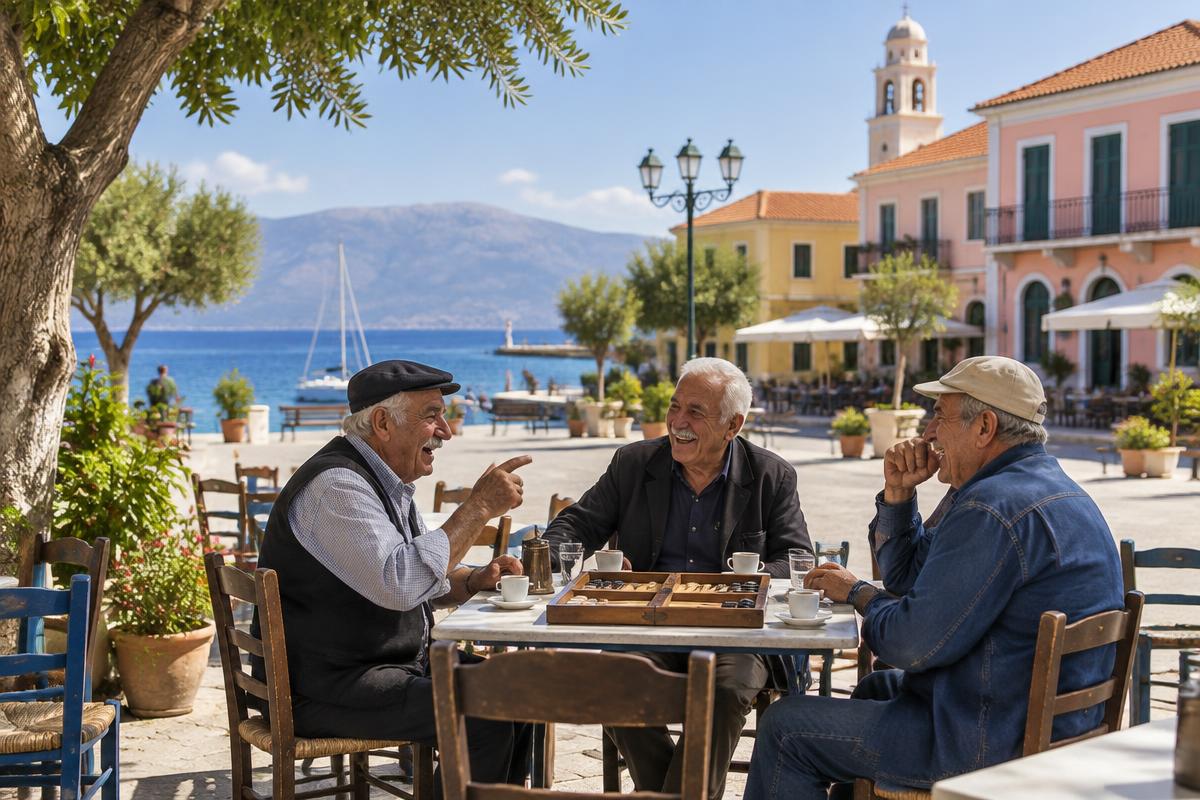
An Island with a Reputation
Three days ago, on October 20, Cephalonia celebrated its patron saint, Saint Gerasimos. Ecclesiastical tradition associates him with caring for the mentally and physically ill and healing the "possessed." For an island that the rest of Greece considers the "craziest" in the country, the coincidence is eloquent, to say the least.
The "crazy Cephalonian" is one of the country's most enduring regional stereotypes. One encounters it in jokes, barracks banter, student dormitories, and sports headlines. The interesting thing, however, is not that others call us crazy. It is that we ourselves say it with a certain pride.
Where does this reputation come from? What exactly does it describe? And why does a label that elsewhere would be deemed an insult function here almost as a badge of honor?
"Kourlos": A Word with a Local Accent
On the island, madness has its own word. A "kourlos" is not quite the madman of standard modern Greek. He is unpredictable, stubborn, the one who speaks his mind and does whatever he sets his mind to, even if it makes no sense to anyone else. The word belongs to the Heptanesian dialect, shaped to a great extent under long Venetian rule in the Ionian Islands.
There is no documented "birth date" for the stereotype. It cannot be found in a founding text or at a specific historical moment. It lives primarily in oral tradition: in jokes, stories passed down from generation to generation, and banter between islands and regions.
What can be recorded with certainty is its contemporary use. When the NEO Lixouri basketball team rose within a few years from local leagues to the National B Division, the sports press attributed its ascent precisely to the "madness" of the Cephalonians. In other words, the stereotype is not only used to explain an eccentricity. It is also used to explain an unexpected success.
A Distinct Historical Path
Every stereotype stems from a sense of difference. In Cephalonia's case, this difference has a historical foundation. Aside from a brief Ottoman period in the late 15th century, the island lived for centuries under Venetian rule, like the rest of the Ionian Islands, and that era left deep marks on its language and culture. The French and the British followed, and union with Greece came only in 1864.
This meant different institutions, a different education, a different relationship with Europe. The scions of wealthy families studied in Italy and later in other European cities. The language filled with Italian words. Music, architecture, and social life followed rhythms distinct from those of mainland Greece.
When two communities come into contact after centuries of divergent evolution, one inevitably views the other as "strange." It is a reasonable assumption that part of the Cephalonians' reputation was born precisely of this encounter: whatever was merely different was labeled eccentric. This remains, however, an interpretation rather than an established historical fact.
The same applies to a frequent explanation heard on the island: that earthquakes—life on constantly shifting ground—spawned people who take nothing too seriously. It is a nice story. It is not proof.
An Island That Laughed at Itself
If its historical path explains why Cephalonians appeared different, the island's satirical tradition explains why this difference found a voice. In the 19th and early 20th centuries, Cephalonia produced a series of satirical poets who unflinchingly targeted authority, the clergy, the ruling class, and often their own compatriots.
The most famous, Andreas Laskarakis, has already featured in our pages. Alongside him, however, stand others. Mikelis Avlichos, born in Lixouri in 1844, studied in Bern, came into contact with the anarchist ideas of the time, and returned to Lixouri, where he lived until his death in 1917. He remained an atheist to the end and asked his friends not to mourn him because, as he said, he was not going to death, but to life.
In Argostoli, Georgios Molfetas (1871–1916) continued in the same vein with his satirical poetry. The two towns, which disagreed on so much else, agreed on at least this: that nothing is so sacred that it cannot become the subject of a jest.
A society that produces such voices is not necessarily "mad." But it is a society that tolerates, and often relishes, irreverence. For an outside observer, distinguishing between the two is not always easy.
From Label to Identity
The most characteristic aspect of the stereotype today is that Cephalonians have embraced it. In texts they write about their origins, "kourlosyni" (madness) appears not as a flaw, but as a core component of the local character—something as natural as earthquakes, the local idioms, and the shadow of Mount Ainos.
This same irreverence extends even to the patron saint. On the island, a story circulates in various forms about a card player who cursed Saint Gerasimos every time he lost. When his fellow players threatened to kick him from the table, he stopped cursing out loud and began spitting silently into his hat. The anecdote reveals something fundamental: the Cephalonian does not revere his saint any less. He simply considers him close enough to get angry with him.
The stereotype, then, serves a dual purpose. Outwardly, it is a label affixed by others. Inwardly, it is a way of saying "we are different" without having to explain how. When a Cephalonian says "we are crazy," they are rarely making an apology. They are making a statement.
What Does a Stereotype Do to a Community?
For decades, social psychology—through Henri Tajfel and John Turner's social identity theory—has described how groups construct their self-image through comparison with "others." A community needs something that sets it apart. When others provide that distinguishing mark in the form of mockery, the group has two choices: to reject it, or to appropriate it and invert its meaning.
Cephalonians, it seems, chose the second path. "Madness" was translated into independence, outspokenness, and a refusal to conform to what is deemed normal. It is a convenient translation, as it grants everyone permission to be a little eccentric without having to offer explanations.
Yet there is also a less amusing side. When the word "crazy" becomes a badge of honor, it risks obscuring the fact that genuine mental suffering is neither picturesque nor charming. It is an irony of history that the island's patron saint is venerated precisely for caring for those suffering from mental affliction. Cephalonia's tradition, in other words, already contains both facets: a smile toward eccentricity, and responsibility toward suffering.
In the End, Are We?
The question of whether Cephalonians are truly "crazier" than other Greeks cannot be answered, and perhaps it does not need to be. No stereotype accurately describes an entire population. What it does describe is a relationship: how others see us, and how we choose to respond.
Cephalonia's answer, from the satirists of Lixouri and Argostoli to today's sports headlines, has remained consistently the same: not denial, but acceptance, with a wink. In an era when islands tend to look increasingly alike, this insistence on difference is hardly the worst inheritance one could possess.
So long as we remember that being a little "kourlos" is a stylistic choice. Caring for those who are truly struggling is an obligation. Our patron saint, after all, understood that four centuries ago.
Related Articles
Άσσος: ο οικισμός, το φρούριο και η εικόνα που άντεξε στον χρόνο
Πώς η μικρή Άσσος της βόρειας Κεφαλονιάς συγκεντρώνει σε έναν τόπο γεωγραφία, ενετική στρατηγική, μετασεισμική ανασυγκρότηση και σημερινή τουριστική απήχηση.
Η ναυτική ιστορία του νησιού πέρα από τα λιμάνια
Από το παράκτιο εμπόριο του Ιονίου έως τη Μαύρη Θάλασσα, τον Δούναβη και το Λονδίνο: πλοιοκτήτες, καπετάνιοι, ναυτικοί και οικογένειες που έδωσαν στο νησί διεθνή ναυτική παρουσία.
Κεφαλονιά: Μικρές ιστορίες πίσω από γνωστά σημεία του νησιού
Από τη Γέφυρα Δεβοσέτου και τις Καταβόθρες μέχρι τη Μελισσάνη, την Άσσο και το Φισκάρδο: μικρές ιστορίες που εξηγούν την Κεφαλονιά πίσω από τις γνωστές της εικόνες.