Saint Gerasimos: The Patron Saint of Kefalonia Through Art
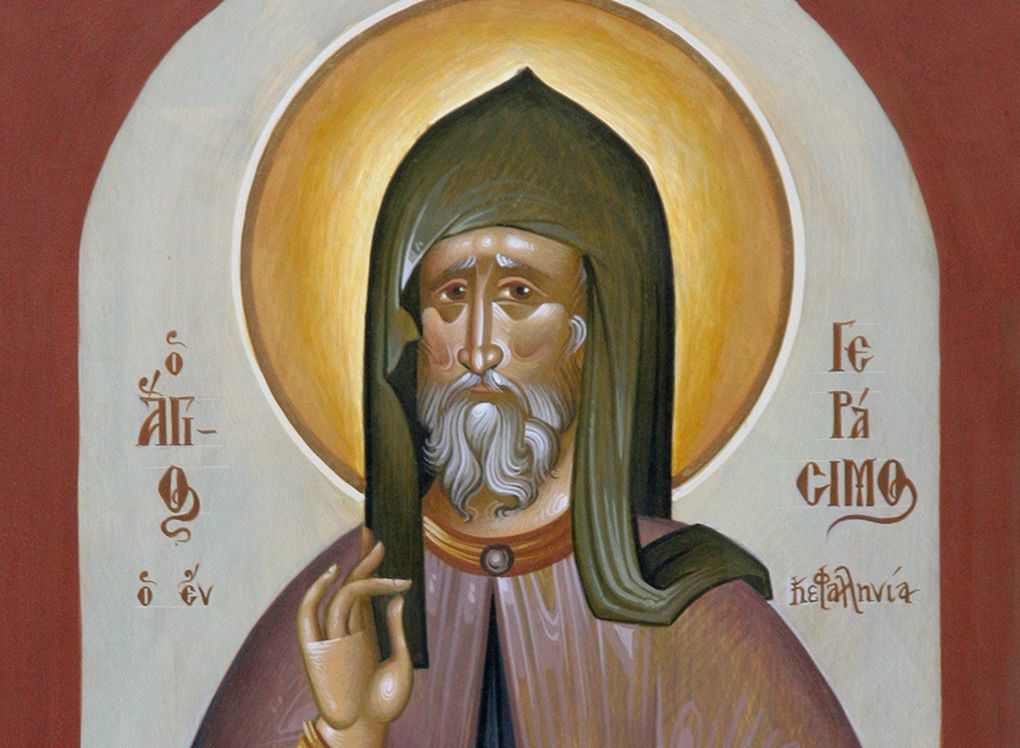
From hagiographies and poems, to votive offerings and festivals, the figure of the Saint remains alive in every aspect of Kefalonian life.
In Kefalonia, faith in Saint Gerasimos of Kefalonia is not merely an ecclesiastical matter; it is an element of the island's collective identity, deeply rooted in the life and memory of its people. The Saint, who reposed in 1579 and was officially canonized in 1622, is honored with two major feasts: on August 16th, the day of his repose, and on October 20th, the day of the translation of his relics. The events, centered around the monastery in Omala, attract a multitude of faithful every year from all over Greece and the diaspora.
Every year, on August 16th, Kefalonia celebrates its patron saint with devotion and festive splendor. The day begins with a Divine Liturgy at the Saint's monastery in Omala – the most important religious monument on the island – and culminates with the customary procession of the sacred relics. Thousands of faithful – locals and visitors – come to venerate the incorruptible relic of the Saint, which is a precious treasure for the Kefalonians. The philharmonic orchestra accompanies the procession, while the day concludes with folk festivals in the surrounding villages, with food, wine, Kefalonian songs, and dances. It is a day where spiritual devotion meets communal joy.
The name Gerasimos is a landmark in itself: you will rarely find a family in Kefalonia without at least one Gerasimos or a Gerasimoula. It is not just a matter of tradition, but also an act of daily connection with the island's spiritual heritage. The Saint is not for the Kefalonians a simple figure of Orthodoxy; he is a protector, a healer, and a silent companion.
Beyond his devotional dimension, however, Saint Gerasimos has left a strong imprint on art – in hagiography, painting, literature, and folk creation. Artistic depictions of the Saint, from official hagiographies to more humble folk versions, tell a story of faith and memory that transcends the boundaries of time.
The Icon of the Saint
The most recognizable form of the Patron Saint of Kefalonia is that preserved in icon paintings: an ascetic with a stern gaze, a serene face, and a slightly bent back, dressed in dark monastic robes. He is often depicted holding a cross or holding the New Testament, symbols of his spiritual testimony.
A peculiar element that appears in several of his depictions is the presence of a lion. This refers to the tradition according to which the Saint had healed a wounded lion, which faithfully followed him for the rest of his life. The lion, a symbol of strength and courage, acquires a spiritual character when coexisting with Saint Gerasimos – it becomes a symbol of the calm strength of faith and religious serenity.
The Heptanesian School and the influence of the West
The iconography of Saint Gerasimos does not remain purely Byzantine. The Heptanesian School, influenced by the Western painting tradition due to Venetian rule in the Ionian Islands, introduced new elements in the depiction of saints: more natural poses, more realistic features, rich colors, and perspective. Icons of Saint Gerasimos are part of this context, highlighting not only his spirituality but also his human nature.
Artists such as Andreas Karantinos (1780-1823) and Georgios Nomikos (1776-1851), representatives of Heptanesian art, combine respect for the Byzantine tradition with Western technique, offering a result that moves and inspires the pilgrim.
Gerasimos Pitsamanos: A Kefalonian of Art
Special mention should be made of Gerasimos Pitsamanos (1787–1825), an architect, painter, and portraitist, who was born in Argostoli. Pitsamanos was educated in Italy and adopted a European style, but his love for his homeland and his roots was reflected in several works of a religious or local character. His influence on the generation of Kefalonian painters who dealt with hagiography is undeniable. His artistic eye influenced the rendering of the Saint in both frescoes and iconographic designs of monasteries.
The Saint in folk art and relics
The figure of Saint Gerasimos has inspired not only official painters and iconographers, but also folk craftsmen, woodcarvers, and miniaturists. In many parishes and homes in Kefalonia, one can find carved portable icons, icons on canvas, woven fabrics, and handmade embroideries depicting the Saint.
Monastic relics, such as old icons, crosses, and even oil lamps with the Saint's name, testify to the timeless relationship of the people with their patron. Each family is accompanied by a souvenir, a votive offering, a personal item associated with the Saint.
Memory as a Living Act of Art
The presence of Saint Gerasimos in art is not merely a cultural imprint; it is proof that faith can be transformed into creation. From his icon on the iconostasis of a church to the carved wood in a village living room, from the verse of a poem to the humble oil lamp that burns incessantly in Omala, all compose a mosaic of love, hope, and gratitude.
In Kefalonia, the memory of the Saint is not exhausted in religious ritual. It is part of everyday life, artistic expression, collective memory. And if art is – as they say – a form of immortality, then Saint Gerasimos is visible in every corner of the island: in the faces of the people, in the works of craftsmen, in the colors of painters, in the silent prayers of poets.
Related Articles
Άσσος: ο οικισμός, το φρούριο και η εικόνα που άντεξε στον χρόνο
Πώς η μικρή Άσσος της βόρειας Κεφαλονιάς συγκεντρώνει σε έναν τόπο γεωγραφία, ενετική στρατηγική, μετασεισμική ανασυγκρότηση και σημερινή τουριστική απήχηση.
Η ναυτική ιστορία του νησιού πέρα από τα λιμάνια
Από το παράκτιο εμπόριο του Ιονίου έως τη Μαύρη Θάλασσα, τον Δούναβη και το Λονδίνο: πλοιοκτήτες, καπετάνιοι, ναυτικοί και οικογένειες που έδωσαν στο νησί διεθνή ναυτική παρουσία.
Κεφαλονιά: Μικρές ιστορίες πίσω από γνωστά σημεία του νησιού
Από τη Γέφυρα Δεβοσέτου και τις Καταβόθρες μέχρι τη Μελισσάνη, την Άσσο και το Φισκάρδο: μικρές ιστορίες που εξηγούν την Κεφαλονιά πίσω από τις γνωστές της εικόνες.