A Dive into the Depths of Cephalonian Gastronomy
Caramelized almonds, zesty tomato sauce with hints of cinnamon, delicate distillates, aromatic Robola.
And many more.
Cephalonia is not only famous for the aristocratic beauty of the Ionian Islands, its lush green slopes, and the crystal-clear waters of the Ionian Sea, but it is also synonymous with gastronomic delight. The flavors of Cephalonia reflect its history, culture, and the influences of various eras, with the Venetian occupation having left deep marks, adding a North Italian touch.
The Cephalonian land bears fruit under the sun, offering a wide variety of local delicacies, such as olive oil, pure dairy products, herbs, jams, and pure honey, while the island's fertile soils favor the cultivation of vines, citrus fruits, and fruit trees.
Broadly speaking, they say that the cuisine of each region is like a mirror of its history and tradition. The flavors, ingredients, recipes, and cooking techniques developed over centuries are directly linked to the culture, society, and environment of each area. In the case of Cephalonia, what is certain is that locals love clean flavors and simplicity in recipes, choosing local products from Mother Earth, ensuring their quality and nutritional value. Of course, the above does not imply a lack of creativity; on the contrary, the Cephalonian zest and the temperament of the Ionian Islands are loudly present.
It should be noted that this mastery is not a forgotten tangle of memories in the dusty corners of history, but a living thread that passes from generation to generation, through local festivals and celebrations. For example, the autumn festival with bourbourelia – or polysporia – offers the ideal setting to taste traditional dishes. In fact, in the summer of 2024, the Kefalonian Tratarisma - Gastronomy & Wine Festival took place for the first time, a culinary gathering of exquisite producers and cooperatives from the island.
Local products
The Venetians were the first to introduce tomato cultivation to Cephalonia, and due to the extensive consumption of olive oil, they were responsible for the increase of olive groves on the island. Although olives had been cultivated in Cephalonia since ancient times, the Venetians strengthened this tradition by offering financial incentives to locals for planting new trees across the island. The olive, although emblematic for all of Greece, is treated uniquely in Cephalonia, as it is not only used after classic processing but is often cooked, a technique that requires skill and special knowledge in managing its fruits. Cephalonian olive oil is considered among the best in Greece, thanks to the island's favorable climate and fertile soil. Local varieties, such as Koroneiki, yield olive oil with a deep, rich flavor and characteristic aromas. Extensive olive groves are cultivated in the areas of Lixouri and Sami, producing high-quality products.
Next in line is the queen of foods. Cephalonian honey, known for its rich taste and aromas, comes mainly from thyme flowers and fir trees. Honey from Mount Ainos is particularly famous, considered among the best in Greece and used in many preparations, such as mandoles and mystopites. Cephalonian cheeses hold a prominent place in local gastronomy, with their reputation extending beyond the island's borders. They include feta, myzithra, manouromyzhithra, and the excellent quality kefalograviera, each with its own unique taste and texture. In fact, there are 14 cheese dairies on the island, mainly small and medium-sized family businesses, that maintain traditional production techniques and incorporate the region's heritage into their products.
Undoubtedly, fresh vegetables and wild greens are an integral part of Cephalonian cuisine. Tomatoes, as mentioned earlier, peppers, courgettes, and greens (such as Swiss chard and wild chicory) are cultivated in fields and used in many recipes. A favorite local dish is tsigaridia, made from wild greens or wild vegetables (Swiss chard, wild chicory, sorrel, sea fennel) stir-fried with spinach, leeks, and spring onions.
Naturally, as an integral part of the Ionian Islands, Cephalonia and its gastronomy bear the strong imprint of the Venetians. These astute merchants, who brought Oriental spices to Europe, also left their mark on the local cuisine. Cephalonian cuisine thus acquired the intense flavors and aromas that characterize it, as is clearly seen in “prokado” veal. This traditional dish is cooked with cloves, an element that gives it a warm and spicy note, and is usually served with potatoes, offering a unique culinary experience.
The Most Famous Local Dishes
Pies, greens, and meats characterize the traditional cuisine of Cephalonia, with recipes that may not be found elsewhere. In Cephalonia, meats are celebrated, with a wide variety of meats and unique cooking techniques. For example, lagoto is synonymous with Cephalonia. It is a traditional dish prepared with a red, zesty, and explosive sauce and served with thick pasta. This recipe is made throughout the island, without necessarily indicating the meat used, as it can be rabbit or hare, or instead, rooster, goat, or lamb, and even fish like bonito. Rarer recipes include pastitsio with goat or lamb, or pork combined with potatoes and quince, creating a harmonious combination of sweet and savory flavors.
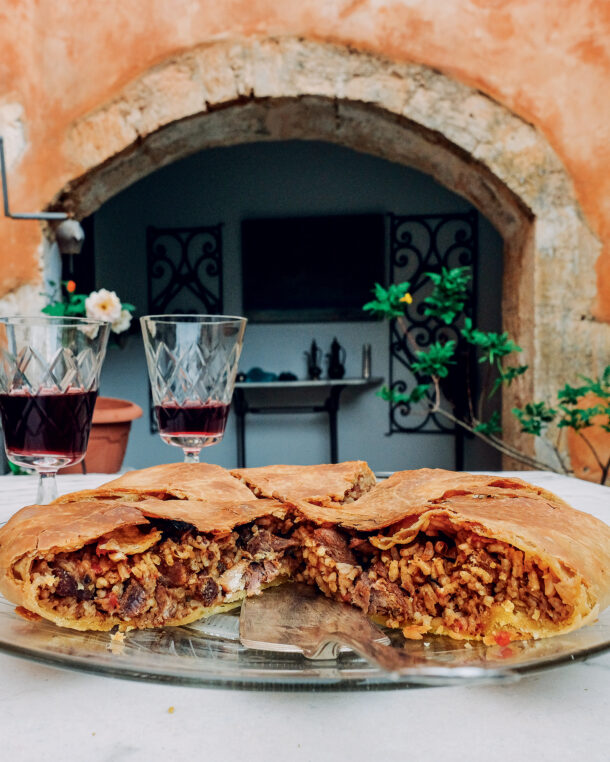
Discovering the unique flavors of the region, the local meat pie is undoubtedly the most emblematic dish of Cephalonia. However, while everyone has heard of the Cephalonian meat pie, few know that local housewives make it from three separate types of meat (pork, goat, and beef), even fewer know its variations (in Lixouri they add plums), and even fewer still know how many other pies are made in Cephalonia. The most prominent among these are artichoke pie, made from cleaned artichoke hearts, cheese pies from the island's unique cheeses, hortopites (greens pies), kalitsounia, and bakaliaropita (cod pie) made from salted cod.
On the other hand, in the island's seaside tavernas, fish and seafood are the absolute protagonists. Visitors can enjoy delicious lobster pasta, shrimp pasta, and linguine with shellfish. Smoked eel, marinated anchovies, grilled mackerel, and charcoal-grilled horse mackerel are just some of the tempting options. Also, cod or octopus are often accompanied by traditional aliada (garlic dip) and boiled courgettes, which on the island are called moropoula, while dishes such as bourdeto fish, which embody the authentic taste of the sea, are not absent. Savoro, a dish with marinated fish cooked with vinegar, garlic, rosemary, and raisins, also holds an important place on the Cephalonian table. This recipe originated from the fishermen's need to preserve fish for longer and is characteristic of the tradition of the Ionian islands.
Another favorite dish is bourbourelia, which even has its own namesake festival every autumn. It is a rich soup based on legumes, mainly beans, often enriched with seasonal greens or vegetables. This simple but flavorful dish was traditionally cooked during cold winters, offering farmers, after a tiring day in the field, a warm and nutritious option.
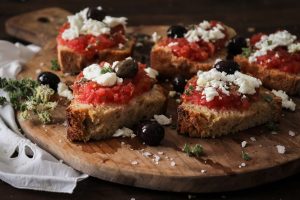
Of course, it would be unthinkable not to mention the island's absolute summer dish, always served first in a meal: riganada, made from slices of black bread, drizzled with olive oil, tomatoes, and oregano.
Sweet Delicacies
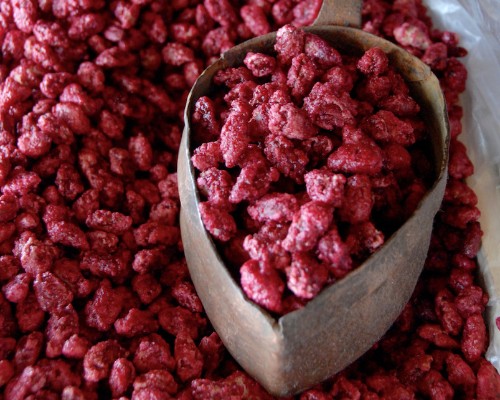
Now for the confectionery delights of the ingredients. Mandoles are one of Cephalonia's most characteristic sweets, made from caramelized almonds. This unique flavor is achieved when fresh almonds meet sugar and acquire their distinctive red color from natural sea algae. This delicacy is a favorite choice for locals and visitors to the island. In addition to mandoles, mystopita, made from must, semolina, and almonds, and pastokydono, a sweet made from quince and almonds with a characteristic sweet taste, are also famous.
Local Wines
The vine on this lush green island is perfectly generous, offering wines that embody the essence of Cephalonian soil. The island is famous for its wines, with Robola being the most renowned variety. It is cultivated mainly on the Omalos plateau, at the foot of Mount Ainos, and is distinguished by its unique aromatic flavor. The Agricultural Wine Cooperative of Cephalonian Robola Producers is responsible for the production of this famous variety, which pairs excellently with local dishes. In addition to Robola, other important varieties such as Mavrodafni and Moschato are worth mentioning, offering rich aromas and complex flavors.
In every corner of Cephalonia, tradition is not just a memory, but a living core of flavors and aromas that continues to breathe through the local dishes. In recent years, organic farming has gained ground on the island, with many products acquiring certifications, which strengthens both the local economy and environmental protection. Every tasting experience in Cephalonia is a journey to the roots of tradition, where visitors do not merely taste the products of the land, but experience the soul of the island. With every bite, history, nature, and authenticity become part of a gastronomic experience that remains indelibly etched in memory.
Related Articles
Η οικονομία των 100 ημερών: Πώς η εποχικότητα αλλάζει τα νησιά
Τι σημαίνει πραγματικά να ζει ένα νησί από λίγους μήνες τουρισμού — και γιατί η «οικονομία των 100 ημερών» καθορίζει την εργασία, την κατοικία και τις υποδομές όλο τον χρόνο.
Πόσο κοστίζει πλέον ένα καλοκαίρι
Η μετακίνηση, η διαμονή και η καθημερινή κατανάλωση ανεβάζουν τον λογαριασμό των διακοπών στην Κεφαλονιά, ενώ οι ίδιες αυξήσεις μεταφέρονται στη ζωή των μόνιμων κατοίκων.
Το Ίδρυμα Γεωργίου & Μάρης Βεργωτή τιμήθηκε με το Βραβείο Ευκράντη για την Κοινωνική Προσφορά
Το Ίδρυμα Γεωργίου & Μάρης Βεργωτή τιμήθηκε με το Βραβείο Ευκράντη για την Κοινωνική Προσφορά, σε μια χρονιά-ορόσημο κατά την οποία συμπληρώνει 50 χρόνια αδιάλειπτης παρουσίας και προσφοράς.