Kefalonia's Village Schools: The Issue Beyond Student Numbers
Buildings, staffing, and transportation: why the debate over village schools in Kefalonia cannot be limited solely to student numbers.
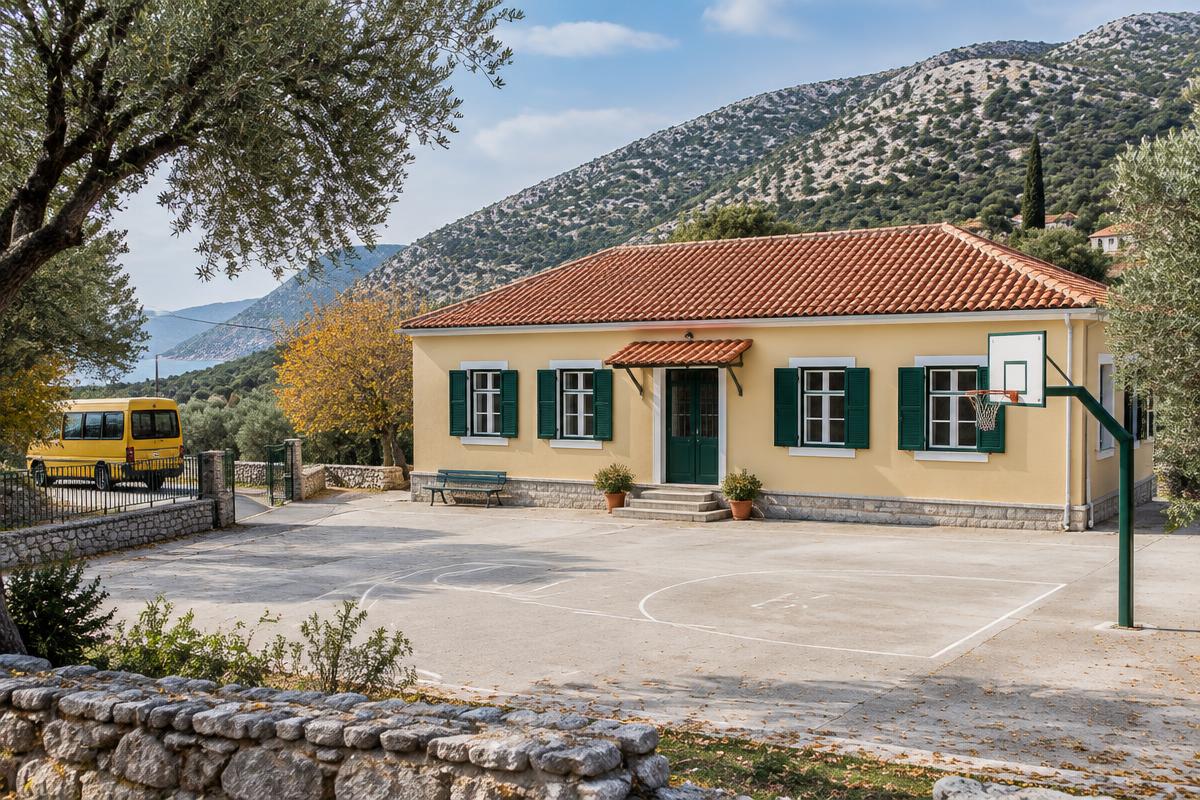
Every summer, Regional Directorates of Education publish decisions in the Government Gazette regarding school units that will not operate in the new school year. Demographics are almost always cited as the cause. In Kefalonia, however, the discussion about village schools cannot be reduced simply to the question of how many children are born. The available data show that the island’s problems relate just as much to buildings, staffing, and the services that support school operations. They also show a lack of the information that would allow for an evidence-based discussion.
The national picture: more suspensions each year
According to data published by the educational website alfavita.gr, primary schools with suspended operations increased from 247 in 2018–2019 to 319 in 2025–2026. Suspended kindergartens rose during the same period from 312 to 355. In total, non-operating primary education units stand at 714, up from 559—an increase of 155 in seven years. In a parliamentary question tabled in February 2026, the number of suspended units for 2025–2026 is placed between 714 and 766, depending on the source.
The decline in the student population is the primary factor. In a report published by Kathimerini on August 31, 2025, the total number of students in primary, secondary, and vocational education is estimated at approximately 1,210,000 for 2025–2026, compared to 1,363,912 in 2018–2019.
For the 2026–2027 school year, decisions are published by region. In Central Macedonia, operations are suspended for 144 units (45 primary schools and 99 kindergartens), according to a decision published in Government Gazette B' 5179/14-8-2026. In Eastern Macedonia and Thrace the list reaches 48 units, and in the Dodecanese 11.
What suspension means and what it does not mean
Suspension is not equivalent to abolition. It is an administrative measure that can be lifted if the necessary conditions are met in the future, primarily regarding student numbers. In practice, however, many units remain closed for years. The parliamentary question submitted in June 2026 mentions a school unit that has been under suspension since 2023.
The point often overlooked is that student numbers are not the only reason. The decision for Central Macedonia cites three distinct causes: the lack of a school building since the unit’s founding, structural/facility problems, and zero or low student enrollment. This distinction matters for Kefalonia, where building issues are well-documented and recent.
Kefalonia: a stable population, an unknown breakdown
The permanent population of the Regional Unit of Cephalonia stood at 35,801 residents in 2011 and 36,064 in 2021, according to ELSTAT census results. This represents a change of +0.7%. In a country that lost 3.5% of its population over the same decade, the island appears stable.
The aggregate figure, however, reveals nothing about demographics or distribution. It does not show how many school-age children live in each village, nor how many of them attend their local school versus commuting elsewhere. These data, broken down by municipal unit and school unit, were not found published in our research. The Directorate of Primary Education and the municipalities possess enrollment data for their school units; no public analysis per school was identified.
Here lies a question worth asking directly: if the island's population is stable, why is the discussion about village schools not based on enrollment figures? And if these numbers are alarming, why are they not public knowledge?
Village schools on the recent list
The list of schools included in the "School Meals" program for 2026–2027, under a joint ministerial decision signed on September 22, includes 19 primary schools in Kefalonia: 13 in the Municipality of Argostoli, 3 in the Municipality of Lixouri, and 3 in the Municipality of Sami. This list does not constitute a full census of the island’s schools. It shows, however, that school units operate in smaller communities such as Vlachata, Dilinata, Poros, Skala, Agios Gerasimos, Chionata, Agia Thekla, Mesovounia, and Pilaros.
Yet continuing to operate is not the sole criterion. Recent news regarding village schools centers largely on their operating conditions.
Poros: building and all-day school
At the blessing ceremony marking the start of the school year on September 11, 2026, the principal of Poros Primary School, Dimitrios Ververis, warned that the courtyard surface poses a danger to children and stated that he has been trying to resolve the issue since 2012, according to reports by kefaloniapress.gr and other media outlets. According to the same reports, the mayor confirmed the poor condition of the courtyard. The all-day program runs at full capacity until 3:00 p.m., and parents are required to arrange transportation for children living off the bus routes. This picture shows that the operation of a village school depends on a network of services—from transportation to infrastructure—and not merely on having classes formed. The Poros school was included in the "School Meals" list approved a few days later.
Mesovounia: three decades in prefabricated classrooms
In Mesovounia, in the Municipality of Sami, students of the Gymnasium and Lyceum classes launched a school sit-in/occupation in November 2026. The 15-member student council asserts that the school has been housed in prefabricated classrooms for about 30 years, that safety and hygiene issues persist, and that an email sent to the Municipality of Sami went unanswered. According to 902.gr, three other secondary school complexes on the island—the 2nd and 3rd Gymnasiums of Argostoli and the Pastra Gymnasium-Lyceum—are also housed in prefabricated facilities.
The students’ statements are claims and should be treated as such until the competent authorities respond. The fact that a 15-member student council felt compelled to take over a school because an email went unanswered is, in itself, telling evidence regarding the functioning of local administration.
Kerameies: class mergers
In 2025, the Directorate of Primary Education of Cephalonia decided to temporarily merge the two fourth-grade sections of Kerameies Primary School. The Minister of Education responded to a question by KKE MPs that the merger was undertaken to meet an urgent operational need due to a teacher shortage, and that it complied with the law. This case demonstrates a mechanism that requires no administrative decision of suspension: staffing alone can alter a school's operation, regardless of the number of children enrolled.
The cost of distance
A report in To Vima on the start of the 2026–2027 school year points out that suspending a school does not eliminate costs: students must commute to another unit, creating a new fiscal burden. The same analysis notes that class mergers lead to sections with up to 25 students.
For Kefalonia, this observation has practical ramifications. Transporting children from a village to Argostoli or Lixouri requires transportation, and transportation comes at a cost—borne either by the municipality or by the family. The question is whether families considering living in one of the island's villages—whether long-time residents or newcomers—take the presence of a school within a reasonable distance for granted. The answer links directly to issues we have previously analyzed: the island’s demographic trajectory and housing for permanent residents in Argostoli, Lixouri, and Eleios-Pronnoi.
What needs to be published
An informed, evidence-based discussion requires data that are currently inaccessible. The most useful would be:
- the number of students and classes per school unit in Kefalonia and Ithaca over the last five years,
- the number of births per municipal unit, indicating which villages will have students in the coming years,
- the structural condition and pending repairs for each school, along with the agency responsible, and
- the cost and logistics of student transportation per municipality.
The Municipality of Argostoli, the Municipality of Lixouri, the Municipality of Sami, and the Directorate of Education possess or can request most of these figures. There is no reason for this information to remain confined to internal administrative desks.
Conclusion
The national trend toward increased operational suspensions is well-documented. Kefalonia’s position within this trend is less clear, because the island’s population is overall stable and enrollment data per school are not made public. What emerges from recent news is that village schools are already being impacted by conditions unrelated to demographics: courtyards, prefabricated classrooms, teacher shortages, and transportation.
If left unaddressed, student enrollment in a village can decline for reasons that have nothing to do with birth rates. A family seeing that their local school lacks a safe playground or stable teaching staff is likely to choose another area. The question for local stakeholders is whether they will wait for the list in the Government Gazette or tackle the underlying causes before things get that far.
Related Articles
Το νερό στην Κεφαλονιά: πρόβλημα ποιότητας, υποδομών και χρηματοδότησης
Η ποιότητα του νερού, η υφαλμύριση, οι ευάλωτες υποδομές και η χρηματοδότηση της ύδρευσης στην Κεφαλονιά: τα διαθέσιμα στοιχεία και τα ερωτήματα που παραμένουν ανοιχτά.
Άλλη μια δημόσια δομή κλείνει στο Ληξούρι και η Δημοτική Αρχή Κατσιβέλη απλά παρακολουθεί!
Η Λαϊκή Συσπείρωση στον Δήμο Ληξουρίου καταγγέλλει το οριστικό κλείσιμο του Γραφείου Εξυπηρέτησης Φορολογουμένων και ζητά να αποτραπεί η απομάκρυνση ακόμη μιας κρίσιμης δημόσιας δομής από την Παλική.
Βαλλιάνειο ΓΕΛ Κεραμειών: Πρόσκληση στην εκδήλωση αποφοίτησης 2025-2026
Η τελετή αποφοίτησης του Βαλλιανείου ΓΕΛ Κεραμειών θα πραγματοποιηθεί την Πέμπτη 25 Ιουνίου 2026, στις 20:00, στο Λυκιαρδοπούλειο Θέατρο Κεραμειών.