The seasonality of Kefalonia's economy: what remains when the season ends
In August 2025, 100,237 passengers flew between the UK and Kefalonia; in December, two. What remains of the island's economy when the season ends?
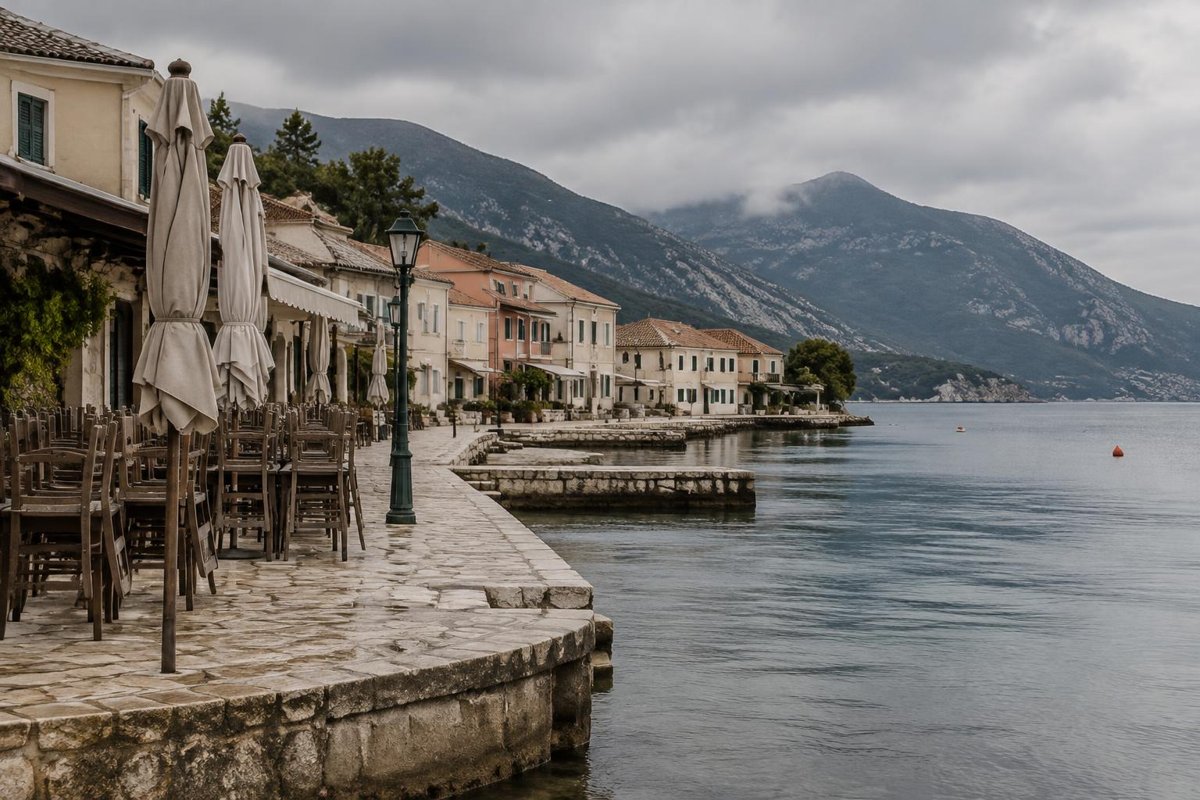
In August 2025, 100,237 passengers travelled to and from the United Kingdom through Kefalonia airport. In December of the same year, the number was two.
This is not a typo. It is the shortest description of the island's economy: a place that within a few weeks goes from a packed season to a winter in which flights, jobs and much of economic life almost come to a halt.
In 2026 Kefalonia is living the biggest tourist year in its history. Yet anyone who lives permanently in Argostoli, Lixouri or Elios-Pronnoi knows that the August record says nothing about January. Official figures show how abrupt the transition from one season to the other is, and who pays its cost.
What remains in the island's economy when the visitor leaves? And can a place plan its future when half of its year runs on entirely different rules from the other half?
An airport that lives six months
The airport is the clearest mirror of this shift. From May to October, flights from Britain, Italy, the Netherlands and other countries bring thousands of visitors every week. This year traffic was so heavy that within nine months it exceeded the whole of last year.
After October, almost all international flights stop. One route remains: the connection with Athens. Even that operates at a fraction of its summer traffic.
For the visitor, this simply means Kefalonia is a summer destination. For those who live here, it means something far more practical. A business trip in January, a hospital appointment in Athens, a visit to children studying far away: everything passes through a single route. The island is organised around those who arrive, not around those who stay.
The jobs that end in October
The same picture appears in employment. From spring onwards, restaurants, hotels, rented rooms and shops look for staff. In August, thousands more people work on the island than in winter.
In autumn, the cycle reverses. According to data from the ERGANI system, in 2025 almost 8,000 jobs were lost in Kefalonia in just three months, from September to November. What the season had created had almost disappeared before Christmas.
To grasp the scale: at the same time, all of the island's businesses together reported about 5,650 salaried employees. The positions that closed during autumn were therefore more than all those who continued to work for a wage.
Most are not dismissals in the usual sense. They are contracts that had an end date from the start. The worker knows from May that in October they will be left without a job. That certainty does not make winter any easier.
Who carries the weight of winter
Behind these contracts are people the island knows well: the waitress who works six months without a day off at a beach restaurant, the young person who returns from studies every May, the cleaner of rented rooms, the cook who comes from another region and leaves in October.
For them, winter is not a holiday. It is months without a salary, covered, where they are covered, by unemployment benefit and summer savings. In spring the cycle begins again, with the hope that the next season will also be good.
The burden is not carried by workers alone. Small businesses that stay open all year, such as a kafeneio in Lixouri or a shop in the Argostoli market, operate in winter on low turnover, while rent, energy and contributions run as normal. How many businesses close temporarily each winter is not recorded by any public source. It is a gap that the Chamber of Commerce and the Municipality would do well to fill.
Seasonality also has a less visible consequence, linked to what we have written about housing and demographics. A young person who can only find work for five or six months is unlikely to stay on the island. And when summer returns, they often find nowhere to live, because homes have turned to short-term rentals. Seasonal employment and the loss of permanent population are not two different problems. They are the same problem, seen from two sides.
Is the season getting longer, or just bigger?
Extending the tourist season has for years been a constant goal of public debate. Cruise tourism is often presented as one of its tools. In 2025, according to the Hellenic Ports Association, the port of Kefalonia–Ithaca received more than 250,000 cruise passengers. The number is significant. The crucial question, however, is not how many come, but when they come and how much they spend.
A cruise passenger stays on the island for a few hours. If they arrive in July or August, they add to a town that is already full. If they arrive in October or April, they may keep some shops in the market open a few weeks longer. But it is not enough to keep a hotel open or renew an employment contract for the winter.
The same question applies to the 2026 record. More passengers mean more income for the island. It remains to be seen, however, when the monthly winter figures are published, whether the season became longer or simply more intense. If the peak rises without spreading, the gap between summer and winter widens, and with it the pressure on infrastructure, housing and the people who work.
There is therefore a question the local community must ask: does Kefalonia want more visitors, or visitors in more months?
What a twelve-month economy would mean
The solution is not for Kefalonia to become less touristic. Tourism is the island's main source of income and will remain so. The goal is for it to stop being the only one.
The island already has activities that operate in the months when tourism stops. The olive harvest takes place in autumn and winter, exactly when seasonal contracts expire. As we have written, however, the sector is already under pressure. Education, health, shipping, remote work and the processing of local products are also twelve-month activities. Can they absorb part of the work that is lost every October today?
For this to happen, decisions are needed that the market does not take on its own:
- Year-round connectivity. An air and ferry connection that serves the resident in January, not only the visitor in August.
- Housing for those who work. Without affordable housing, no twelve-month job can be filled by a permanent resident.
- Knowledge of the real picture. There is currently no public record of how many businesses close in winter or how many workers stay on the island after the season. Without this, planning is done blindly.
- Making use of the low season. Sports, cultural and educational tourism can bring visitors in months when the island is empty today, provided there is open accommodation and connections.
The 2026 record shows that Kefalonia is attractive. The question for the coming years is whether this attractiveness can be turned into an island where people can live and work all year round, and not only for as long as the season lasts.
Kefalonia's records are measured in August. The real picture of its economy shows in February.
Sources
- Kefalonia Airport / Fraport Greece – Traffic Report by Country, January–December 2025
- Fraport Greece – passenger traffic September 2026 (republished by flash.gr)
- Ministry of Labour – ERGANI, Salaried employment flows, August 2025
- Ministry of Labour – ERGANI, Salaried employment flows, November 2025 (copy forin.gr)
- Ministry of Labour – ERGANI, Special annual issue 2025 (copy naftemporiki.gr)
- Ministry of Labour – ERGANI information system reports (all monthly reports)
- DYPA – subsidised seasonal workers, April 2026 (news-24)
- DYPA – subsidised seasonal workers, June 2026 (Naftemporiki)
- ELIME – cruise traffic 2025 by port (ERT)
Related Articles
Η ακρίβεια στην Κεφαλονιά: γιατί τα νοικοκυριά των Ιονίων ξοδεύουν περισσότερο
Οι δαπάνες των νοικοκυριών στα Ιόνια αυξήθηκαν κατά 12% το 2025. Τι σημαίνουν η νησιωτικότητα, τα καύσιμα και ο τουρισμός για τους κατοίκους της Κεφαλονιάς;
Η οικονομία των 100 ημερών: Πώς η εποχικότητα αλλάζει τα νησιά
Τι σημαίνει πραγματικά να ζει ένα νησί από λίγους μήνες τουρισμού — και γιατί η «οικονομία των 100 ημερών» καθορίζει την εργασία, την κατοικία και τις υποδομές όλο τον χρόνο.
Πόσο κοστίζει πλέον ένα καλοκαίρι
Η μετακίνηση, η διαμονή και η καθημερινή κατανάλωση ανεβάζουν τον λογαριασμό των διακοπών στην Κεφαλονιά, ενώ οι ίδιες αυξήσεις μεταφέρονται στη ζωή των μόνιμων κατοίκων.