Lixouri: The “Piccolo Paris” of Kefalonia
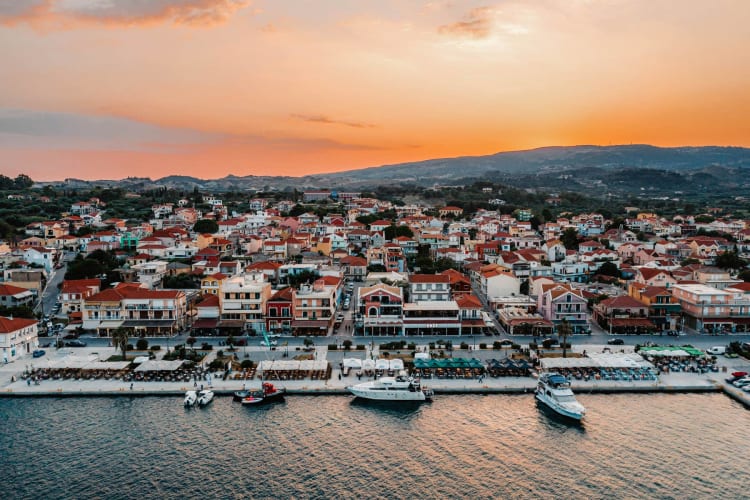
How a nickname that started as a joke became the mirror of a city that learned to laugh at itself.
Lixouri: the “Piccolo Paris” of Kefalonia — a title that has stood the test of time
Lixouri carries a characteristic that is hard to miss: “Piccolo Paris”. A title uttered more than a century ago, with a dose of admiration but also irony, yet it rooted deep in the consciousness of its inhabitants. Because only a place like Lixouri could keep such a nickname without taking it too seriously and without disowning it.
The phrase seems to have been born in the early 20th century, when the city was experiencing its cultural heyday. At that time, Lixouri had philharmonics, theater groups, literary circles, and people with knowledge and passion for art. The inhabitants discussed politics, read poetry, wrote, sang, and, most importantly, satirized. It was a city that had more spirit than size – and it knew it.
Visitors saw a small society with an urban mentality, self-mockery, and kindness; a place where art, speech, and irony coexisted. Thus, “Piccolo Paris” started as a compliment, but it was established because it described something real: a Lixouri that, in its own way, seemed to live “a little ahead” of the rest of the province.
Today the phrase sounds more bitter, but it still has power. It is no longer a title of honor; it is a mirror of a lost era, of a city that remembers what it once was and wonders if it can be again.
The city of scholars and satire
Lixouri was never an ordinary provincial town. From the years of Venetian rule until the mid-19th century, it was the intellectual and administrative center of Paliki. Its inhabitants were in contact with European thought, spoke Italian, read literature, and followed the currents of the times. It was no coincidence that figures such as Andreas Laskaratos emerged from here, who, with his satire, became a symbol of freedom of speech and independent thought.
Laskaratos was the epitome of the Lixouri spirit: sarcastic, unconventional, intelligent. With his writings, he exposed hypocrisy, questioned the “sacred and holy,” and defended a person’s right to think for themselves. His manner was not gentle, it was honest — and this honesty became a school.
Since then, satire has been deeply rooted in Lixouri. It was not mere entertainment; it was a form of social criticism. The satirical newspapers of the era, such as “Rapsodos” or “Skoufos,” sharply commented on wrongdoings, while the city’s carnival gradually became an open platform for satire. Anyone who went on stage could say whatever they wanted — and everyone laughed, even if they knew the satire was personally aimed at them.
Perhaps this is the essence of the Lixouri character: the ability to laugh at oneself without losing proportion. A city that preferred to mock itself rather than boast; that learned that humor is the safest way to tell the truth.
nThe musical heart of the city
As satire gave voice to Lixouri, music gave it soul. The Lixouri Philharmonic School, founded in the late 19th century, became a point of reference not only for the island but for the entire Ionian. Generations of children passed through there, learning that music is not a luxury but a necessity.
Serenades, mandolin orchestras, and concerts in the squares were a way of life. The city had rhythm, and this rhythm was heard everywhere. There was no celebration without music, no sadness without song. Even after the 1953 earthquakes, when Lixouri was almost razed to the ground, the Philharmonic was reborn before houses could even be rebuilt. The city’s musicians were there to remind everyone that as long as there is sound, there is life.
Music never functioned solely as entertainment; it was also a symbol of unity. The people of Lixouri sang together, satirized together, disagreed together. And through this collectivity, Lixouri managed to keep alive something that is not visible, but exists: the ethos of companionship, the joy of being part of a community that thinks and laughs.
Irony as a way of life
If there’s one thing that truly characterizes Lixouri, it’s irony. Not malice, but that subtle smile that says, “we know what’s going on, but there’s no need to make a fuss.” Irony in Lixouri is culture. It’s the sense of measure, the rejection of pompousness, the ability to see things from a distance without losing the essence.
Every February, the Lixouri Carnival still harkens back to this spirit. It is the mirror of the city: satirical, witty, often rough, but always true. No one escapes criticism, neither local authorities nor residents. And yet, no one takes offense. Because here, satire is not an insult — it is an honor. It means that someone respects you enough to comment on you.
“Piccolo Paris” may never have had boulevards, but it had people who could do social analysis through a single line. And that, for a small town, is a greater achievement than any title.
The “Piccolo Paris” of today
Today, “Piccolo Paris” is neither a myth nor a title of honor. It is more of an ironic smile, a phrase that carries the memory of a city that was once a cultural center and is now looking for its voice again. Lixouri no longer has the vibrancy that the old timers remember. Satire has lost its audience, daily life has become more closed off, more tired. And yet — beneath this silence, something is starting to move again.
The Lixouri Philharmonic School still exists and upholds the musical tradition of the place. Young musicians, children and teenagers, fill the rehearsal rooms and squares with sounds that remind us that nothing is completely lost. Events, theater groups, small efforts by people who believe that culture does not die as long as there are people to nurture it, are slowly breathing new life into the city. These are timid steps, but they are steps forward.
“Piccolo Paris” no longer describes Lixouri, but it suits it for another reason: because it reminds us that it was once a place with spirit and dignity — and that it can be again. Perhaps not as it was then, but in a way that suits its current reality. Without grand words, without flashy symbols, just with consistency, education, and a little of the old Lixouri irony that always saw the world half-seriously and half-jokingly.
Whether it will ever regain its old title does not matter. The goal is not to resemble Paris — it is to remember itself. And that, fortunately, seems to have already begun.
Related Articles
Το Ίδρυμα Γεωργίου & Μάρης Βεργωτή τιμήθηκε με το Βραβείο Ευκράντη για την Κοινωνική Προσφορά
Το Ίδρυμα Γεωργίου & Μάρης Βεργωτή τιμήθηκε με το Βραβείο Ευκράντη για την Κοινωνική Προσφορά, σε μια χρονιά-ορόσημο κατά την οποία συμπληρώνει 50 χρόνια αδιάλειπτης παρουσίας και προσφοράς.
Με θλίψη ανακοινώνεται ο θάνατος της εκπαιδευτικού Ράνιας Φραγκισκάτου
Ο Σύλλογος Εκπαιδευτικών Π.Ε. Κεφαλονιάς – Ιθάκης ανακοινώνει με βαθιά θλίψη τον θάνατο της Ράνιας Φραγκισκάτου, επί σειρά ετών διευθύντριας στο Ειδικό Σχολείο.
Συλλυπητήρια ανακοίνωση του Ιδρύματος Γεωργίου και Μάρης Βεργωτή για την απώλεια του Νικόλαου Σ. Βεργωτή
Το Διοικητικό Συμβούλιο του Ιδρύματος Γεωργίου και Μάρης Βεργωτή εκφράζει θερμά συλλυπητήρια στον Πρόεδρο, κ. Γεράσιμο Ν. Βεργωτή, και την οικογένειά του για την απώλεια του πατέρα του, Νικόλαου Σ. Βεργωτή.